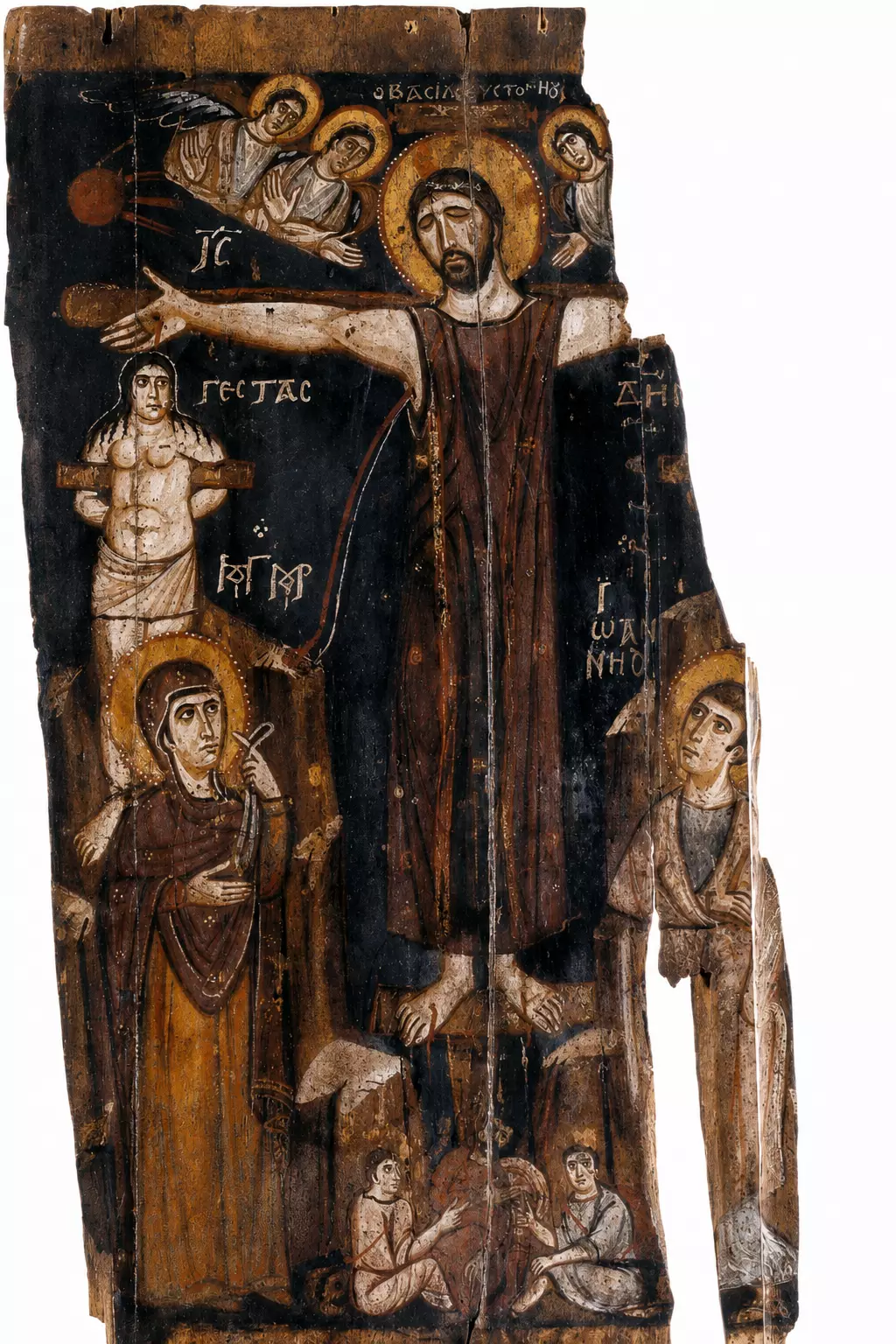
Measuring only about 46.4 × 25.5 cm, the Sinai Crucifixion Icon preserves one of the most consequential early formulations of the Crucifixion in Byzantine art. The small wooden panel, painted by an unidentified artist during the eighth century and preserved at the Monastery of Saint Catherine on Mount Sinai, presents Christ on the cross together with the two thieves, the Theotokos, Saint John, angels and soldiers dividing his garments. Remarkable is the density of the scene. Almost every surviving area of the dark pictorial field participates in the narrative, yet the commanding vertical of Christ establishes an immediate visual hierarchy.
The icon is generally dated to the eighth century, with comparisons to the Crucifixion wall painting at Santa Maria Antiqua in Rome, dated to 741–752, providing an important point of reference. Its medium is recorded as tempera on wood. Scholars have also raised the possibility that it was produced at Sinai itself, though its painter remains unknown.
Of particular importance is the treatment of Christ after death. His eyes are closed, his head inclines to one side, and a crown of thorns appears upon his head. The Sinai panel has been identified as the earliest surviving icon known to combine these features, giving unusual emphasis to the physical reality of the Crucifixion. The names of the two thieves are also inscribed, another exceptionally early element within surviving Christian imagery.
The Sinai Crucifixion Icon and its composition
Across the narrow board, the painter organizes an unusually complex narrative around a firm vertical axis. Christ occupies almost the entire height of the composition. His outstretched arms extend towards the edges, while his long body descends through the centre until his feet meet the cross above the group of soldiers below. On smaller crosses at either side appear the thieves, establishing a secondary frame around the dominant central figure.
This arrangement produces a strongly hierarchical composition. Scale carries meaning: Christ is substantially larger than the surrounding figures, while Mary and John occupy an intermediate level and the soldiers form a much smaller narrative group near the bottom. The spatial field is shallow, with figures placed largely one above another. Even so, overlapping bodies, crosses, upright shafts and gestures generate considerable visual movement within the compressed surface.
Above Christ, angelic figures lean towards the Crucifixion, their bodies projecting diagonally into the dark background, their gestures animated, their gazes directed downward. Three remain clearly visible in the surviving panel. Damage along Christ’s left side has removed a substantial section of the original support, including portions of the upper and middle registers, so that the initial balance of this zone is only partially preserved.
The celestial imagery continues with the dark red disk of the sun on Christ’s right. A corresponding moon once occupied the opposite side but has disappeared with the loss of the wooden board. Medieval images frequently placed these two heavenly bodies beside the cross, and their presence gave the event a cosmic dimension without requiring an elaborate landscape.
Christ, the colobium and the reality of death
One of the most distinctive elements is Christ’s clothing. He wears a long reddish-brown colobium, a sleeveless tunic descending almost to the ankles. The garment covers most of the torso and establishes a broad vertical mass of deep red and brown, crossed by thin linear highlights and darker folds. This older iconographic form belongs to an early tradition of representing the Crucifixion and would gradually yield to other treatments of Christ’s body in subsequent medieval art.
The body itself is elongated and deliberately exposed against the almost black background. The arms form an emphatic horizontal line, while the inclination of the head interrupts the otherwise severe geometry. Facial modelling remains economical — the long nose, closed eyelids, dark beard and narrow face are defined through strong contours and restrained tonal transitions. The expression carries the stillness of death without exaggerated physical suffering.
From Christ’s side flow blood and water, a direct visual reference to the Gospel of John (19:34). The painter gives this small element considerable clarity against the pale flesh. The wound in the hand is treated similarly, with red pigment concentrated around the point of attachment. Such details acquire particular importance beside the closed eyes and crown of thorns. In this icon, according to the Metropolitan Museum’s discussion of the Sinai panels, the emphasis upon Christ’s death relates to theological concerns already expressed at Sinai during the seventh century by Anastasius of Sinai.
Above the head, the surviving Greek lettering belongs to the inscription identifying Christ as the King of Glory. Elsewhere, the familiar Christogram IC appears beside the cross. Writing and image therefore function together, the inscriptions providing identities while the painted bodies carry the emotional and narrative weight of the scene.
Gestas, Dismas and the inscriptions
The two crucified thieves form one of the panel’s most historically significant features. Both are much smaller than Christ and are represented with comparatively abbreviated anatomy, their bodies attached to transverse beams by extended arms. Their reduced scale immediately establishes their subordinate position.
Greek inscriptions identify them individually. Gestas is named on Christ’s right, while the damaged inscription on the opposite side preserves the beginning of the name usually read as Demas or Dismas. The Sinai Crucifixion has been described as the earliest surviving icon to record the names of the two thieves, whose individual names derive from traditions outside the canonical Gospel narratives.
Their bodies also introduce another rhythm into the composition, the shorter crossbeams cutting horizontally across the dark ground and echoing the extended arms of Christ while remaining visually subordinate to them. Gestas survives far more completely; on the other side, extensive loss in the wooden support has removed much of the corresponding figure.
The Theotokos and Saint John
On Christ’s right stands the Theotokos, enclosed by a large ochre-gold halo and wrapped in dark red garments. Her face turns upward, while one hand rises towards the Crucified. The other is drawn closer to her body. Within the otherwise frontal structure of the image, her gesture creates a diagonal movement from the lower register towards Christ’s outstretched arm.
Her sorrow is expressed through posture and facial direction rather than through violent movement. The long figure stands firmly, nearly parallel to the vertical shaft of the cross. Red, brown and ochre dominate her garments, with narrow linear accents defining the folds. Beside her, the identifying inscription survives in abbreviated form.
Saint John occupies the corresponding position on Christ’s left, though the physical loss of the panel has interrupted his body and surrounding field. His haloed head and part of his upper figure remain, tilted upward towards Christ. The youthfulness of his face, particularly in comparison with the bearded Crucified, helps differentiate the two physiognomies. The surviving inscription identifies him as John. The combination of Mary and John reflects the Gospel narrative placing them beside the cross (John 19:26–27) and would remain fundamental to later Byzantine Crucifixion iconography.
Angels, soldiers and the garments of Christ
At the lower edge of the panel the scale changes abruptly. Soldiers gather beneath Christ’s feet to divide his clothing, translating the Gospel episode (John 19:23–24) into a compact subsidiary scene. Scholarship describes three soldiers in this lower group, although two seated figures dominate the surviving surface. Their bent knees, turned heads and reaching hands create a small knot of movement under the static vertical of the cross.
Long shafts rise through this lower area, connecting the group visually with the larger Crucifixion above. The seated bodies overlap one another and are rendered with simplified folds and firm outlines; their smaller dimensions allow the painter to compress an additional episode into a narrow strip without competing with Christ.
Above, angels respond to the death of Christ; at the centre, Mary and John turn towards him; below, soldiers remain occupied with his garments — and so, within a single vertical field, different reactions to the same event unfold simultaneously.
Colour, line and the damaged wooden panel
A restricted palette binds the composition together. Deep brown-black forms the background, against which pale flesh, red-brown garments and warm ochre halos appear with considerable intensity. White accents mark eyes, contours and drapery, while touches of red draw attention to wounds and other small details. The painter’s method is strongly linear: contours frequently carry more descriptive force than gradual modelling, especially in the smaller figures.
The surface has endured substantial material loss. Vertical cracks run through the wooden support, abrasion interrupts several painted areas, the upper edge is irregular, and a major section on Christ’s left is missing from top to bottom. These losses are integral to the object’s present state of preservation and explain the abrupt disappearance of several figures and inscriptions.
Its survival belongs to the exceptional history of Saint Catherine’s Monastery. Sinai had passed outside Byzantine imperial control by the early seventh century, and during the eighth and ninth centuries it consequently remained beyond the jurisdiction in which Byzantine Iconoclasm was enforced. The monastery preserves a remarkable group of panels from precisely these centuries, material evidence for the continuity of Christian figural painting during a period when such works were being destroyed or replaced elsewhere within Byzantine-controlled territories.
Within that group, the Crucifixion occupies a particularly important position. Closed eyes, crown of thorns, blood and water from the side, named thieves, grieving witnesses and the small scene of the divided garments bring several strands of early Christian iconography together on a panel scarcely wider than a human handspan. Across its cracked surface, the dark field still holds the extended arms of Christ, the warm circles of the halos and the closely gathered figures beneath the cross.