
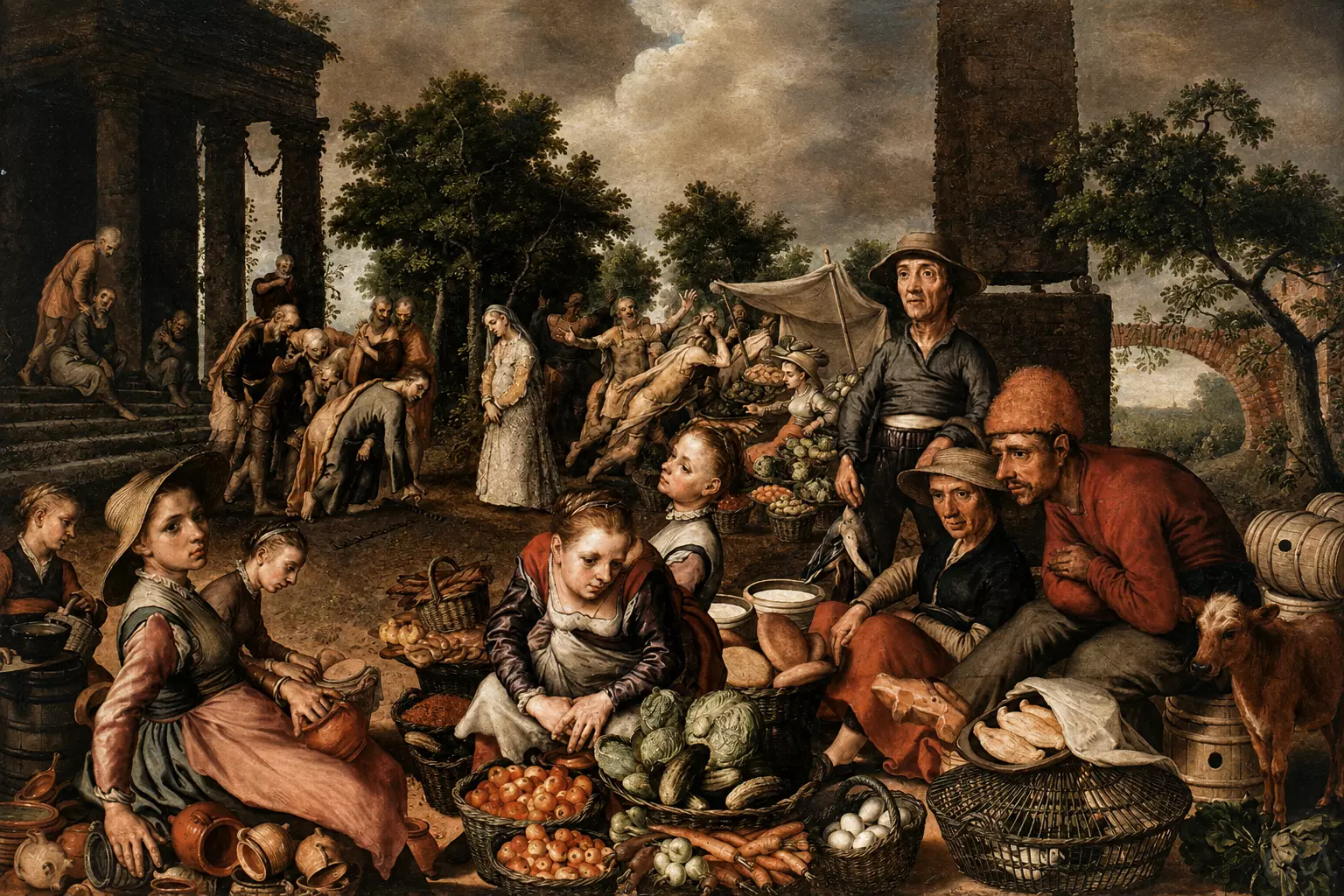
Pieter Aertsen’s Market Scene with Christ and the Adulteress, when the eye first encounters it, unsettles the expected order of a religious picture almost immediately. The biblical episode of Christ and the woman accused of adultery (John 8:3–11) is present, yet it is pushed into the middle distance, while the foreground belongs to market women, poultry, fruit, vegetables, bread, eggs, pottery and baskets packed so densely that the picture first appears to proclaim the abundance of ordinary life. Aertsen, an Amsterdam-born painter whose career was closely connected with Antwerp before his return to his native city, made this reversal of pictorial hierarchy one of the most distinctive devices of sixteenth-century Netherlandish painting. Although older descriptions often call the work oil on wood, the Städel’s current catalogue records mixed technique on oak, measuring 122.5 × 180.5 cm; it also records Aertsen’s monogram and the date 1559 on the barrel at the left. It entered the museum in 1904 as a gift from the heirs of Karl Nikolaus Berg. (Digital Collection)
The subject is divided, though never simply split, between what the eye first desires to examine and what the narrative asks it eventually to recognise. Food, bodies, merchandise, glances: these fill the front plane. Behind them, Christ bends towards the ground before the woman accused of adultery, surrounded by those who have brought her forward for judgement. The sacred story has not disappeared. It has been made visually difficult, and that difficulty is the painting’s central intelligence.
Market Scene with Christ and the Adulteress: abundance, judgement and the redirected gaze
Across the lower half of the panel Aertsen builds a market from objects whose variety is almost excessive. Earthenware vessels gather at the left edge; nearby, a seated woman turns outward while another young figure bends over the goods. Towards the centre, baskets and bowls hold fruit and vegetables, and a woman positioned prominently behind them handles poultry. Carrots, eggs, loaves and further produce extend the display towards the right, where a seated vendor, a man leaning over her shoulder and another standing figure create a compact group around the merchandise. A calf presses into the extreme right-hand zone. Objects overlap figures, baskets cut across bodies, food protrudes towards the viewer; the pictorial field becomes an accumulation of edible matter, containers, hands, faces.
The handling of space is decisive. Aertsen does not construct the foreground as a neutral stage through which the viewer passes towards the biblical event. He makes it dense enough to resist passage. Through narrower intervals behind the stalls open a paved strip, clusters of figures, a canopy, vertical architectural forms, trees and, at the far right, a glimpse of landscape. The transition from large foreground forms to smaller middle-ground figures creates recession, but the spatial organisation has an ethical as well as an optical function. The eye must work its way backwards.
At the centre of that recession stands the woman brought before Christ, dressed in a pale garment that separates her from the darker crowd around her. Christ bends close to the ground, corresponding to the Johannine account in which he writes with his finger while the accusers press their case (John 8:6, 8). Aertsen does not enlarge the episode to guarantee its authority. He permits it to remain visually subordinate. This inversion, in which a sacred narrative occupies a reduced zone behind an emphatic display of food and trade, became fundamental to his market and kitchen paintings and to the emergence of new forms of genre and still-life imagery in the Low Countries. The Städel itself describes the Frankfurt panel as an important stage in the development of Dutch still-life and genre painting.
The scholarly difficulty begins at precisely this point. Should the foreground be treated as temptation, as social observation, as a display of painterly virtuosity, or as all three at once? Studies of Aertsen, which have repeatedly addressed the interpretative instability of these compositions, have long resisted any single answer. Ethan Matt Kavaler’s market-piece study addresses the complexity of the form, while Keith Moxey’s interpretive essay is central to the debate over “hidden symbolism” in Aertsen. Such caution suits this picture. Certain associations are historically grounded; others become fragile when every vegetable, vessel or animal is forced to carry a fixed moral code.
One interpretation, however, is explicitly advanced by the Städel. The museum reads the various birds among the wares as sexual allusions, pointing to the period meaning of the Dutch and German verb vögeln, and connects the direct gazes of the market women with contemporary ideas of shamelessness and erotic desire. On this reading, the foreground stages a field of sensual appetite against the biblical scene of accusation, judgement and moral self-examination. The force of the argument lies less in turning every item into a cipher than in recognising how conspicuously Aertsen places abundance, flesh, looking and commerce before the viewer.
The glances matter. Several figures in the market zone do not remain enclosed within their tasks; they look outward, establishing an uncomfortable reciprocity between painted seller and spectator. We inspect their goods, yet they seem to inspect us in return. That exchange alters the role of still life. Fruit, bread, eggs and poultry are not presented as detached specimens. They belong to an inhabited economy of desire, appetite and sale. The viewer’s visual consumption of the picture becomes part of the subject.
Colour and light support the tension. Warm ochres, earthy reds, browns and muted greens dominate the lower register, interrupted by lighter flesh tones, pale bread, eggs and the clothing of individual figures. Above them, the sky and distant landscape create a less congested field. Aertsen’s tonal modelling gives the produce palpable weight, but he avoids the highly polished isolation associated with later seventeenth-century still life. His objects remain socially entangled. A basket is also a commodity container; a loaf passes near a hand; poultry is handled, displayed, desired. Descriptive precision serves movement and human use.
There is also a striking temporal disjunction. In an imagined antiquity stand the biblical protagonists; in the foreground, recognisably, the sixteenth-century market familiar to Aertsen’s audience. The two times coexist within one continuous space. That coexistence makes the Gospel story contemporary without translating Christ into the costume and social behaviour of the market sellers. The modern world presses forward and nearly blocks the ancient narrative. The past survives behind present appetites.
If the market were removed, the biblical scene would become direct and legible; if Christ and the accused woman disappeared, the foreground could function as a secular market subject. Their conjunction prevents either half from settling into a single genre. Religious history, genre painting, still life, social observation, moral address: all occupy the same panel, unequal in scale yet dependent upon one another.
The recent material history of the painting adds another layer to its reception. The Städel, which began conservation and restoration of the work in 2024, reports that earlier interventions included non-original varnish layers and discoloured retouching; the treatment was completed in 2025, and the painting returned to display in the Old Masters galleries. That information is particularly relevant to a work whose effect relies so heavily on distinctions of depth, surface, colour and visual emphasis. Changes to varnish and retouching can alter the very hierarchy through which foreground and middle distance compete for attention. (Städel Museum)
What remains most radical is the refusal to tell the viewer where to look first. Aertsen gives visual priority to what traditional hierarchy would have considered secondary: sellers, goods, foodstuffs, pots, birds, a calf, the material apparatus of ordinary exchange. Christ, the ostensible centre of the narrative, has to be discovered. Once found, however, he reorganises what has already been seen. The market does not cease to be a market; the fruit does not stop being fruit. Their abundance acquires a sharper moral atmosphere because the act of judgement unfolds behind them, quietly, almost withheld.
That delayed recognition explains the panel’s extraordinary place in Northern Renaissance painting. The picture teaches by misdirection. It allows the eye to be seduced by matter, then makes the act of looking itself available for scrutiny. In Market Scene with Christ and the Adulteress, the sacred persists in reduced scale without visual triumph, demanding attention after attention has already been spent elsewhere.
(The translation was edited by K. Pappas.)