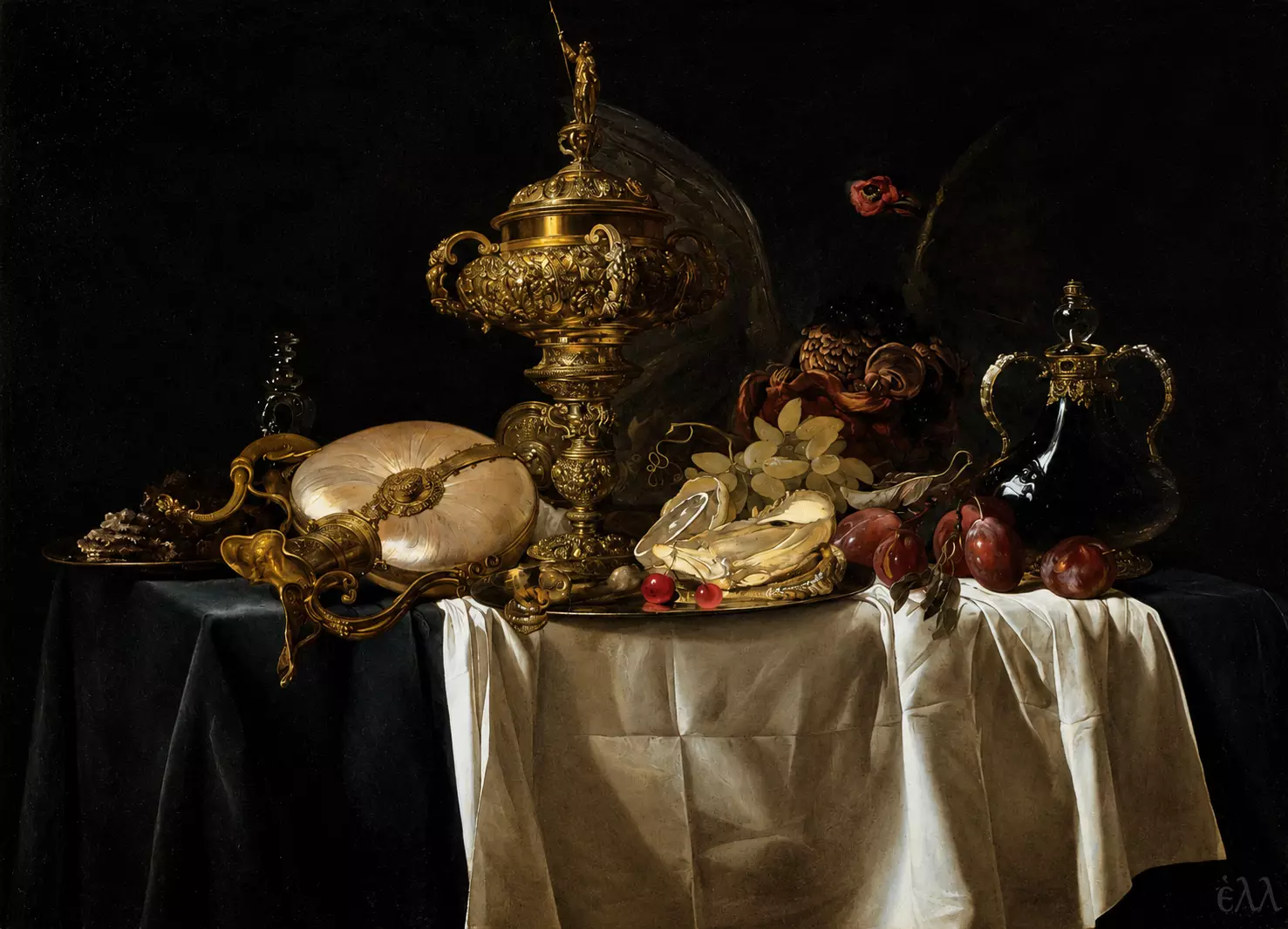
Painted in 1653, Willem van Aelst’s Still-Life with Fruit, Parrot, and Nautilus Pitcher is an oil on canvas measuring 77 × 102 cm, now in the Galleria Palatina of the Palazzo Pitti in Florence. Its first impression is one of concentrated luxury. Against a nearly black ground, objects emerge one by one into light: a mounted nautilus shell at the left, a tall vessel, richly worked, behind it, fruit spread across a low platter, a dark vessel with elaborate mounts, and, above the central cluster, a parrot whose red head catches the eye almost before its body becomes fully distinct. The white cloth falling over the front of the table does something different. It does not glitter. Its broad folds receive the light, interrupt the darker mass of objects and establish the nearest plane of the composition.
Van Aelst, a Dutch painter born in Delft in 1627 who died in Amsterdam around 1683, became closely associated with still-life painting. A study devoted to the socio-historical context of Dutch still life identifies him among the artists who contributed to the genre’s further development. In this painting, however, the achievement is not dependent on abundance alone. It arises from the deliberate separation of surfaces—shell, metal, fruit skin, transparent material, textile—and from the way each is allowed to appear only partially before the dark background absorbs its edges again.
Still-Life with Fruit: luxury, texture and controlled imbalance
The composition is asymmetrical, yet it does not feel unstable. A tall vertical mass rises left of centre, built from the ornate covered vessel and the curving forms around the nautilus pitcher; on the opposite side, the dark vessel, the fruit laid across the cloth and the parrot supply a quieter counterweight. Nothing is arranged on a single horizontal line. Some objects sit close to the table edge, others retreat into shadow, others rise sharply upwards. Van Aelst thus constructs depth through overlapping and interruption before relying on any broad recession into space. The room itself is scarcely described. What matters is the interval between one object and the next.
Within that interval, the nautilus pitcher plays an especially important role. Its pale shell body, enclosed and extended by elaborate gold-coloured mounts, combines a natural structure with human craftsmanship in a single object. The eye registers smoothness, curvature, reflected light, worked ornament, then the darker handle and projecting metalwork. Its form is large enough to compete with the central vessel yet low enough to remain tied to the table. Behind it, the tall covered vessel is more architectural: foot, stem, swelling body, lid, handles, finial. The elaborate sequence of parts gives it a vertical rhythm quite unlike the broad oval of the shell.
Central to Van Aelst’s pictorial intelligence are such distinctions. Seventeenth-century still life repeatedly made the problem of representation visible through things that challenge the painter to distinguish one substance from another. In Van Aelst’s case, the challenge becomes almost a demonstration of control. The lustre of metal cannot be rendered in the same manner as the bloom of fruit; transparent surfaces demand reflected points of light; linen depends upon broad tonal shifts and angular folds. Paul Barolsky’s discussion of still-life metamorphosis offers a useful wider context for considering this transformation of material things through painting.
Fruit, vessels and the pressure of the foreground
Across the middle of the table, fruit supplies the composition with softer, irregular forms. A sliced citrus fruit and curling peel occupy the central platter, accompanied by pale grapes and small red fruits, while larger reddish fruit continues towards the right. Leaves and stems remain attached in places. Their presence does more than furnish the arrangement; they disturb the smooth geometry of the vessels and create a restless contour against the cloth. The platter itself is seen at a shallow angle, its thin edge catching light beneath the fruit, so that food, metal and textile are compressed into a narrow band.
The right side is darker and more difficult to read at first glance. That difficulty is productive. A dark vessel with a clear stopper and gold-coloured mounts rises behind the fruit, almost disappearing into the ground except where light strikes its neck, handles and a narrow reflective streak along the body. Beside and above it, the parrot is equally dependent on selective illumination. Its body is largely absorbed into shadow; the red head, curved beak and several feathered contours emerge more clearly. The bird introduces life into an arrangement otherwise governed by inanimate objects, but Van Aelst does not turn it into a narrative protagonist. It watches, or simply occupies, the still life.
That restraint matters. The temptation with seventeenth-century still life is to assign a fixed symbolic meaning to every fruit, vessel, shell or animal. The image itself does not require such a programme. What can be observed with confidence is Van Aelst’s sustained interest in rarity, surface, perishability and display. Fruit can be cut, peeled, bruised or consumed; a fragile vessel may be broken; polished metal depends for much of its visual presence upon light; a shell begins as a natural structure and is transformed through elaborate mounting. Such relationships may have carried associations for contemporary viewers without forcing the entire painting into a single allegorical key.
Light as an organising device
Light binds this accumulation together. It strikes the pale shell, flashes across the relief-like ornament of metal, catches the exposed flesh of the citrus, then descends into the white cloth. The background remains so dark that the illuminated surfaces seem to occupy a shallow stage. Chiaroscuro therefore functions as a structural instrument, deciding which contour appears, where one object separates from another and which passages dissolve into uncertainty.
At the front, the cloth proves essential. Its folds are large, angular, irregular, with deep vertical breaks and broad planes of grey-white. One section hangs beneath the central platter, another drops over the right edge, and between them the dark covering of the table reappears. This uneven distribution prevents the foreground from becoming a decorative curtain. It also gives the lower part of the painting a different tempo from the intricate metalwork above. Large shapes below, minute articulation above.
Van Aelst’s handling is most persuasive when these opposite scales meet. The smallest highlights on a vessel are set against broad darkness; individual grapes or small red fruits cluster beside expansive cloth; the parrot’s minute red head punctuates a large field of black. Even the composition’s richest object does not dominate absolutely because another texture immediately interrupts it, so the eye moves, pauses, and returns instead of settling.
A peculiar visual tension consequently develops around possession and perception. Precious objects are presented for scrutiny, yet they are never equally accessible. Some are brightly exposed, some half concealed, some almost lost. The effect feels refined rather than crowded. Van Aelst keeps the tabletop crowded while preserving intervals of darkness between forms, and those intervals are indispensable: without them the shell, the fruit, the worked vessels and the bird would collapse into one ornamental mass.
Colour operates with comparable restraint. Much of the canvas is held within brown-black, ochre, muted red and warm metallic tones; against these, the creamy shell and white cloth acquire unusual intensity. The small red accents of the fruit answer the parrot’s head across the centre-right of the painting. Pale grapes form another bridge, visually softer, between the sliced citrus below and the shadowed bird above. No single colour spreads evenly across the surface. Each appears locally, disappears, then re-emerges somewhere else.
The parrot provides perhaps the most unexpected interruption. Positioned above the fruit and partly enveloped by the surrounding darkness, it belongs neither entirely to the vertical display of vessels nor to the horizontal spread of food. Its living presence changes the rhythm without disturbing the stillness. Bird, fruit, shell, fashioned objects: heterogeneous things are brought into proximity, each preserving its own texture and scale.
In a canvas little more than a metre across, Van Aelst created a dense theatre of materials without sacrificing clarity. The objects appear sumptuous because their surfaces have been differentiated so carefully, and mysterious because considerable portions of them remain submerged in shadow. This balance between disclosure and concealment gives the painting much of its authority. Its title preserves the unlikely conjunction that makes the work memorable—fruit, parrot, nautilus pitcher—yet the real unity lies in the act of painting itself, in the patient conversion of smooth shell, folded cloth, soft fruit, reflective ornament and feathers into light laid upon canvas.
(The translation was edited by N. Jones.)