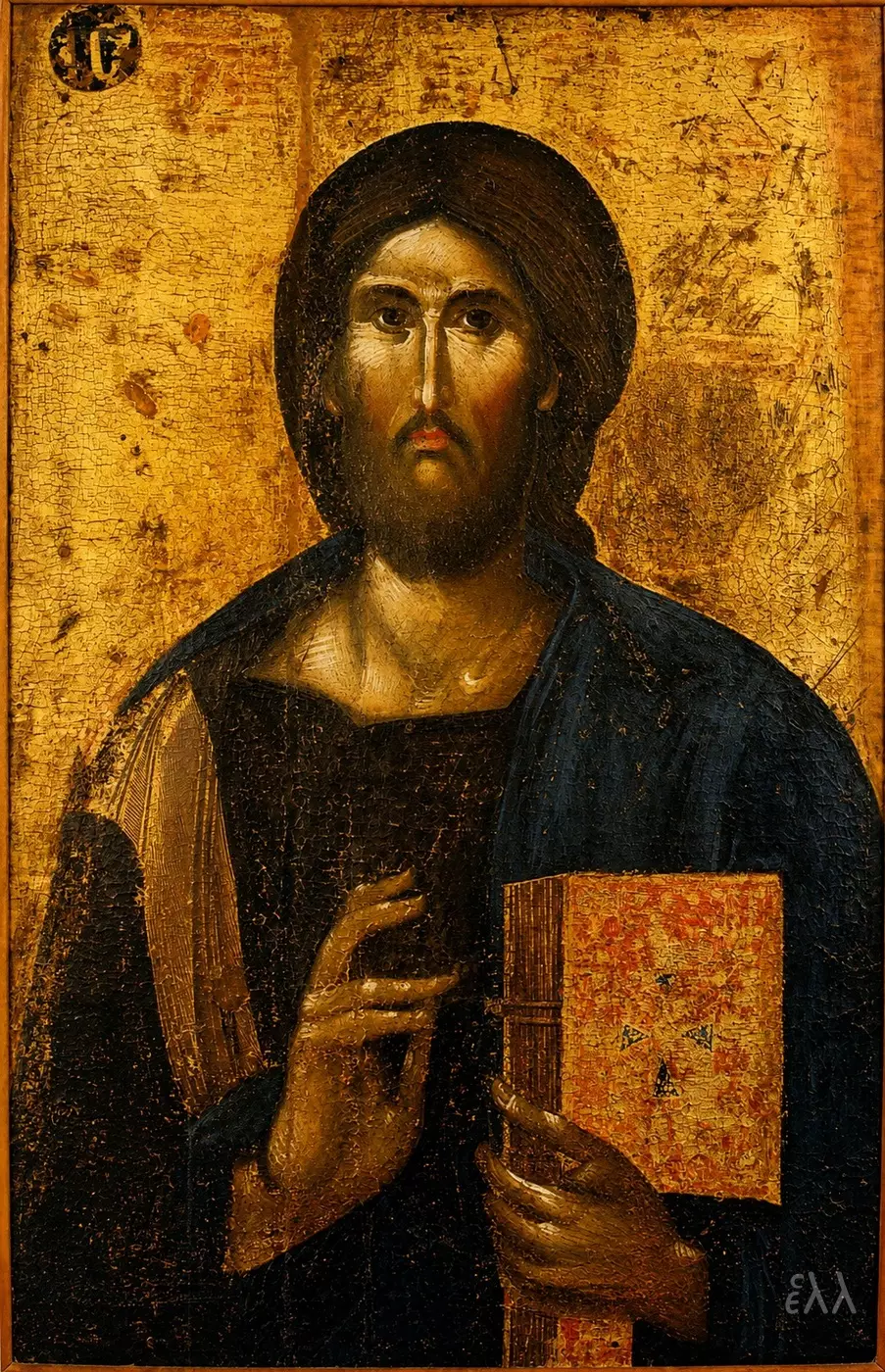
The Christ Pantokrator Icon of Mytilene is a large Late Byzantine panel painted by an unknown artist around the middle of the fourteenth century and now preserved in the Ecclesiastical and Byzantine Museum of Mytilene. Measuring 107 by 69.5 cm and only 2 cm thick, it represents Christ from the waist upwards against a gold ground, his right hand raised in blessing and his left supporting a closed Gospel book. These dimensions, recorded in the Greek Ministry of Culture catalogue, give the figure a physical presence approaching that of monumental painting, although the composition remains tightly enclosed within the vertical wooden panel.
A deep purple chiton, the broad gold-toned ornament upon its shoulder, and the weighty blue himation establish the principal chromatic divisions. The colours are grave and unusually dense. Against them, the flesh and the extensive gold field acquire a warmer luminosity, disrupted now by cracks, losses, incisions, and the accumulated traces of the icon’s long material history. The painter has retained the recognized Pantokrator type while adjusting its internal balance through a slight turn of the torso and an opposing movement of the eyes, so that Christ remains frontal without the frontality becoming immobile.
The panel has also been identified as one side of a bilateral icon originating from the Monastery of the Taxiarches at Kato Tritos on Lesbos. A later image of Saint John the Theologian occupies the reverse, according to research on bilateral icons in Byzantium. The two paintings need not have been executed simultaneously. Their coexistence nevertheless reveals how an already valued wooden support could remain in ecclesiastical use, receive another sacred image, and acquire a history extending beyond the intention of its first painter.
The Christ Pantokrator Icon and Its Palaiologan Form
The composition rests upon a small number of forms, each made emphatic. Christ’s shoulders spread across almost the full width of the pictorial field, while the large head, broad neck, raised hand, and rectangular Gospel book produce a compact structure of intersecting verticals and diagonals. Space is shallow. The gold ground neither describes an interior nor provides measurable distance; it places the form within an abstract field whose visual function is separation, radiance, and concentration.
With his right hand, Christ makes the conventional gesture of benediction. The fingers are long and carefully articulated, though the artist has not pursued anatomical naturalism as an independent aim. Their curved sequence has a calligraphic quality, continued by the dark contour of the wrist and the narrow opening of the sleeve. The blessing hand stands free against the purple chiton, its relative isolation lending the gesture exceptional clarity.
The left hand behaves differently. It bends around the lower edge of the Gospel book, exerting visible pressure through the fingertips. This is an object with thickness and weight: a closed codex with a broad reddish-gold cover, dark ornament, and a substantial page block along its inner edge. Held upright against the body, it conceals part of the himation and fixes the lower composition in place. The book is closed, so no particular Gospel passage directs the interpretation; its presence is more distilled, signifying Christ’s teaching and authority through the codex as a complete object.
Garments, Colour, and the Structure of the Body
The blue himation descends heavily from Christ’s left shoulder, its broad surface only moderately broken by folds. Across the opposite shoulder, the purple chiton is interrupted by a luminous gold-purple panel that draws attention to the upper arm and widens the composition. A body conceived with considerable mass lies beneath the garments. The exposed neck, the collarbones, and the transition into the shoulders are unusually pronounced, especially for a figure governed by such strict frontality.
Colour strengthens that impression. The garment tones remain close to darkness, while the face, neck, and hands advance through warm ochres and sharp white highlights. Gold surrounds everything, but the brightest painted accents occur upon the human form itself.
The Face of Christ
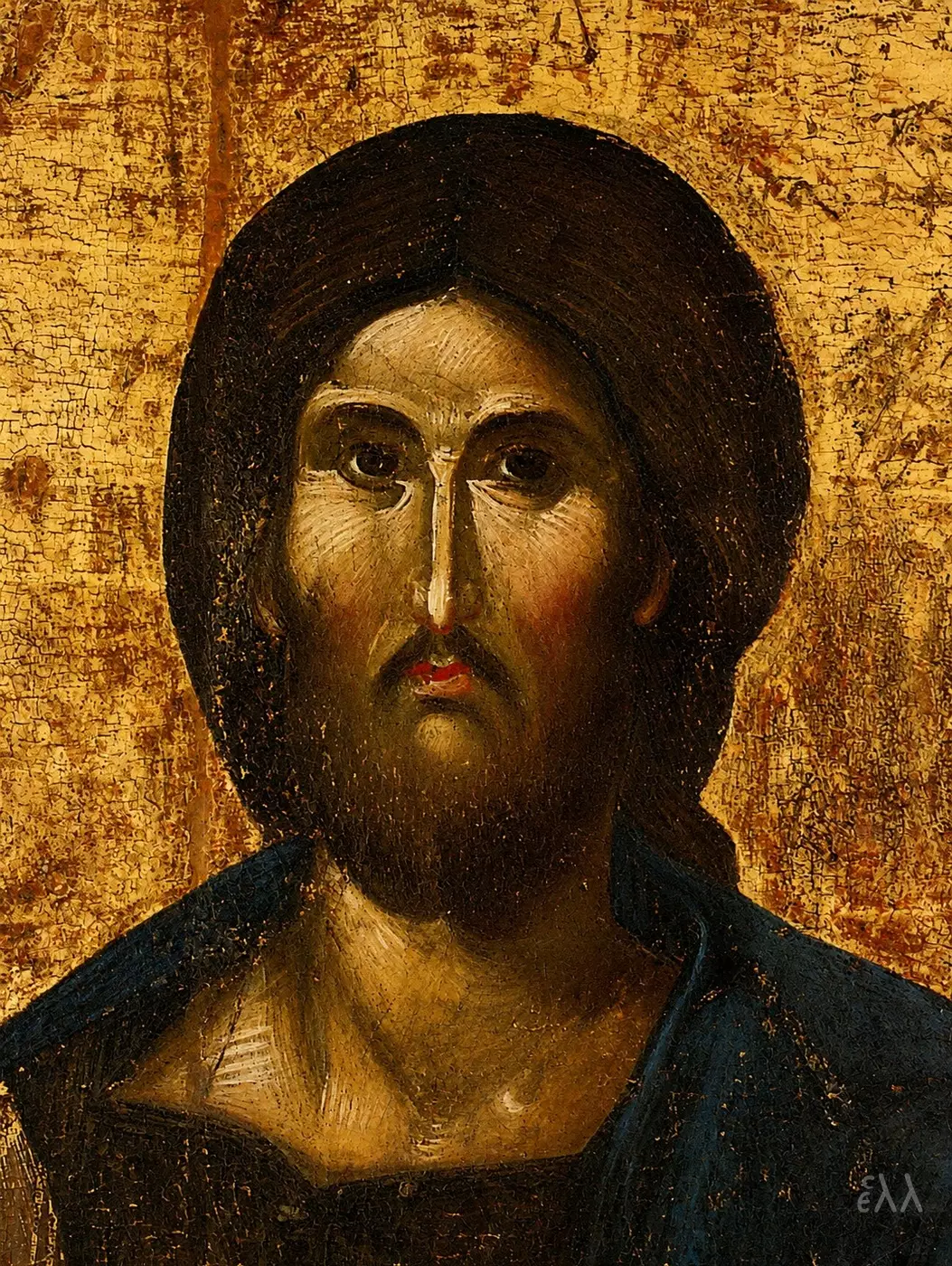
In the enlarged facial detail, the artist’s method becomes particularly legible. A dark olive-brown underpainting provides the base for the complexion. Over it, lighter flesh tones have been applied in narrow, energetic strokes: across the forehead, beneath the eyes, along the ridge of the nose, and in radiating groups over the cheeks. These touches do not dissolve the darker foundation. Light emerges from it unevenly, with some passages densely worked and others left almost untouched.
The face is long and firmly constructed. Arched brows meet the strong vertical of the nose; the eyes are wide, shadowed, and directed subtly towards Christ’s left. The lips, picked out in a restrained red, are small in relation to the breadth of the lower face. Dark hair encloses the forehead in a continuous mass and falls behind the neck, while the moustache and beard are modeled with softer linear passages. A reddish modulation upon the cheeks disturbs the otherwise ochre complexion. This slight chromatic heat matters: it prevents the physiognomy from becoming remote or bloodless.
Human corporeality and sovereign stillness consequently occupy the same face. The image does not illustrate Christological doctrine as a diagram, but its pictorial language holds together tangible bodily presence and the authority attached to the Pantokrator type. In this respect, its still, iconic mode differs from the increasingly elaborate narrative mode in Late Byzantine painting. No event unfolds, no secondary figure supplies a reaction, no architectural setting determines a moment, and meaning remains concentrated in one person, one gaze, one gesture.
Gold Ground and Material History
The gold ground survives as an active surface, though far from an untouched one. Networks of craquelure cross it, and numerous abrasions, scratches, small losses, and darker stains interrupt its original continuity. Around the head, the halo is absorbed into this worn golden expanse, its circumference perceived through incised and tonal boundaries. The aged surface changes the encounter with the icon. Light no longer moves evenly across the background; it catches upon fissures and irregularities, producing an unstable brilliance.
Similar wear is visible over the garments and the Gospel cover. Some details have become subdued, while the white highlights remain strikingly immediate, particularly on the face and hands. Condition and execution can still be distinguished: the damage belongs to the object’s later life, but the underlying contrast between dark colour, warm flesh, and gold was fundamental to the original design.
A Late Byzantine Icon from Lesbos
Several features support the icon’s placement within Palaiologan painting: its monumental half-length figure, the strongly modeled neck and hands, the vigorous linear highlighting, and the uneasy relationship between strict frontality and a gaze shifted off the central axis. Its stylistic refinement has encouraged comparison with Constantinopolitan workshop practice of the fourteenth century. Such an association should remain a matter of affinity, since neither a signature nor documentary evidence identifies the painter or the place of production.
Lesbos, situated within the maritime routes of the eastern Aegean, was not isolated from artistic developments in Constantinople, Thessaloniki, the monasteries of Mount Athos, or the western coast of Asia Minor. Portable icons moved through these networks with patrons, clergy, merchants, and monastic communities. The Mytilene panel belongs to that larger geography of transmission, even if the circumstances of its commission are lost.
What remains is remarkably specific: the fingers curved in blessing, the second hand tightened around a heavy book, the dark blue cloth spreading across the shoulder, and the face emerging through short strokes of light. Across the scarred gold field, the image still preserves the compact pictorial intelligence of a fourteenth-century painter whose name has disappeared.
(The translation was edited by K. Pappas.)