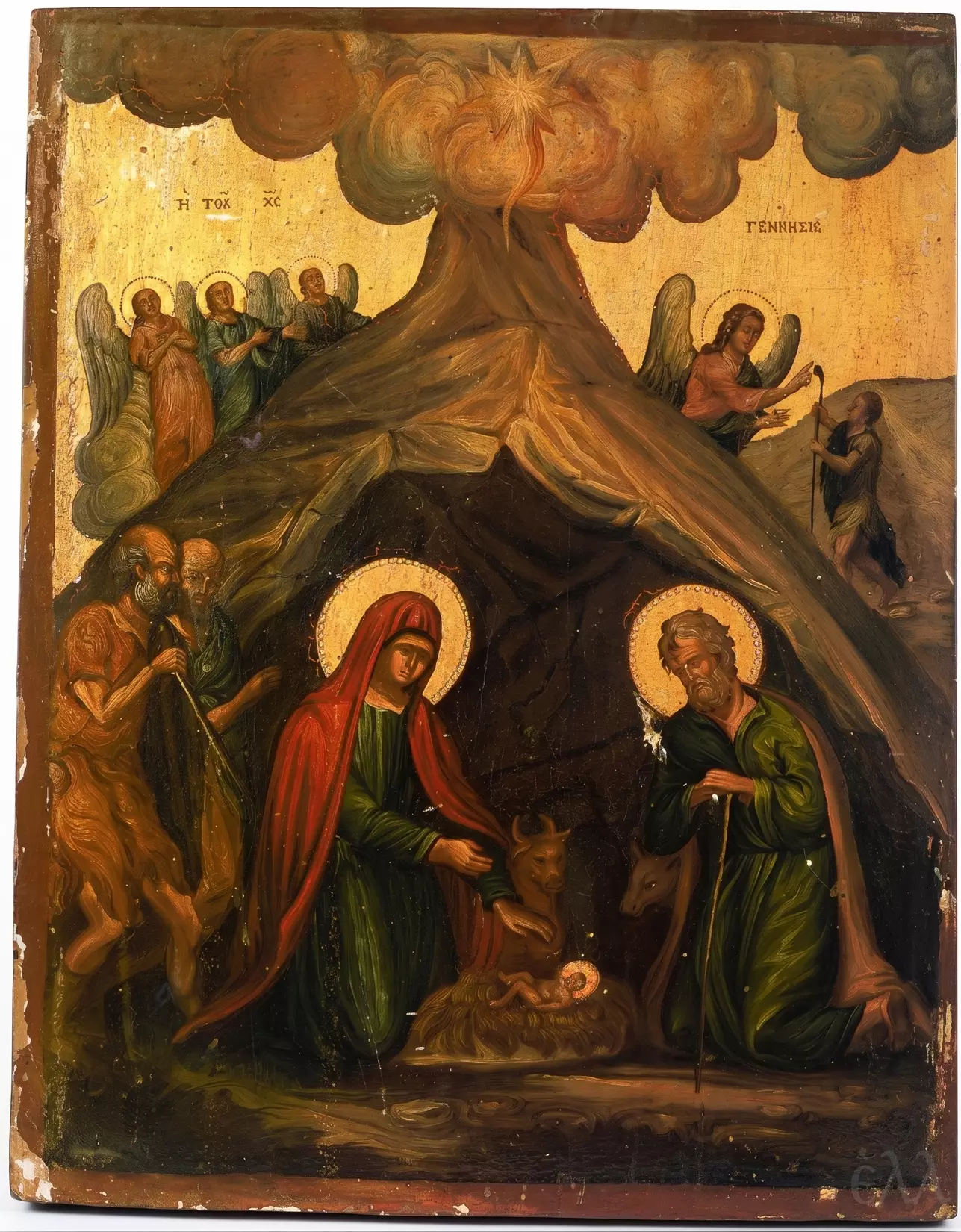
The Nativity of Christ icon preserved in the Greek Church of Santa Maria degli Angeli at Barletta, in Apulia, belongs to the eighteenth-century phase of an ecclesiastical ensemble whose history extends across several centuries. The composition retains the recognisable structure of the Post-Byzantine Nativity (Luke 2:1–20; Matthew 1:18–25), while allowing a markedly different conception of the human figure to enter its visual language. Upright beside the manger, the Virgin inclines gently towards Christ and opens her hands over him rather than reclining apart from the Child, as she does in many medieval Byzantine representations. Opposite her, Joseph kneels with his staff, his head lowered and his attention directed towards the centre.
Around this intimate group the painter constructs a broader narrative. A steeply rising mountain encloses the dark cave; immediately behind the principal figures, the ox and ass emerge from its recess; at the left, shepherds approach, while above them angels participate in two distinct episodes. At the summit, the star descends through a dense band of clouds towards the cavern below (Matthew 2:2, 9–10). Gold occupies the remaining background field, compressing landscape, earthly action and celestial manifestation within a single pictorial space.
The icon belongs to the tier of the Twelve Feasts on the monumental iconostasis of Santa Maria degli Angeli. The municipality of Barletta, which records the Nativity as the second panel in this sequence after the Annunciation, places it within a wooden iconostasis approximately ten metres high and six metres wide. Assembled in different periods, the screen contains works ranging from the late sixteenth to the nineteenth century.
The Nativity of Christ Icon and the Barletta Iconostasis
The composition is governed by the mountain. Rising from the lower half of the panel almost to its upper edge, it forms a great irregular triangle whose ridges divide the narrative without requiring architectural compartments. Beneath the overhanging rocks opens the cave, almost black, an expanse of darkness against which the haloes and garments acquire exceptional visual force. Above, ochres, browns, muted greenish tones: overlapping planes that suggest depth while keeping the space compressed and resistant to consistently naturalistic perspective. The ridges do not describe a continuous landscape in ordinary spatial terms. Instead they partition the field, creating ledges and slopes on which the subsidiary episodes can be placed without breaking the overall triangular structure.
At the base of this mass appears the principal event. The Virgin wears a deep red maphorion over a dark green garment. Her body, elongated and gently inclined towards the Child, remains restrained in movement. One arm descends towards the manger; the other opens across the same axis. These parallel gestures establish a quiet enclosure around Christ, whose small figure lies on the straw directly between Mary and Joseph. The halo surrounding the Child produces the brightest accent in the lower centre of the panel.
Across the composition Joseph answers the Virgin. Kneeling beside his staff and wrapped in green and dark blue-green drapery, he bends his grey-haired head towards the manger. The correspondence remains clear without becoming symmetrical: Mary advances towards the centre, Joseph withdraws slightly; her hands open and extended, his body more contained. Between them emerge the ox and ass from the obscurity of the cave, their heads lowered towards the manger. Their muzzles, heads and partly visible bodies create an intermediate zone between the sacred figures and the darkness behind them, giving the animals an unusually immediate presence.
This treatment preserves part of the accumulated imagery of Byzantine representations of the Nativity while editing that inheritance considerably. The older type could assemble the Virgin, cave and manger, Joseph, angels, shepherds, Magi and the bathing of the newborn Christ within the same mountainous landscape. In Barletta the narrative is reduced. The bath of the Child is absent; the Magi, whose visit is narrated in Matthew 2:1–12, do not appear in this panel; the shepherds and angelic proclamation receive conspicuous emphasis (Luke 2:8–14). Read from a distance, the selection gives the composition a clearer narrative hierarchy and accords with the panel’s place within a larger festal sequence.
Byzantine representations of the Nativity never depended exclusively upon the short Gospel narratives. Hymnography, homiletic literature and inherited pictorial conventions enlarged biblical events into richer visual structures. Henry Maguire’s Byzantine study of rhetoric and Byzantine art examines this relationship between literary elaboration and pictorial form, including the Nativity among the subjects shaped by such processes.
Above the cave the painter distributes the secondary episodes with considerable economy. Three angels appear together on the upper left, emerging from curling, cloud-like forms. Their overlapping wings establish a dense vertical rhythm, interrupted by open gestures of the hands. Across the mountain another angel bends towards a shepherd holding a long staff, an episode corresponding to the announcement to the shepherds (Luke 2:8–14). Separate moments, one pictorial field: rock ridge, angelic wing, raised staff, each diagonal answering the next.
At the summit the star establishes the principal vertical axis. Its narrow ray penetrates the clustered clouds and descends towards the peak before continuing conceptually into the cave. Heaven, mountain and manger are thereby threaded together by a single downward movement; around it, the episodes unfold laterally. The spatial construction, though deliberately compressed, is carefully ordered.
The gold ground works differently. Ordinary atmosphere disappears, while the reddish-brown mountain assumes the visual weight of an almost independent mass and the angels and shepherds stand clearly against the luminous field. Across this upper zone is divided the surviving Greek inscription, whose components identify the subject as the Nativity of Christ and reinforce what the pictorial arrangement already makes unmistakable.
Colour provides another level of organisation. The Virgin’s red maphorion is the most saturated large area in the lower half; Joseph is built from greens, brownish pink and near-black tones. Comparable greens recur among the angels and shepherds, while ochre, umber and reddish earth colours move through the mountain. Repetition links figures belonging to different narrative zones. Rich yet restricted, the palette allows the gold ground and the Virgin’s red to carry much of the chromatic emphasis.
The Barletta iconostasis provides a particularly useful setting for these stylistic choices. Its earliest major panels include despotic icons by the Cretan painter Thomas Bathas, active during the later sixteenth century, whereas the festal and apostolic tiers belong to a later artistic campaign. Within a single liturgical screen, therefore, accumulated Orthodox painting traditions from different periods remain visible together rather than forming a construction produced at one moment. The chronological layering is important for the Nativity, since its eighteenth-century visual language is encountered in direct proximity to earlier icons whose pictorial assumptions belong to a different phase of Orthodox painting.
For the later group the attribution becomes more precise. Eugenia Drakopoulou, in her study of Orthodox religious painting and artistic movement across the Adriatic, attributes the icons of the Twelve Feasts and the apostles at Santa Maria degli Angeli to Dimitrios Bogdanos. She describes Bogdanos as a painter who remained substantially faithful to Byzantine models while possessing some knowledge of Italian painting; documentary evidence records him in Lecce in 1799 in connection with the Corfiot community. The Nativity, one of the Barletta feast icons, consequently belongs to this attributed ensemble, although the proposed authorship should remain qualified. Drakopoulou develops the broader argument in her scholarly study of eighteenth- and nineteenth-century artistic transfers across the Adriatic; an article copy is also available online.
That context matters because Barletta stood within a network extending beyond southern Italy. Greek Orthodox communities established or renewed churches in Italian cities while maintaining artistic contacts with the Ionian Islands and the eastern Mediterranean. Painters from the Ionian world, Drakopoulou identifies, worked for these communities and adapted inherited Orthodox forms to surroundings in which Italian pictorial traditions were present. The Barletta panels belong convincingly to this field of artistic exchange, where continuity did not require the mechanical repetition of an older model. Elements inherited from Byzantine iconography could remain structurally decisive while the handling of bodies, drapery and spatial relations absorbed other habits of looking.
The church itself returned to Orthodox use in 1789 after the reconstitution of the Greek community, having passed through a long period under Roman Catholic administration. Against that history, the eighteenth-century dating supplied for the Nativity coincides closely with a significant phase in the renewed life of the church and its furnishings.
The Virgin, Joseph and the Cave: A Closer Detail
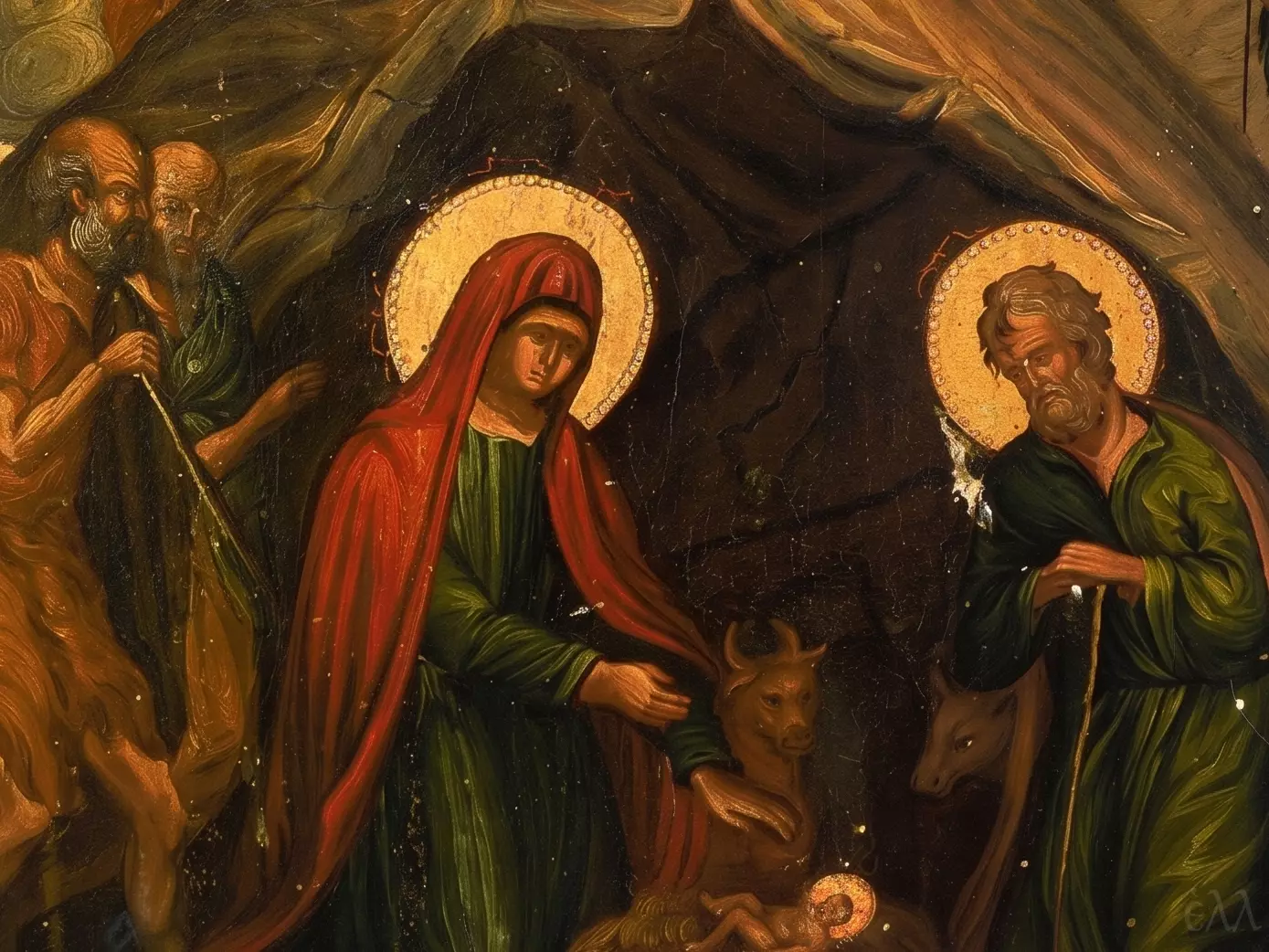
Seen at closer range, the central group reveals how strongly the painter relies upon line while seeking greater bodily volume. Mary’s face remains stylised: long nose, narrow mouth, dark contours around the eyes, controlled highlights. Her red maphorion, however, falls in broad, curving folds rather than dissolving into an entirely linear pattern. Green sleeves emerge beneath it; the hands, lengthened and lightly modelled, are directed towards the Child with a restraint that gives the gesture its emphasis.
More rugged is Joseph’s physiognomy. Grey hair separates into individual curling locks, light lines furrow the forehead, and the beard expands into a broad irregular mass. His face turns downward and inward. The difference between the two figures is deliberate in appearance: Mary smooth, grave, almost immobile in expression; Joseph older, more heavily modelled, visibly marked by age.
Between them the cave becomes nearly absolute darkness. Against it, the ox is rendered in warm brown and the ass in cooler grey-brown, each defined by restrained highlights along forehead and muzzle. Overlap deepens the pictorial space: Virgin, manger and animals in front, the dark recess behind. Within so shallow a field, the painter obtains a surprisingly strong sense of recession.
Small irregularities of preservation remain visible across the surface. Fine cracking passes through darker passages, scattered abrasions interrupt the paint layer, and local losses are especially noticeable around parts of Joseph’s halo and the adjoining area. Along the outer edges of the full panel, further losses and worn sections remain visible. Such features document the present state of preservation; from the photographs alone, neither the date of particular damage nor the history of any conservation intervention can be established.
Perhaps the most revealing aspect of the detail is its controlled hybridity. Byzantine visual memory survives in the cave, gold ground, haloes, mountain, animals and narrative compression. The figures, meanwhile, have acquired greater corporeality, softer tonal transitions and an increased interest in bodily interaction. The Virgin does not withdraw from the scene. She bends towards it. Joseph does not remain isolated at the distant edge. He has entered the intimate circle around the manger. Within an eighteenth-century Greek community on the Italian Adriatic, such adjustments gave continued life to an artistic language old, adaptable, still recognisably Orthodox.
(The translation was edited by A. Orfanos.)