
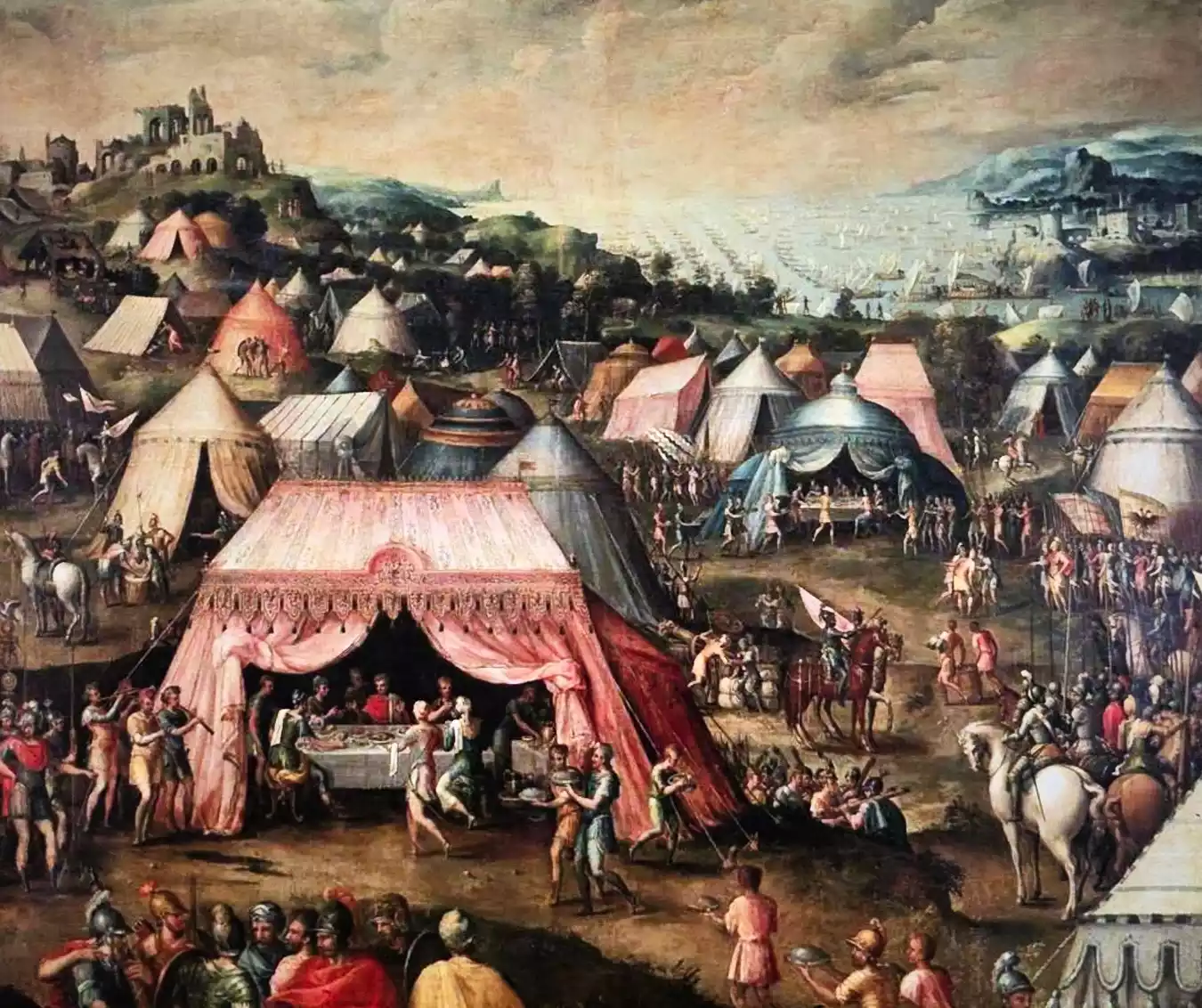
A canvas measuring 175.5 by 211 centimetres, preserved today in the Courtauld Gallery in London, a gift of Sir Alec and Lady Martin in 1951, gathers together, around 1546 to 1550, a scene that far exceeds the bounds of a mere historical record. The painter of the work is Niccolò dell’Abate, born in Modena around 1509, apprenticed alongside Correggio and Parmigianino before he settled in Bologna in 1547. The subject of the painting is the meeting of Charles V, Emperor of the Holy Roman Empire, with the Bey of Tunis, a few years after the campaign of conquest of the city in 1535. Although the historical event might have been rendered with the austerity of a chronicle, dell’Abate chooses exactly the opposite. Tents of pink and blue fabric rise like a temporary city upon the sand, soldiers parade in ranks, horses gallop among groups of officers, while in the distance a bay full of ships is lost within a haze of light.
The crowd, not the two rulers, occupies the centre of the composition. Studies of the war iconography of the sixteenth-century Mediterranean place works such as this within a broader tradition in which military victory is translated into spectacle, into an almost carnivalesque celebration. The painter, later a member of the Fontainebleau group, appears to take more delight in the density of the figures than he is concerned with fidelity to protocol. It is this tension, between the historical occasion and the painting of excess, that makes the work so vivid even today.
The panorama of a triumph: crowd, tents, and landscape
Charles V at Tunis: the banquet beneath the pink tent
In the foreground, a tent clad in deep pink fabric, with gold fringes and embroidered decorative motifs upon the drapery of its entrance, reveals the interior of a banquet. Around a table covered with white linen sit figures clothed in heavy, pleated garments, while servants in green, orange, and rose-coloured tunics carry platters full of food. One of them, on the left, seems almost to dance as he offers something to a seated figure, a movement that lends the scene a light, almost theatrical quality.
The heavy curtain, drawn to the side with cords and tassels, allows the viewer to look directly into the interior, as spectator of a backstage suddenly thrown open. Among these figures may be discerned, without any particular visual emphasis, Charles V and the Bey of Tunis, the two protagonists of a meeting that one might expect to occupy the centre of the composition. Dell’Abate refuses this hierarchy. No halo, no gesture of power sets the emperor apart from those around him, and this refusal of visual priority says more about the painter’s intention than any conventional composition of despotic projection would say.
Further off, a second tent in blue and white fabric, with a vaulted crown, houses yet another table, as counterpoint to the first, reminding us that the banquet is not a single event but a repeated ritual throughout the camp.
Soldiers, horses, and order within the crowd
To the right of the tent, long lines of soldiers bearing pikes advance in formation, their helmets flashing in grey and silver tones beneath a sky painted in faint orange and pink. Among them may be discerned a banner bearing a dark-coloured emblem, perhaps a double-headed bird, an element common to the imperial standards of the age.
A white horse, at the left edge of the canvas, stands almost motionless among foot-soldiers armed with swords, while nearer the centre riders upon red and chestnut horses hold banners that flutter without fully unfurling. The figures in the foreground, with helmets, breastplates, and red cloaks, look in different directions, creating a sense of turmoil that betrays, however, no actual conflict.
This is a display, not a battle. The lances are raised as they would be raised in a parade, and the bodies are arranged with an order that recalls, almost, choreography.
Ruins, the bay, and the light in the distance
In the distance, to the left, a hill bears the ruins of an old fortress, its arches half-collapsed, while around them small tents spread out in a row, recalling a camp-village traced downward upon the rise. To the right, ranges of mountains are shaded in deep blue, and among them may be discerned a walled settlement at the water’s edge.
The bay at the centre of the painting fills with countless small vessels, their sails dense points of white upon the blue, giving the impression of a fleet stretching to the very limits of sight. The sky, dim and clouded, with hues ranging from ochre to deep grey, lends the whole an atmospheric perspective that draws the gaze gradually away from the tension of the foreground towards a silent, almost dream-like distance. The high vantage point, almost that of a bird above the scene, permits this simultaneous reading of both the detail and the whole, a technique favoured in the Mannerist landscape painting of northern Italy.
This composition is situated precisely at the moment when dell’Abate passes from his apprenticeship beside Correggio towards a mature, personal language of landscape and narrative, shortly before he undertakes the great frescoes of Bologna and before he travels, in 1552, towards Fontainebleau, where he would contribute to the shaping of an entire French school of painting. The density of the figures, the love of costume, the attention to fabric and to the scenography of power, are not a chance choice of subject. They herald the style that would later dominate the French court, where the art of the banquet, the festival, and the parade would become an almost autonomous genre of painting.
The Tunisian campaign of 1535 did not inspire dell’Abate alone. In almost that same period, between 1546 and 1550, Jan Cornelisz Vermeyen was working on the cartoons for the great series of tapestries of the Conquest of Tunis, a commission which Charles V himself considered among the most important undertakings for the projection of the Habsburg dynasty. Without there being any documented relation between the two works, the coincidence shows how vivid the memory of that campaign remained within the painting and the weaving of the age, how valuable material it proved for artists of very different points of departure.
What remains, in the end, of a diplomatic meeting of 1535, once fifteen years have passed and a painter remakes it with his own eye? What remains is the crowd. What remain are the colours of the tents, the horses, the banners, the bay full of ships. Charles V and the Bey of Tunis become almost a pretext, two names among hundreds of anonymous figures whom the canvas refuses to single out. Perhaps this is the most interesting point of the work: the refusal of the painting to function as a faithful chronicle, and its preference for spectacle, for turmoil, for the human mass that moves around two men whom history remembers by their names, while the painting prefers to remember the crowd.
(Translated from the Greek text; translation by K. Pappas.)

