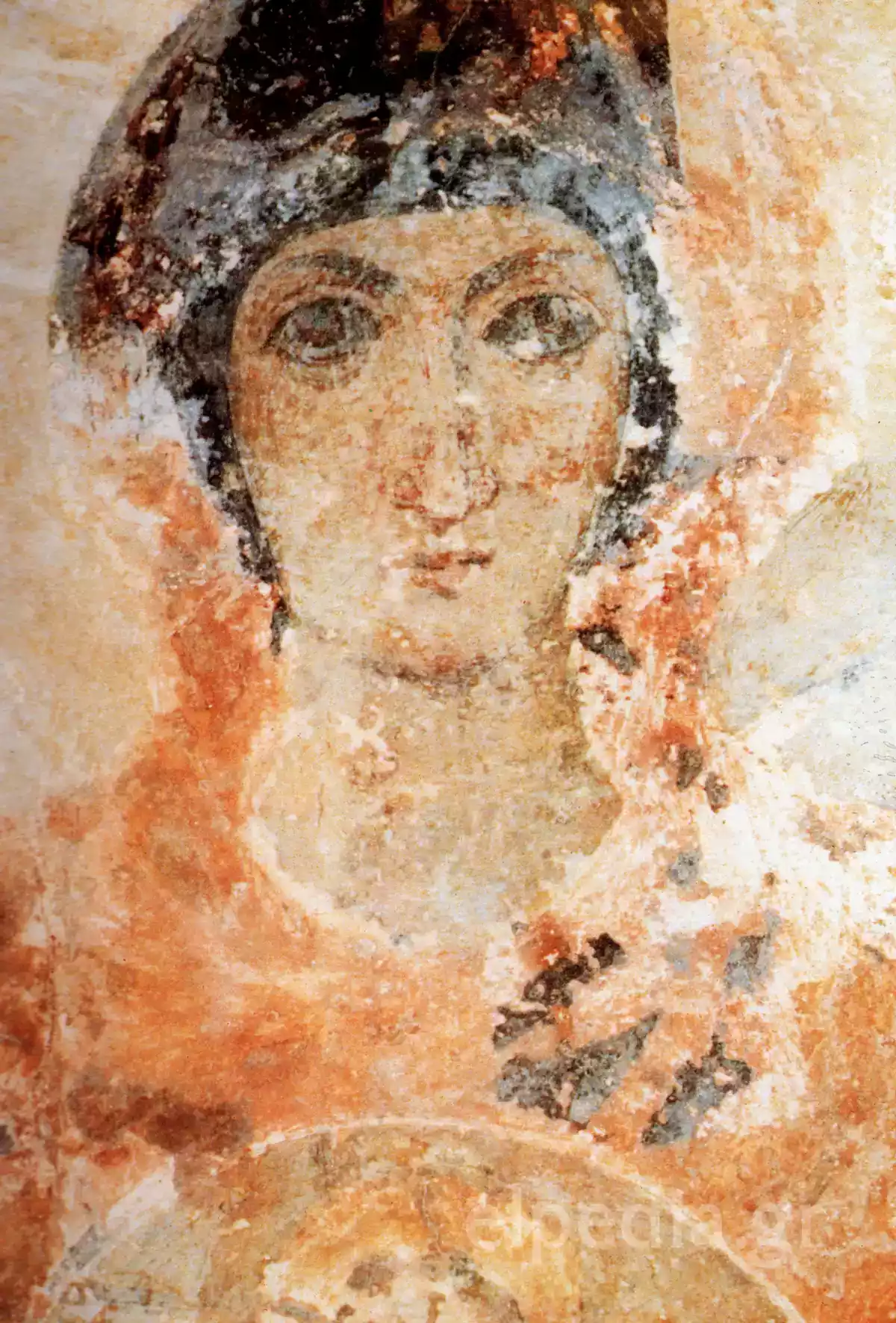
The wall painting of the Theotokos that adorns the northern apse of the church of the Panagia Drosiani, in the village of Moni on Naxos, dates back to the seventh century and depicts the form known in Byzantine iconography as the Panagia Nikopoios. The craftsman remains anonymous, as indeed do most painters of the Early Christian period in the Cyclades, yet his hand is recognisable in every line of the face, in every layer of ochre laid upon the wet plaster. It is not a full-length composition, since the wall painting survives only down to the waist, and yet this damage takes nothing away from the gravity that defined religious painting before the Iconoclasm. Naxos, the largest island of the Cyclades, preserves in this small church successive pictorial layers spanning almost seven centuries, with the Panagia Nikopoios constituting the oldest of them all.
The word Nikopoios itself, with the loose meaning “she who brings victory”, designates an iconographic type held in particular honour in Byzantium: the Theotokos stands frontally, holding the infant Christ before her breast within a circular mandorla, in the belief that her presence secured the victory of the army and the protection of the empire, being borne indeed as a standard on campaigns. At Drosiani the same theme acquires a plainer, almost intimate dimension, far from the courtly magnificence of Constantinople, yet no less charged spiritually. How systematically, one wonders, has this pictorial unit been studied? The oldest painted layer at Drosiani occupied scholarly research as early as the late 1990s, when its systematic dating between the sixth and the seventh century was attempted for the first time.
The Iconography of the Panagia Nikopoios at Drosiani
The church of Drosiani, a single-aisled, triconch structure with a dome, built of unworked stone in the Aegean manner, is considered by scholars to possess the best-preserved painted programme of its period in the whole of the Aegean. Against this background may be discerned the form of the Panagia Nikopoios, one of the very few examples in which painting before the Iconoclasm survives almost untouched by later repainting.
The iconographic type of the Nikopoios was not born on Naxos. It occurs already from the sixth century on Byzantine seals and coins, where it took the place of the ancient personification of Nike, and was gradually associated with the idea of the divine protection of the army and the state, honoured almost equally with the Hodegetria. Tradition, indeed, attributed the original icon to the Evangelist Luke, lending it an authority that surpassed every local cult. But how did so imperial a theme arrive at a provincial apse on Naxos? The answer lies rather in the widespread dissemination of the great iconographic types of the capital, which reached the islands by way of the trade routes and the ecclesiastical administration, adapted each time to the capacities and to the technique of the local workshop.
The Composition, the Colour, and the Ravages of Time
The head and neck of the Theotokos occupy the greater part of the surviving surface, wrapped in a maphorion that is grey-blue in its lower part, dark and almost brown at the crown, where irregular patches of white plaster interrupt the chromatic continuity. The face stands out against a background of warm, brick-red tone, a choice that departs from the customary blue depth of Byzantine wall paintings and betrays either a local custom or a later oxidation of the pigments. At the lower right edge of the composition a dark, labyrinthine design is preserved, perhaps a remnant of the mandorla of the infant Christ or of some decorative element of the garment, without however permitting a secure identification. Large almond-shaped eyes, arched brows, a straight, long nose, a small, pursed mouth: the features compose that stern, almost military majesty befitting the name Nikopoios, the protectress of the army and the empire. Precisely because it precedes the Iconoclasm, this figure belongs to a scarcely numerous group of monumental depictions that escaped both the destructive fury of the iconoclasts of the eighth and ninth centuries and the habit of later generations of repainting the walls of their churches. The technique follows the customary Byzantine combination of fresco with elements worked upon already dry plaster, a method that allowed the painter to add, the day after the principal application, the last, fine touches to the gaze and to the highlights.
The Face of the Theotokos: Gaze and Plasticity
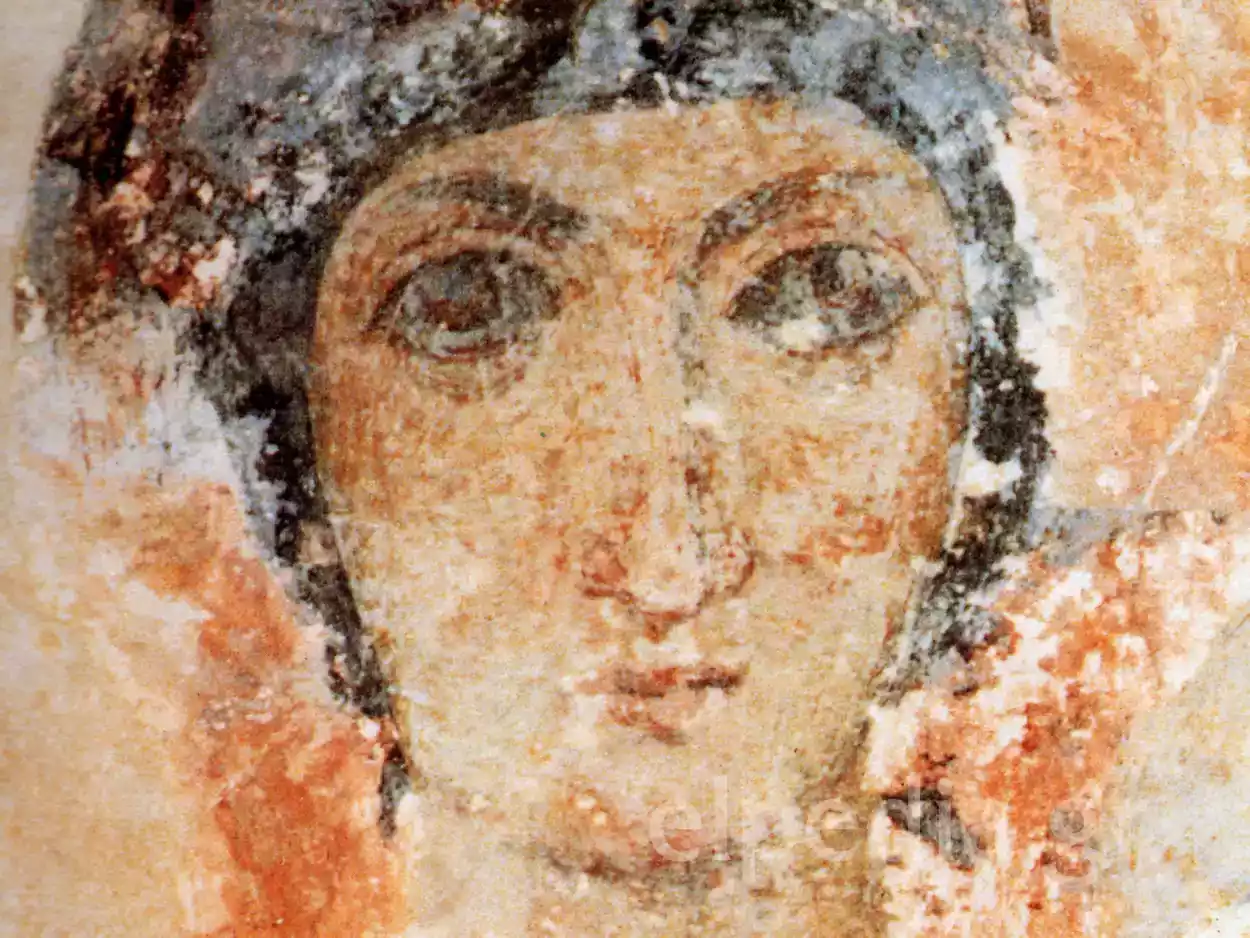
In closer view, the face reveals the painter’s detailed work in the modelling of the volumes: the proplasmos, dark and earthy, remains visible in the hollows beneath the eyes and around the nose, while over it lighter highlights are spread across the forehead, the cheeks, and the bridge of the nose, giving the skin a warm, almost living texture. The eyes, asymmetrical, one slightly larger than the other, look directly at the viewer with an intensity that has nothing conventional about it; it is not the distant, almost abstracted gaze that we shall meet later in Middle Byzantine painting, but an almost personal look, as though the painter had before him a face and not merely a type to be copied.
In this technique something may still be discerned of the late Greco-Roman tradition of the plastic rendering of the face, an inheritance that Byzantine painting had not yet fully abandoned in the seventh century in favour of the flatter, more linear rendering that would prevail later. This gaze, so different from the schematised severity of the later Byzantine Nikopoioi, attests an artist who was still working in terms of naturalistic observation, even within the limits imposed by the religious programme. The mouth, small and closed, with an imperceptible shading beneath the lower lip, completes the impression of a figure grave, introverted, charged with a sorrow not easily explained, perhaps a foreboding of the Passion of the child she once held in her arms. The damage to the plaster, the fine cracks that run vertically across the forehead, do not do the work an injustice; on the contrary, they emphasise its antiquity and the course it has run through fourteen centuries.
The Value of One of the Oldest Forms of the Theotokos
The Panagia Nikopoios of Drosiani never stood alone in her space: around and above her, later painters added, up to the fourteenth century, new layers of images, new saints, new compositions, without however daring to cover the original form of the Theotokos, as though they recognised in her something that ought not to be lost. In the same church other Early Christian representations are also preserved, among them a Deesis with figures around Christ, an indication that the whole of the northern wing functioned as a single theological programme and not as a chance stitching-together of isolated scenes. Lengthy works of uncovering were required before this original pictorial layer appeared beneath later strata of lime-wash, a process that reminded the conservators how fragile the memory of an entire age remains, resting upon a few centimetres of plaster. It is worth noting that the entire church, with its triconch plan and its small dome, is considered among the oldest surviving monuments of Greece, perhaps even of the Balkans, a fact that lends the wall painting a significance surpassing the bounds of local devotion. For scholars of Byzantine art, this face constitutes a rare testimony to the manner in which painting before the Iconoclasm perceived the sacred countenance, without the strict rules that the iconographic tradition of Constantinople would later impose. Whoever stands before her today does not see merely a remnant of the past; he sees a testimony to how art, even through its ravages, can keep alive a gaze of fourteen centuries.
(This is a translation from the Greek original text, translated by K. Pappas.)

