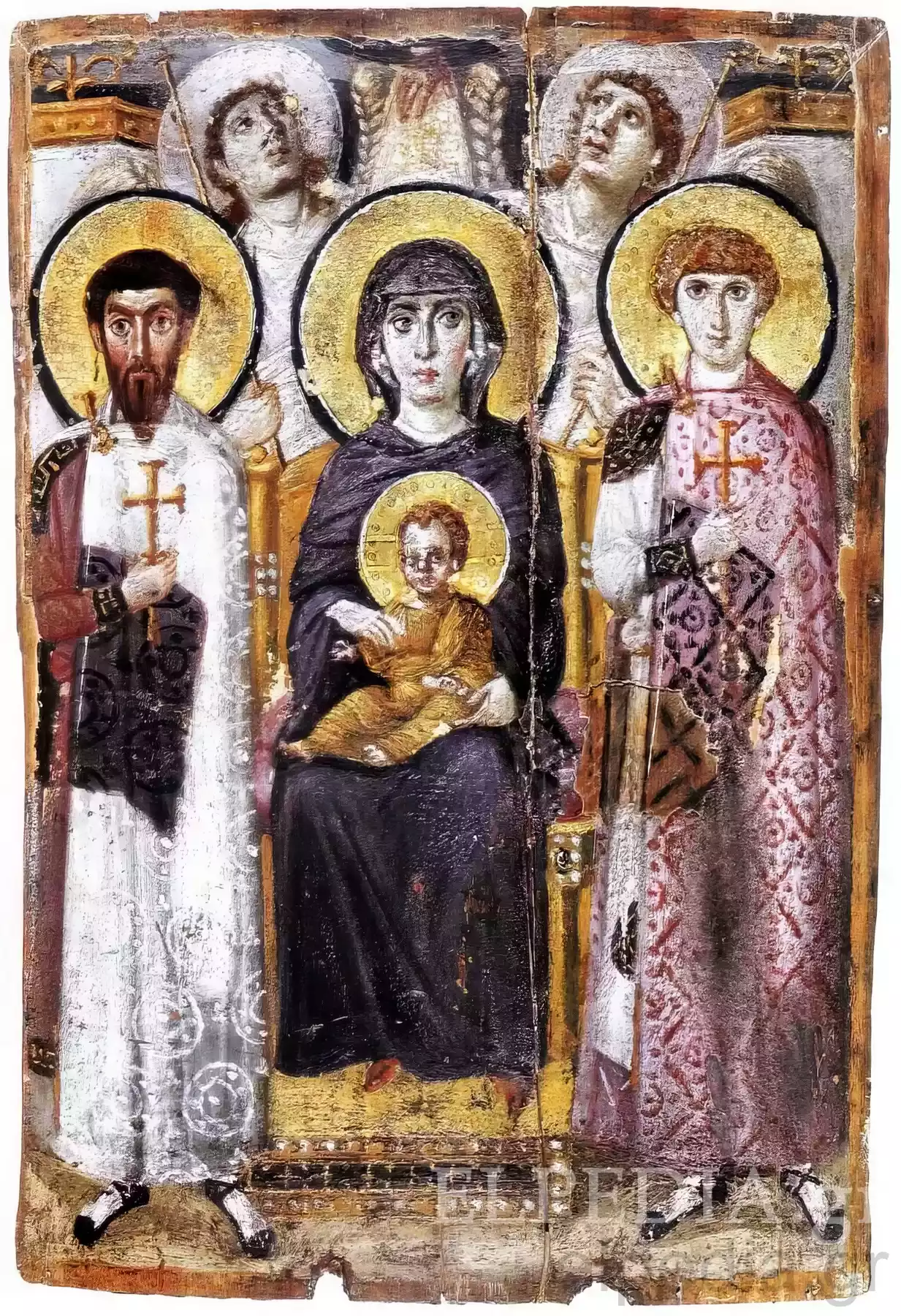
In a wooden panel of 68.5 by 49.7 centimetres, split down the middle by time and the natural contraction of the material, there is preserved in the Monastery of St Catherine on Sinai one of the very few encaustic icons to have survived from the early Christian centuries. It is the composition of the Theotokos Brephokratousa between the military saints Theodore and George, with two angels standing behind her throne.
The painter remains unknown, yet the quality of the execution and the choice of pigments point to a Constantinopolitan workshop, perhaps even to a commission from the imperial court of the second half of the sixth century. The two military saints wear the official dress of the imperial guard and hold martyrs’ crosses, while the gaze of the Virgin avoids our own, turned aside with a discreet melancholy rarely encountered in later works of Byzantine painting. The very concept of the icon in Byzantium was never univocal, since its remotest roots reach back to the Hellenistic tradition of Egyptian funerary portraiture, where the technique of wax lent the face a strange, almost living clarity. The result here is a deeply personal icon, in which each figure seems to breathe with its own rhythm, far from any schematised repetition.
Iconographic Analysis of the Composition
The Theotokos Brephokratousa on the Throne of Glory
At the centre of the composition, upon a throne studded with pearls and precious stones, sits the Theotokos Brephokratousa, holding the infant Christ in her arms. The deep, dark blue of her maphorion absorbs the light rather than reflecting it, in contrast to the golden gleams that run round the Infant’s garment. Her face remains strictly frontal, as the sanctity of the representation demands, yet her eyes incline slightly to the right, as though she were looking at something outside the frame of the panel — perhaps the beholder standing to one side, perhaps a point known only to her. The set of her knees, turned slightly aside, gives the body a volume recalling late Hellenistic sculpture more than later Byzantine schematisation.
The infant Christ, his head likewise turned obliquely, bears no resemblance whatever to a diminished adult, as would be the case centuries later. He is a child, with round cheeks and an open gaze, something the encaustic technique allowed to be rendered with unrivalled naturalness, thanks to the fatty, sculptural texture of the wax. The throne, with its fine gold outlines and its mosaic-like ornament, situates the scene in a space at once earthly and transcendent, resembling something intermediate between a court hall and paradise — an iconographic convention that would come to dominate the art of the following centuries.
The Military Saints Theodore and George
On either side of the Theotokos stand two young men in the characteristic dress of the imperial guard. St Theodore, on the left, bears a dark beard and holds a martyr’s cross in his right hand, clothed in a white garment bearing dark decorative bands.
St George, opposite him, has curly, reddish hair and a rose-coloured garment with a dense, textile ornament of lozenges and crosses, a fabric recalling the luxurious silks of the imperial court. Both hold the symbols of their martyrdom with a calm that has nothing theatrical about it. In contrast to the plasticity of the Theotokos, these two figures maintain a strict, sharply relieved frontality; their eyes look straight at the beholder, without the sidelong deviation we observe in the central figure. This stasis constitutes a conscious compositional choice, a visual counterweight that places the two saints in the role of steadfast, immovable guardians of the throne of glory. The choice of two military saints instead of, say, bishops or ascetics is bound up with the broader climate of the age, in which imperial iconography frequently carried over into religious art the model of enthroned authority framed by its military guard — a visual correspondence between the earthly and the heavenly court.
The Angels and the Gaze toward the Divine Light
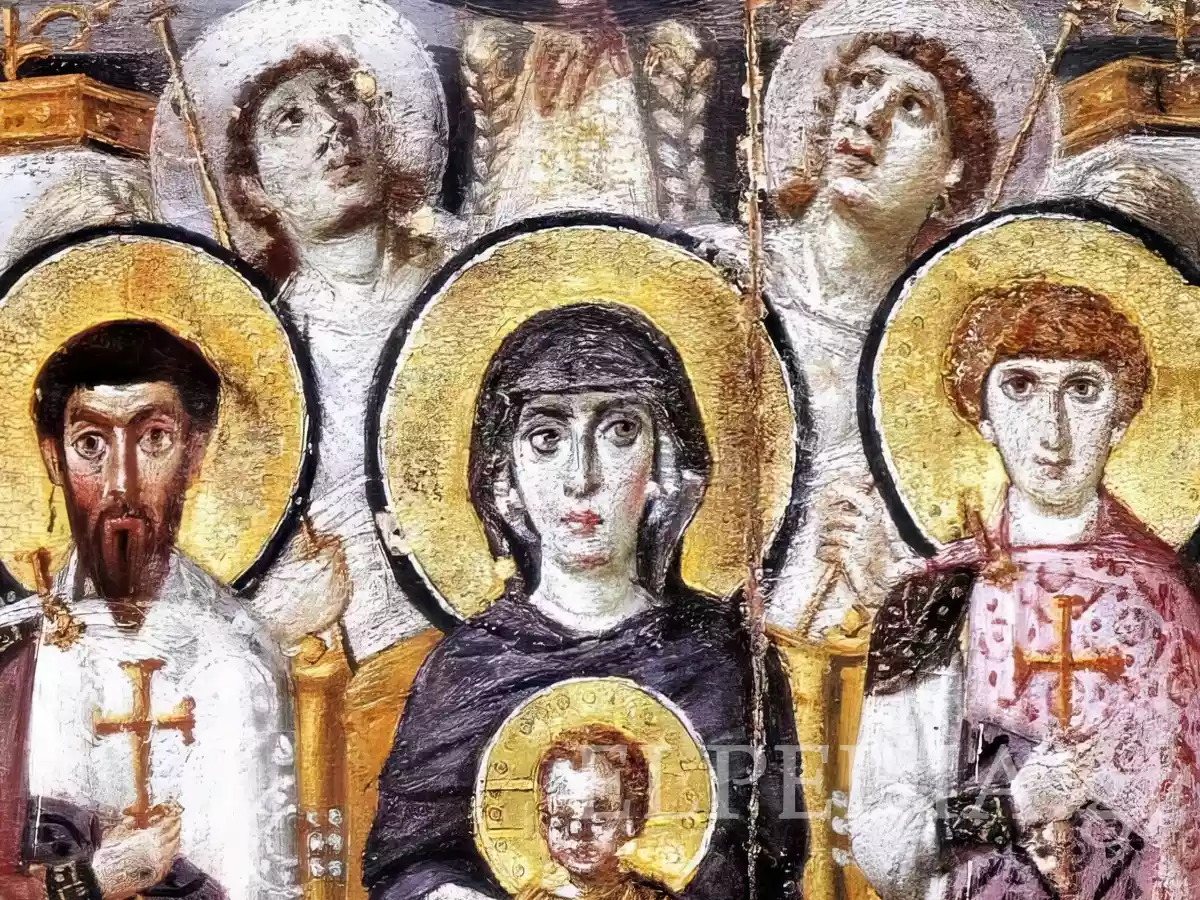
Behind the throne, two angels in white, off-white vestments turn their heads sharply upward. This movement, painted with broad and free brushstrokes, differs radically from the disciplined detail that dominates the rest of the figures in the composition. Their hair is rendered with quick, sketch-like strokes, while their eyes, wide open, gaze at something lying outside our field of vision — a source of light which iconographic tradition places at the uppermost part of the composition.
This gaze, turned upward with an intensity that is almost bodily, gives the angels a vividness that stands out immediately on close inspection. They are not merely guardians or ornament. They appear to take an active part in an event unfolding above the head of the Theotokos, something the rest of the composition only intimates.
The Gold Background and the Language of Colour
Beyond any merely decorative intent, the gold background surrounding the figures intimates a space without perspective, without depth in the sense that Western painting would later give to it — a space in which light is diffused everywhere equally, independent of any particular source. Within this background, the haloes bear fine, incised ornaments in the form of small rosettes, a technique of great refinement also found in other encaustic icons of the same group at Sinai, a detail that reinforces the hypothesis of a common workshop, or at least a shared tradition of technique, among these works.
On the maphorion of the Theotokos, the dark, opaque blue gathers the gaze upon itself like a visual centre of gravity, absorbing it before it can disperse to the surrounding figures. This colour, in the Byzantine tradition, points not so much to mourning as to the idea of an impenetrable, almost regal modesty befitting the Mother of God. Set against it, the rose garment of St George and the white of St Theodore compose a chromatic balance that keeps the composition clear of monotony, without, however, drawing attention away from the central figure.
The Enigma of the Many Hands
This heterogeneity of style did not pass unnoticed by the scholars who have studied the icons of Sinai systematically. The plastic, three-dimensional rendering of the Theotokos, with her slightly turned knee, stands in contrast to the schematised, frontal stance of the two saints and to the free brushstrokes of the angels turning their heads in a swift movement upward, producing a composition in which three different conceptions of how the human form is to be rendered coexist, with a curious harmony. Some researchers have proposed that the work issued from the hands of more than one painter, each specialising in a different part of the composition — a practice customary in the workshops producing luxury works in Constantinople.
Together with the technical kinship it displays with other encaustic icons of Sinai, such as that of Christ Blessing and that of St Peter, the high quality of the execution has led certain scholars to associate this ensemble with a personal donation of the imperial court under Justinian, a period of intense artistic activity around the monastery which the emperor himself had fortified. Others prefer to read this heterogeneity as a conscious choice, a way of visually differentiating the hierarchy of the figures, from the one closest to human experience to the one most distant and spiritual. Whatever the truth of the matter, the result remains among the most fascinating testimonies to how late Hellenistic painting was gradually transformed into the iconographic language of Byzantium. A good number of scholars indeed consider that this may well be the oldest surviving depiction of precisely this iconographic type — the enthroned Theotokos between saints — to have come down to us in so fine a state of preservation.
The survival of this icon owes a great deal to the isolation of Sinai. Iconoclasm, which destroyed or effaced the greater part of early Byzantine religious painting on the territories under Constantinople’s direct control, never reached the Monastery of St Catherine with the same intensity — a monastery which today preserves the largest collection of Byzantine icons in the world. Thanks to this geographical stroke of fortune, the composition of the Theotokos Brephokratousa with Saints Theodore and George was preserved almost intact, save for the crack at the centre of the wooden panel and some minor losses in the hair of St George.
With melted wax and pigments sealed onto the wood by heat, the technique of encaustic already belonged to a long tradition when this work was executed. Its roots are lost in the funerary portraits of Hellenistic and Roman Egypt, where the same method was used to render the faces of the dead with a striking, realistic fidelity. The Byzantine icon, when it sought a way to render the sacred countenance, turned naturally to the very technique that had already been tried centuries earlier in the rendering of the human face in general. A little later, with Iconoclasm and the subsequent reorganisation of ecclesiastical art, this same technique would be abandoned to a great extent in favour of egg tempera, a fact that renders its scant surviving examples, such as this one, especially precious for understanding a technical tradition that died out.
Beyond the composition itself, the study of this work equally illuminates the history of the place that housed it. Sinai has always been an active place of pilgrimage, with its own tradition, its own craftsmen, and its own liturgical needs, far more than a mere repository of works of art. The icon of the Theotokos Brephokratousa was most probably executed for one specific position within the katholikon of the monastery, adapted with precision to the ritual and to the liturgical needs of this particular monastic community. This close relationship between an icon and the space for which it was made goes some way towards explaining why the works of Sinai differ so perceptibly from their counterparts in Constantinople, even when they issue, as here, from a kindred workshop.
Whoever visits the monastery today, at the foot of the mountain where tradition situates the theophany to Moses, stands before this small, worn wooden panel and recognises, within the severity of the composition, the last traces of a world that was passing away — the Hellenistic naturalistic tradition — at the very moment when the strict, hieratic language of the Byzantine icon was being born, as the centuries to come would come to know it.
(Translated from the Greek original by K. Pappas.)

