
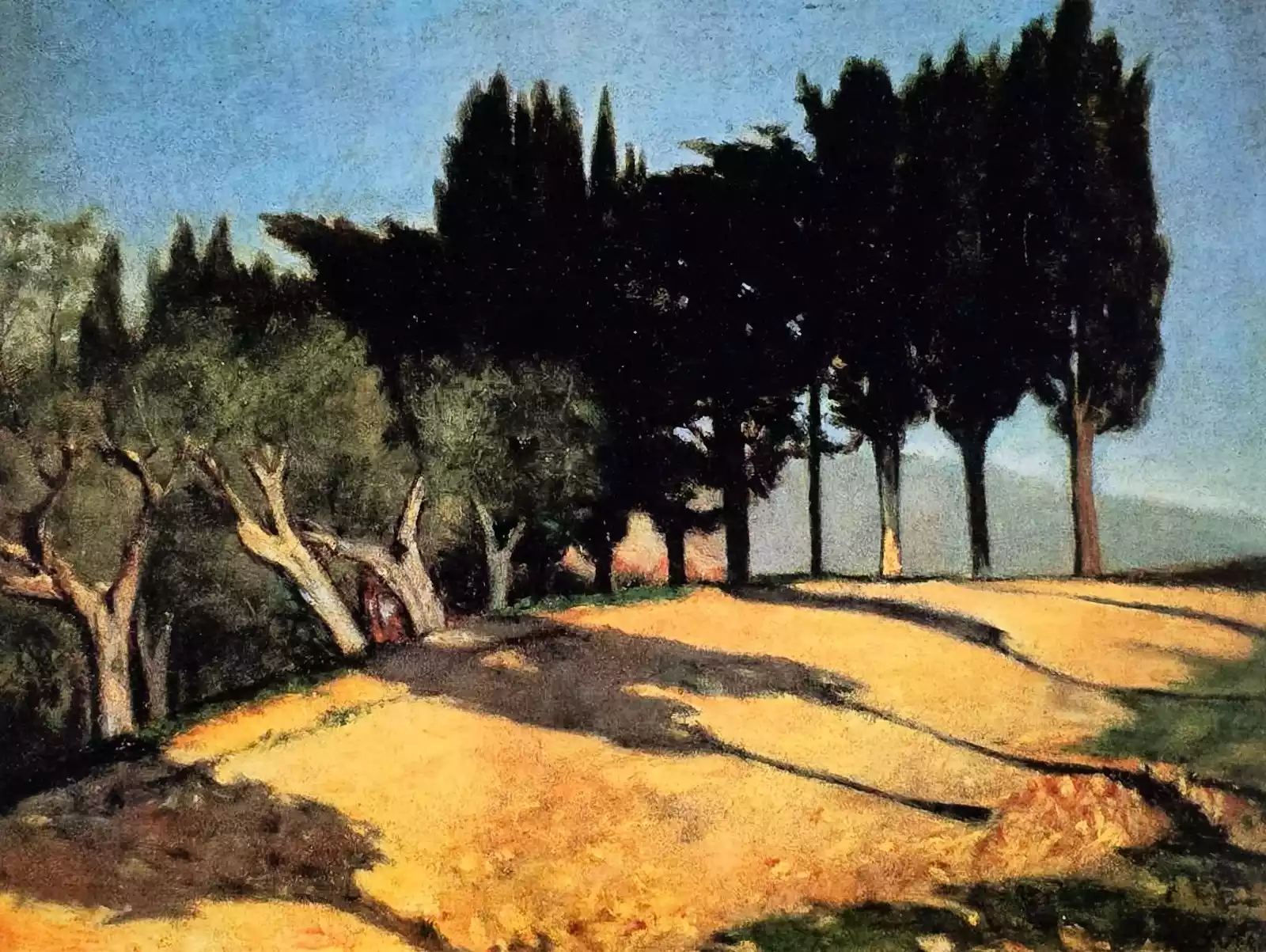
A canvas measuring a mere thirty-seven by twenty-eight centimetres is housed today in the Galleria d’Arte Moderna of the Palazzo Pitti in Florence, gathering into so small a surface one of the most concentrated expressions of nineteenth-century Tuscan painting. It was created by Giuseppe Abbati, born in Naples in 1836 and lost prematurely in 1868, a painter whom art history has ranked among those who were called, at first somewhat mockingly, the Macchiaioli. The title of the work, Strada di campagna con cipressi, is rendered in English as Country Road with Cypresses, and it is dated to around 1860, the very years, that is, in which the young artist, not yet fully thirty, was seeking his own voice within the current of the Florentine realists. It is a painting which, despite its small dimensions, gathers together all the essential characteristics of the movement: the absence of a narrative subject, the emphasis on natural light, and a strict economy of means.
The scholarly literature surrounding the question, in particular a searching study of the Macchiaioli, locates the group’s central concern in the pursuit of the so-called effetto, that is, the visual truth that springs directly from the clash of light and shadow, without the mediation of academic draughtsmanly discipline. Abbati did not merely record a landscape. He set down a condition of lighting, a particular moment of the day in which the sun strikes an earthen road almost vertically, leaving the cypresses to rise as a solid mass of darkness against the blue sky. The matter is not only aesthetic. It concerns an entire way of thinking about painting, one that would mark Italian art long before the French version of Impressionism.
Giuseppe Abbati and the Language of the Macchia
The Road, the Light, and the Architecture of the Composition
The road that crosses the surface of the painting leads nowhere in particular. It begins at the lower left edge, painted in ochre and gold, turns towards the right and into the depth of the picture, with no person crossing it, no carriage, no trace whatsoever of narrative. The light falls almost vertically, a fact that betrays the midday hour, and forms long, slanting shadows upon the earth, which cut diagonally across the surface and lend the tranquil composition a sense of movement that derives from no figure, only from the light itself. This is not a fastidious rendering of every branch. The surface of the canvas retains everywhere the trace of the brushstroke, dense and rapid in the dark areas, more open and diffuse along the lit road.
A row of olive trees, with twisted, pale trunks, some of them almost white, stands to the left, bare, crooked, without embellishment, amid sparse, silver-green foliage. Behind and beside it rises the mass of the cypresses, so dark that it touches upon black, forming an irregular, almost jagged outline against a sky utterly clear, without a cloud, painted in gradations of blue that open upwards. Small patches of a reddish-brown tone, between the dark band of vegetation and the road, hint perhaps at rooftops or bare earth, without being fully revealed. A strip of grass in a livelier green closes the composition on the right. The gaze, as it wanders, returns continually to the point where shadow meets light, to the exact line upon which Abbati appears to have placed the whole of his thought.
The Cypresses Up Close: A Detail in Tension
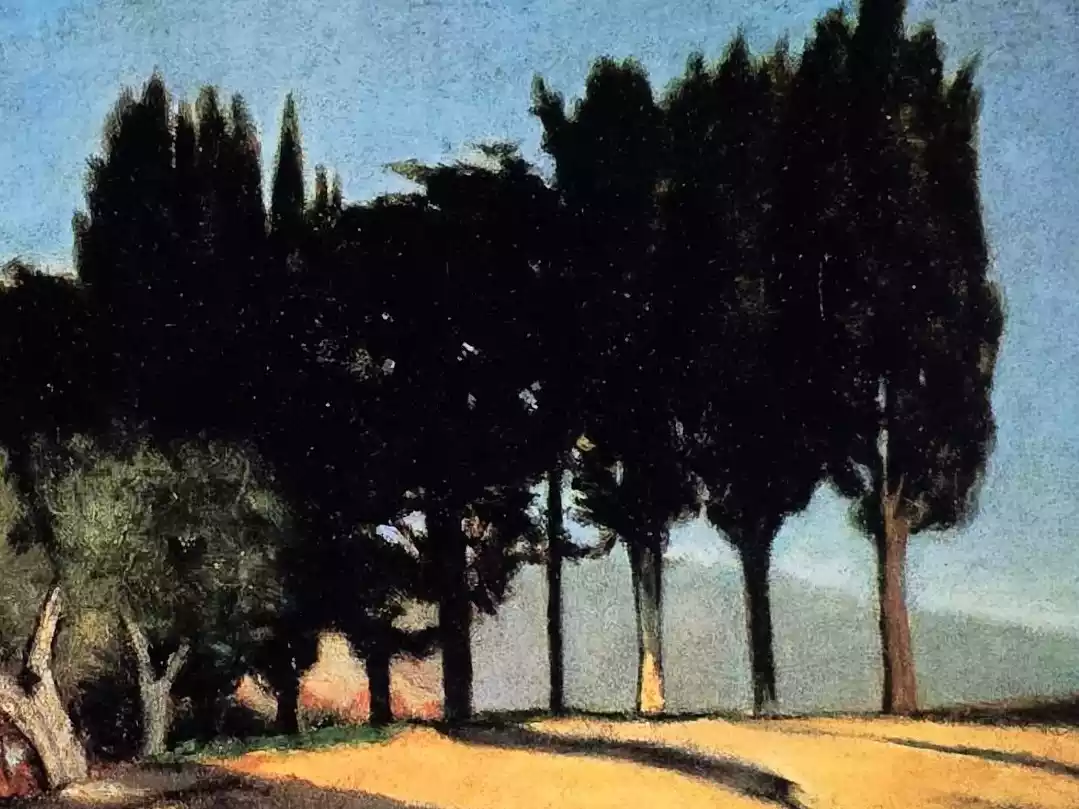
Approaching the mass of the cypresses, the brushstroke reveals something that the overall view of the painting conceals. The colour is not a single black, as one might suppose from a distance, but a web of greens so deep that they touch upon jet black, interwoven with minute, almost invisible glimmers of white that flicker within the dark foliage. At the base of the trees, where the dense vegetation stops and the trunks begin, narrow gaps open through which the sunlight passes, tinting the trunks a warm shade of amber.
One trunk in particular, at the right edge of the detail, is lit so intensely that it seems almost independent of the rest of the tree, a vertical line of gold between the darkness of the foliage and the ochre of the road. This contrast, between the near-total darkness and the burst of light at the root of the trunks, condenses perhaps better than any other point in the painting the logic of the Macchiaioli. Their interest was directed far more towards the tension that arises when two masses, one wholly dark and the other wholly luminous, meet without transition, than towards the botanical precision of a cypress’s foliage. Abbati, in this small corner of the canvas, shows how far austerity can reach when it is served by an eye trained in contrast.
From the Caffè Michelangiolo to the Macchiaioli Movement
The term Macchiaioli was not born within an academy or a course of study. It arose from a hostile review published in the Gazzetta del Popolo on 3 November 1862, in which some journalist mockingly called the group’s works “macchie“, that is, patches or stains, implying that these were unfinished sketches and not completed paintings. The word carried also a second, darker shade of meaning. In Italian, the expression darsi alla macchia meant to hide oneself in the bushes, to live outside the law, and this association with outlaws was not unrelated to the way in which official criticism regarded those young painters who rejected the school. They themselves, rather than rejecting the label, made it their own.
They gathered at the Caffè Michelangiolo in Florence, around the middle of the 1850s, where painters such as Giovanni Fattori, Silvestro Lega, Telemaco Signorini, Odoardo Borrani, and Vincenzo Cabianca discussed, quarrelled, and laid the foundations of a painting that would be painted in the open air, before the very landscape itself, not in the studio. They sought not to narrate some story, but to record the first, unmediated impression of light upon a surface, nearly a decade before the French version of Impressionism, though without sharing with it the same political innocence. Many of the Macchiaioli had fought for the unification of Italy, and their rejection of the official Academies was not merely an aesthetic choice, but part of a broader rejection of every authority that seemed foreign to the new, united Italy.
The War, the Lost Eye, and the Fatal Bite
Abbati did not begin with landscape painting. The offspring of a painter, son of Vincenzo Abbati who painted architectural interiors, he first served his apprenticeship beside his father and later studied at the Academy of Fine Arts in Venice, where the family had settled for years. His earliest paintings depicted the interiors of churches and monasteries, not roads and fields.
In 1860 things changed radically. The young painter enlisted in Garibaldi’s Expedition of the Thousand, and at the Battle of Capua he lost his right eye. A few months later he settled in Florence, where at the Caffè Michelangiolo he came to know Signorini, D’Ancona, and soon the whole circle that would become famous under the name Macchiaioli. It was at that very time, with the wound of war still recent and with his vision permanently altered through the loss of the eye, that he appears to have painted Country Road with Cypresses.
In 1861, at an exhibition in Florence, he was awarded a medal for his interiors, which he refused to accept, as a mark of protest against the composition of the judging panel, a gesture that reveals his character better than many a biographical detail. His story does not stop at this point. In 1866 he fought again, in the Third Italian War of Independence, was taken prisoner by the Austrians, and held in Croatia. He returned to Tuscany, settled near Livorno, on the estate of the Macchiaioli’s friend and patron Diego Martelli, and in December 1867 he was bitten by his own dog. He died two months later, at thirty-two years of age, of rabies.
The Galleria d’Arte Moderna of the Palazzo Pitti today preserves dozens of works by the Macchiaioli, among them landscapes by Fattori with horses and soldiers, interiors by Lega in window light, walls and towers by Abbati himself from his years at the Academy. The small canvas with the cypresses does not stand out at first sight among these. It has neither the size that commands attention, nor any human face to hold the gaze, yet it possesses a wholly spare, almost ascetic trust in the power of contrast in itself, without narrative pretext and without historical reference.
Fattori would become, in the following decades, the most recognisable name of the movement, with works larger in scale and ambition. Abbati did not live to make this journey. His work remained concentrated, to a great extent, in Tuscany and in the years before 1868, a handful of canvases which today are studied chiefly by specialists rather than by the wider public.
The very rural Tuscany that killed him, through the bite of a dog on Martelli’s estate, was the one that had inspired him, eight years earlier, to paint precisely this road. Among the remaining works of the collection, Country Road with Cypresses remains among the most persuasive examples of how the macchia functioned when applied not to an urban scene or a depiction of war, but to the quieter version of the Tuscan countryside, to a road that no one crosses and to two rows of trees whose contrast remains, a century and a half later, unchanged behind the glass of a display case at the Palazzo Pitti.
(This is a translation from the Greek text; the translation was made by K. Pappas.)

