
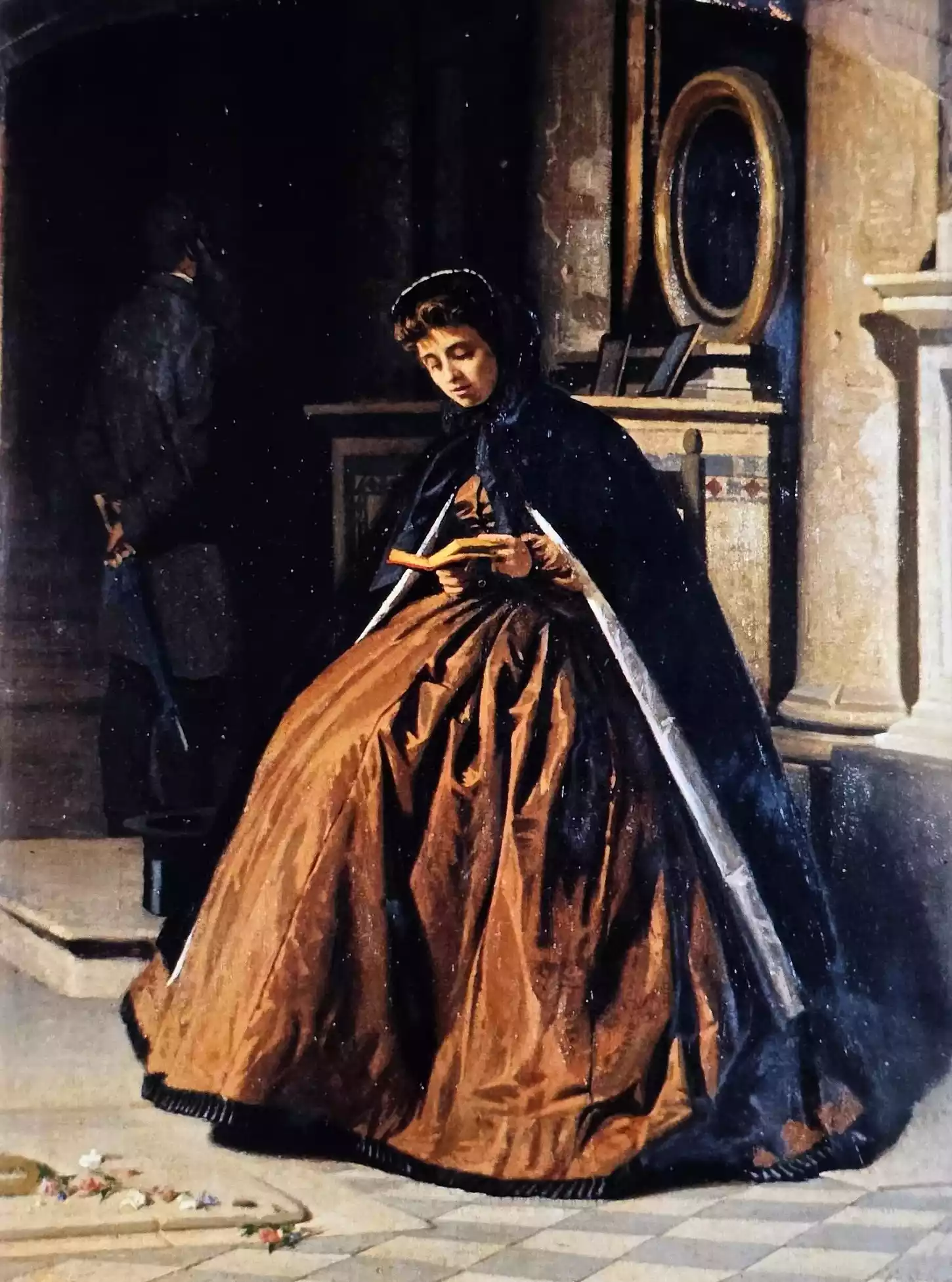
A small work in oil, fifty-seven by forty-two centimetres, executed in 1866 by Giuseppe Abbati, is preserved today in the Gallery of Modern Art of the Pitti Palace in Florence, known by the title The Prayer, or in Italian L’Orazione. A woman, her head bowed over a small book, sits motionless within a space that resembles a temple crypt more than an everyday room. Behind her, half lost in the shadow, a man stands with his back turned, like the guardian of a moment that does not belong to him at all.
The identity of the sitter has not remained entirely unanswered through time. Several scholars recognise, in the woman’s features, Teresa Fabbrini, companion of the critic and collector Diego Martelli, who had already sat for other works by Abbati in those years. The painting was presented at the Promotrice of Florence in 1866 and was purchased immediately by the then Ministry of Public Education, something that did not often happen to an artist so austere in his apparent means.
The very moment which the work captures — a woman enclosed within a space of worship, her gaze fixed upon a book — is not so very far removed from what the Italian tradition of devotional prayer-books describes, a tradition that later travelled even as far as England through movements inspired by Saint Philip Neri. It is a quiet scene of daily life set within a religious space, painted through the eye of an artist who belonged to the Macchiaioli, the movement that revised Italian painting of the second half of the nineteenth century through the contrasts of light and shadow.
The Prayer by Abbati: Light, Composition, and Detail
What dominates one’s first encounter with the work is darkness. Dense, almost impenetrable, it swallows the greater part of the background and allows the woman to emerge out of it, illuminated as though a ray were falling upon her whose source no one can see.
The Woman and the Space of Worship
The woman sits almost in profile, her head inclined downward, her hair gathered beneath a dark covering that recalls a hood rather than a hat of the period. Her gaze is fixed upon a small book with a reddish cover, which she holds with both hands, wearing gloves from which, at the edge of one, a piece of bare skin emerges. She reads neither quickly nor hurriedly. She sits as one sits when the text before one need not be finished soon.
Behind her may be discerned a stone outline resembling a fireplace or a humble altar, several books stacked upon a shelf, and a gilded, oval mirror or frame, the interior of which remains dark.
The Cloak and the Copper-Coloured Dress
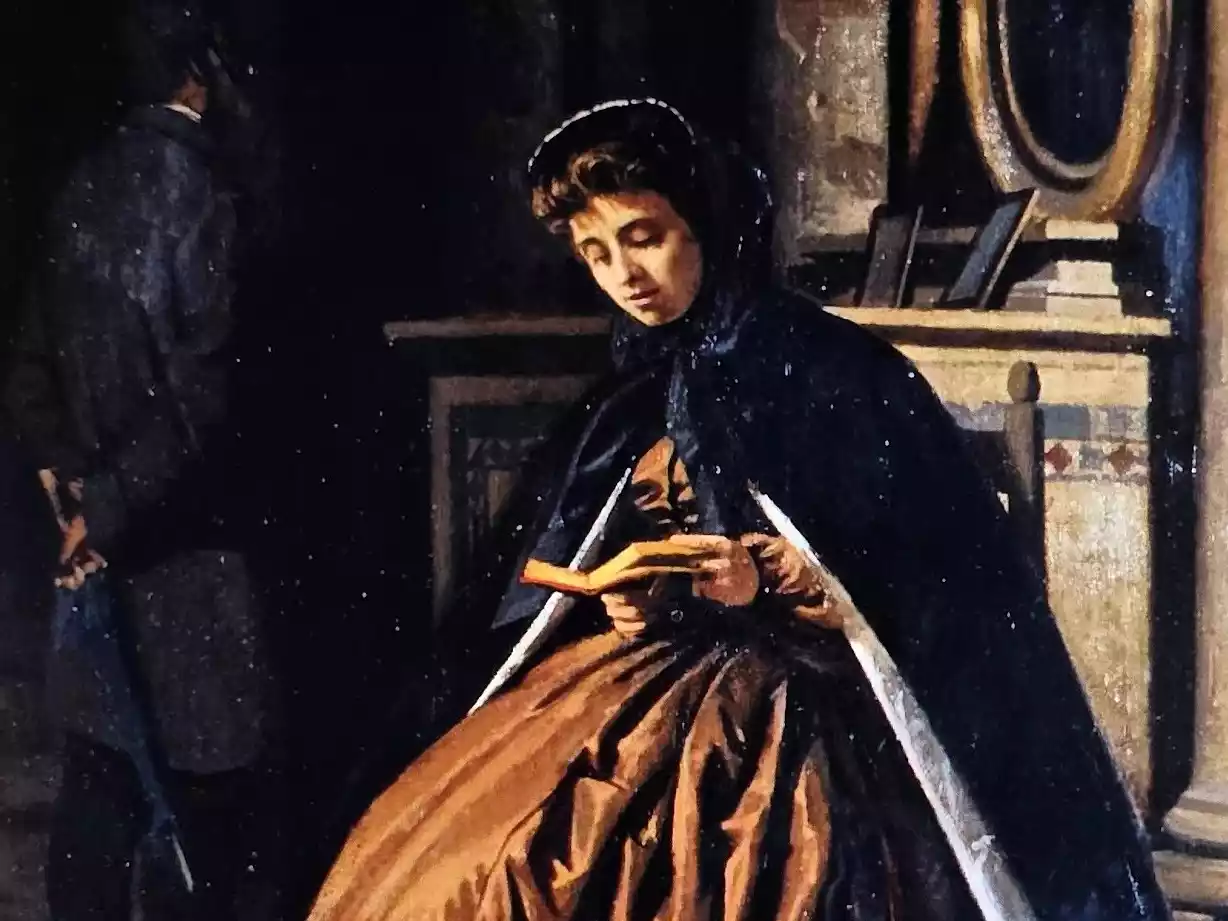
Over a broad tunic the colour of copper, almost caramel where it catches more light and darker within its folds, the woman wears a heavy black cloak that envelops her entirely, from the shoulders to the floor. It is not a simple garment. It functions as a shell, as a boundary between the body and the world around it, enclosing the figure within a dark, glossy surface that reflects light only at those points where the fabric folds sharply. In the detail that reveals the upper part of the body it appears clearly how heavy this fabric must have been, almost like an armour of cloth. Abbati’s father, Vincenzo, painted architectural interiors, and the son learned at his side first to render volumes and surfaces, before he had even touched the human face as a subject. This early apprenticeship is visible here, in the way the fabric falls, folds, and is shadowed, almost as though it were a wall and not a garment upon a body.
The Silent Presence of the Man
In the background, towards the left, a man stands with his back turned, dressed in dark clothing, with something resembling a hat upon his head and his hands behind his waist. We do not see his face. We do not know whether he too is praying, whether he is waiting, or whether he simply stands in silence because someone has asked him to wait. This figure is not explained, nor does it require explanation. It functions as a counterweight to the woman’s absolute stillness, a shape of shadow that reminds us we are not in an empty room, but in a space where someone else looks on, or waits, without taking part.
The Floor, the Flowers, and the Light
At the lower left edge of the composition, almost hidden, a few flowers may be discerned, scattered upon the white and grey slabs of the floor. We do not know whether they fell from some bunch, whether some pilgrim left them in passing, or whether they constitute simply a note of colour which Abbati wished to place at a point otherwise neutral.
The paving, with its square pattern, gives the composition a geometric stability that stands in opposition to the soft, irregular folds of the dress. The geometry of the floor anchors the scene, while the fabric releases it.
The Technique of the Macchiaioli and Abbati’s Position
Abbati was not a marginal figure within the movement. At the Caffè Michelangiolo in Florence, where artists such as Giovanni Fattori, Silvestro Lega, Telemaco Signorini, and Diego Martelli himself often met, he became one of the most recognisable faces. He had already fought with Garibaldi in 1860, losing the sight of one eye at the Battle of Capua, something that never prevented him from continuing to paint with the same, if not greater, precision of light. His summers he often spent at Castiglioncello, at the house of Martelli himself, where he probably came to know at close quarters Teresa Fabbrini too, the person whom many recognise in The Prayer. The movement itself did not believe in line as the boundary of form. It believed in the patch of colour, the macchia, which, placed correctly beside another, could build volume without contour. In The Prayer this is clearly visible in the way the woman’s face stands out from the darkness around it, not through line, but through the sharp difference between the illuminated skin and the dark background.
Abbati did not live to see his work acquire the renown it holds today. He died in 1868, at only thirty-two years of age, of rabies, following a bite from his own dog, an end so sudden and so unrelated to his art that it seems almost incongruous beside the serenity he painted.
At the Palazzo Pitti, The Prayer shares a room today with other works of the same generation, alongside landscapes and interiors that document how an entire generation of Florentine painters decided to look upon light not as decoration, but as the very material of the image. It stands as a record of an age, of a way of seeing silence, and of a face — that of Teresa Fabbrini, or of whatever other woman lies hidden behind that name — which remained bent over a book forever, on a canvas fifty-seven by forty-two centimetres, never to learn how many would stand before it.
(This is a translation from the original Greek text, translated by K. Pappas.)

