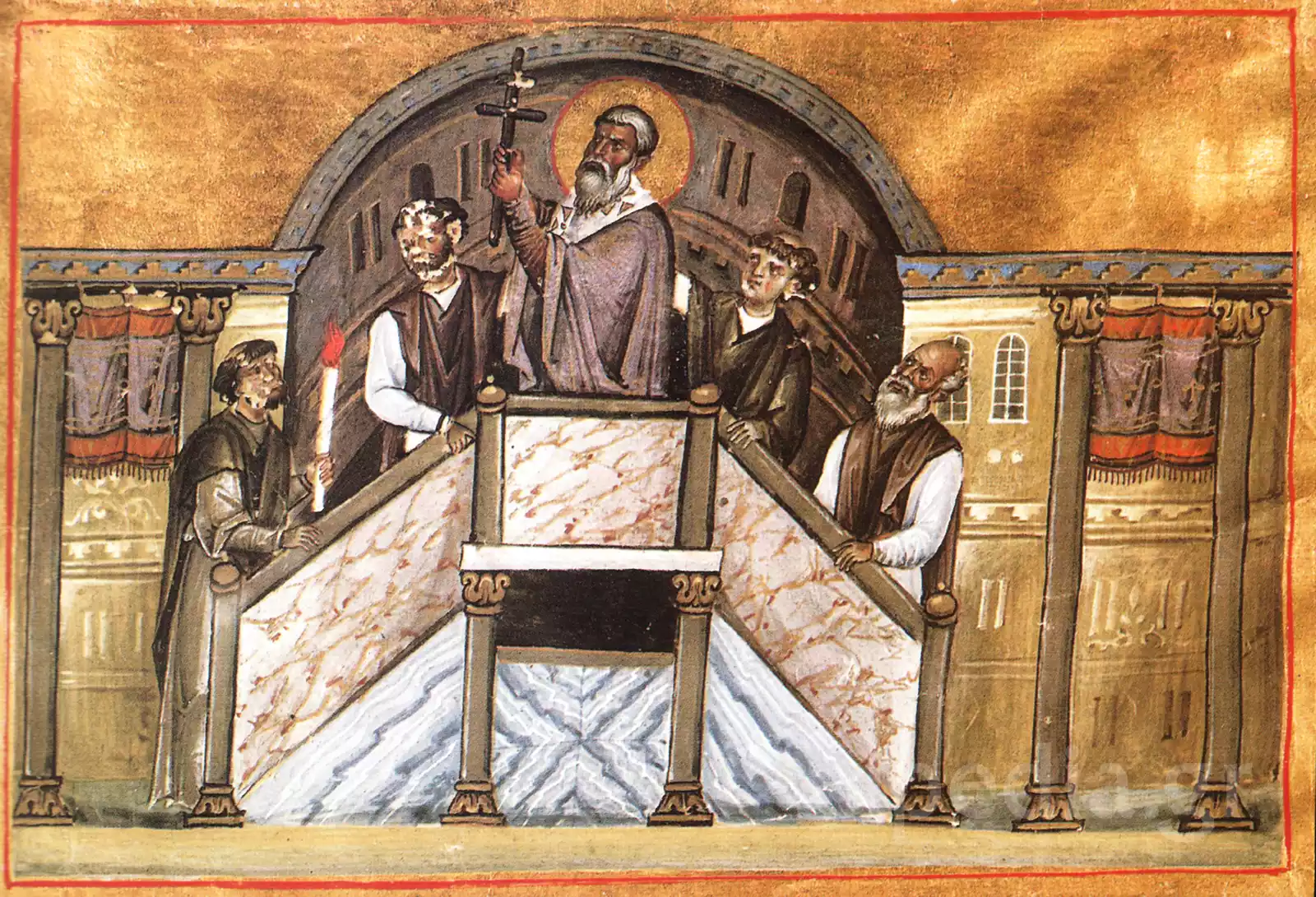
A miniature on folio 35 of the manuscript Vaticanus graecus 1613, known as the Menologion of Basil II, dated to around 985, depicts the ceremony of the Exaltation of the Precious Cross as it was celebrated in Constantinople under the Macedonian dynasty. The patriarch, clad in a greyish-purple vestment and a white omophorion, raises with both hands a dark-coloured cross above a marble ambo veined like the pages of a book, while two clerics hold, on either side, the balustrades of the raised platform. The scene, worked in fine brush upon a gold ground, belongs to a set of some four hundred miniatures adorning the manuscript, the work of eight named painters who laboured on the emperor’s behalf.
The origin of the feast is bound up with two distinct episodes, the finding of the Cross by Saint Helena in the fourth century and its recovery by the Emperor Heraclius some three centuries later, yet the miniature illustrates neither of the two, presenting instead the contemporary liturgical act as it was celebrated at the time of the manuscript’s composition. The identity of the hierarch remains an open question for scholarship, although certain scholars recognise in him Patriarch Nicholas II Chrysoberges, a contemporary of the manuscript’s composition. The miniature thus functions as a visual testimony of an imperial ceremony, one which the power of the age wished to render with precision and magnificence, beyond any intention of devotional use.
The Architectural Setting of the Exaltation of the Cross
Behind the patriarch opens a niche with a semicircular vault, an element recalling the apse of a church or a projecting recess within a palace, while on either side colonnades are visible, with capitals and cloth hangings bound about the columns. The gold ground, common to almost all the miniatures of the Menologion, dissolves any sense of a specific place, although the marble platform with its book-veined markings refers directly to a real liturgical furnishing, comparable to the ambo of Hagia Sophia. Not unconnected with this is the care the painter shows in rendering the ambo, since there, at the top of a stair, the patriarch showed the cross successively toward the four points of the horizon, while the people repeated, “Lord, have mercy.” The feast, established in Jerusalem around 335 on the occasion of the dedication of the Church of the Resurrection, spread gradually throughout the whole empire and had already acquired a universal character by around 720, incorporating the memory of the finding of the Cross with that of its return from Persian captivity. The painter narrates nothing of this. He paints only the ceremony, with a precision that testifies to the well-known turn toward classical models in the art of the Macedonian renaissance, a period during which the court of Constantinople sought again, consciously, the models of Hellenistic painting.
The Detail of the Faces in the Exaltation of the Precious Cross
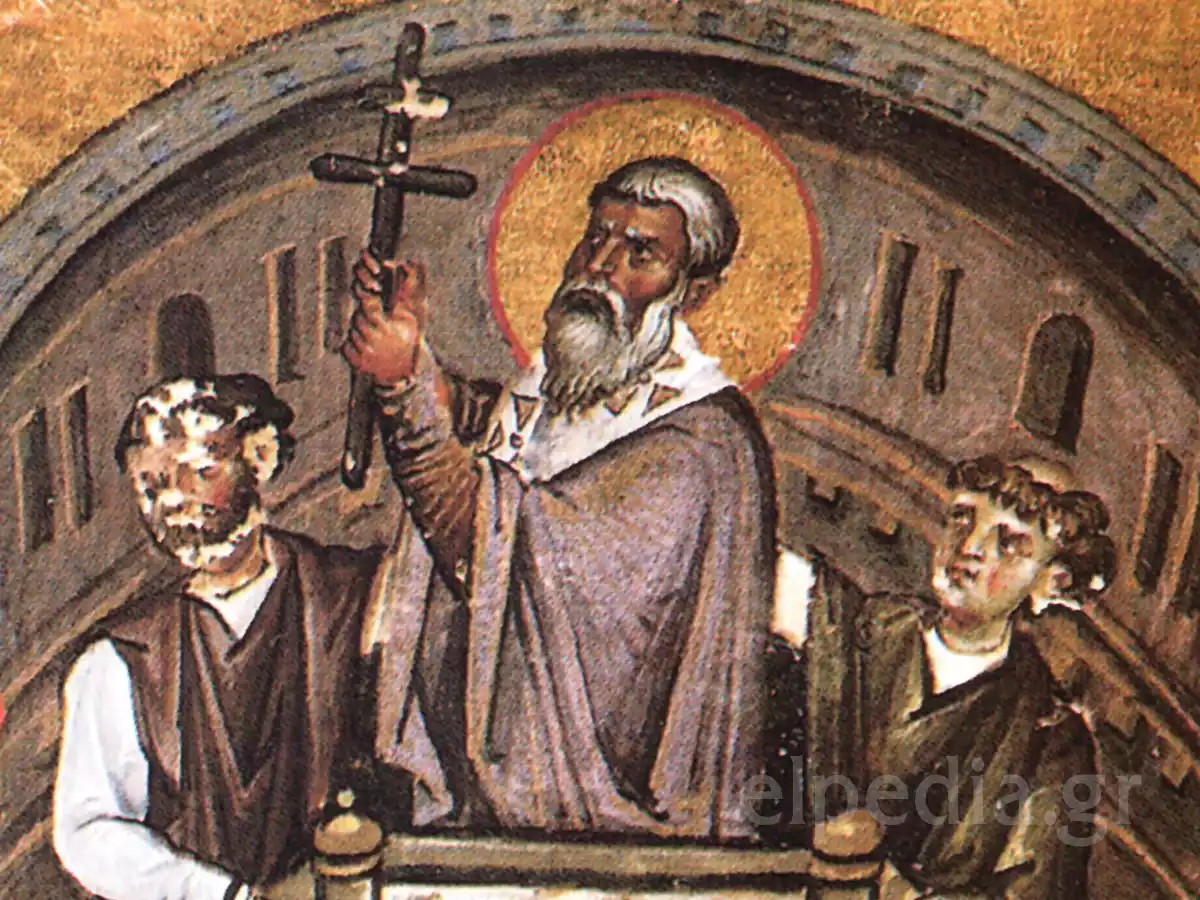
The patriarch’s face, full of deep wrinkles about the eyes and a long white beard, turns slightly upward, following the movement of the hand holding the cross, while about the head is traced a halo with a red outline upon a gold disc. On the left, a cleric with sparse, whitened hair and a short beard grips the balustrade tightly, clad in a dark-coloured ependytes over a white chiton; on the right, a younger assistant, with curly brown hair and rosy cheeks, turns his gaze upward with an expression of almost surprise.
The contrast between these two faces, the aged and the youthful, gives the composition a human gradation of ages rarely encountered with such clarity in miniatures of comparable size. The rendering of the flesh, with the characteristic greenish underlayer and the rosy highlights of the Constantinopolitan workshops, gives the faces a plasticity surpassing the usual schematisation of the period.
Scale small, impression great. The page does not exceed the size of an open palm, a fact which in no way hinders the monumentality of the composition, a matter which has repeatedly occupied scholars of Macedonian manuscripts. The cross, with its dark wood and discreet metal terminals at its extremities, remains the sole element of the composition without counterpart in the architecture around it, the only thing, that is, which belongs neither to the space nor to the people, but only to the ceremony itself.
(Translated from the original Greek text; translation by K. Pappas.)

