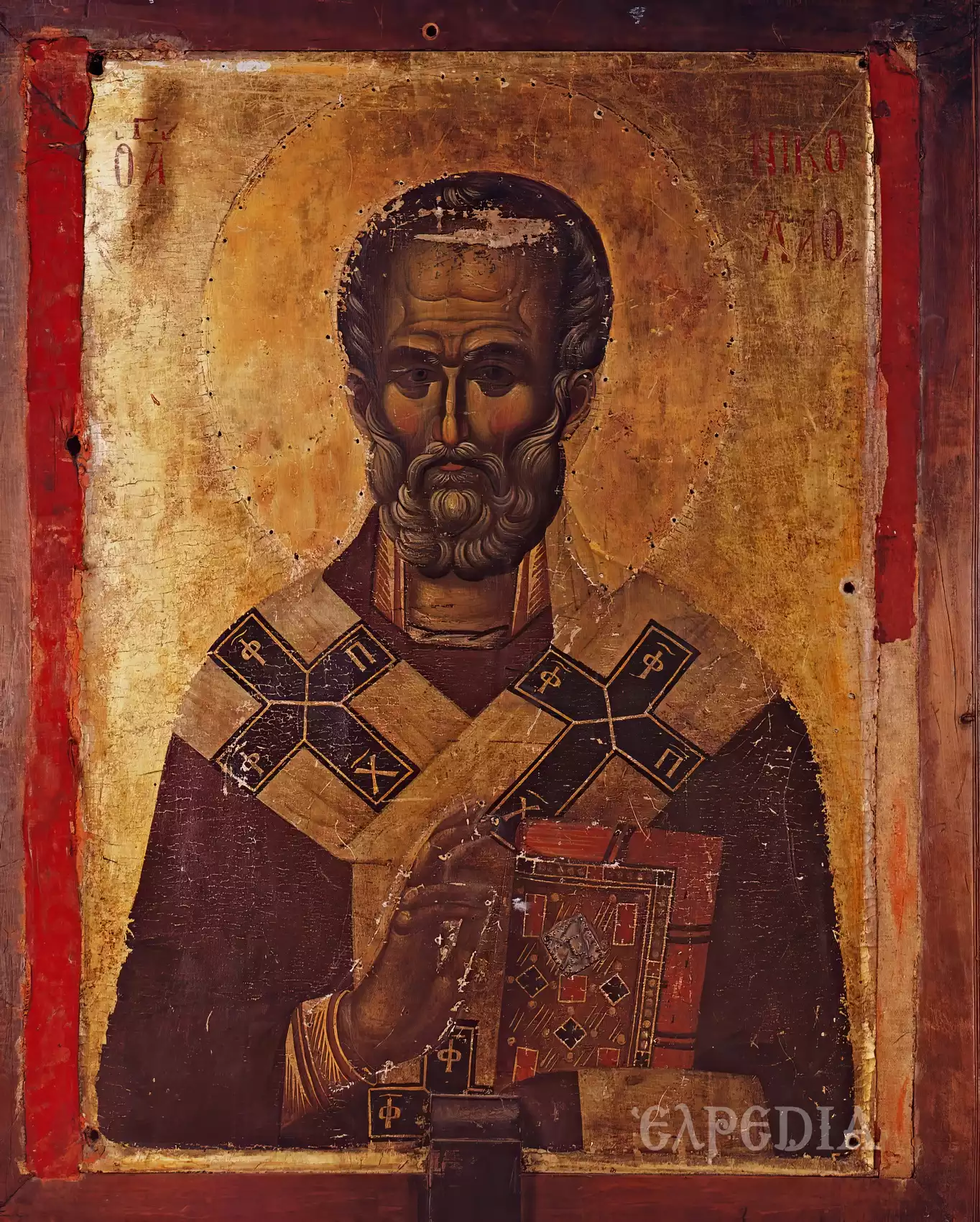
In the treasury of the monastery of Hilandar, on Mount Athos, is preserved a Byzantine icon of Saint Nicholas, a work of the early fourteenth century, around 1320, by an iconographer whose name has not come down to us. Small in dimensions, forty-two by thirty-one centimetres, executed in egg tempera upon a wooden panel, the composition belongs to the years of the reign of the Serbian kral Stefan Uroš II Milutin, who had added to the entrance of the monastery a chapel dedicated precisely to this same hierarch. The painter followed the established model of the Orthodox tradition, the hierarch frontal, blessing with the right hand, holding the Gospel with the left, just as the visual convention for holy bishops had prescribed already from the earliest Byzantine centuries.
At the upper edges of the board may be discerned, in capital Greek letters, the traces of the inscription naming the saint, a common practice even in Serbian monastic settings, where Greek remained the language of the visual and liturgical tradition. In 1320 Constantinople was living through its second flowering, at roughly the same time that in the Monastery of Chora the mosaics were being completed which are today regarded as the foremost example of Palaiologan classicism.
A few decades later, as hesychast spirituality would gradually reshape the visual language of the Byzantine and Slavic lands, the same monastery would go on producing works that recorded this transformation. The icon of Saint Nicholas of Hilandar still belongs to that phase of the calm, classicising form, before it began to dissolve into more sinewy lines and more ascetic bodies.
The Icon of Saint Nicholas of Hilandar: Technique and Iconography
The Technique of Egg Tempera and the Wear of Time
Upon a wooden surface prepared with layers of gesso, the iconographer laid the gold leaf that signifies the immaterial, the divine light, that which does not shine from any particular source but rises up from the very depth of the representation. Upon this golden field the figure was drawn with a fine outline, and there followed the colours bound with egg yolk, a technique slow in execution but durable through time, at least so far as the conditions of preservation allowed. Today the surface bears witness to six centuries.
The gold has been lost over large sections, especially on the left side, where the wood shows bare beneath the layers that have fallen away. Small holes scattered across the surface, traces of old woodworm, perforate the panel in an irregular pattern, while a network of fine cracks crosses the paint like a map of age. The red frame that surrounds the composition, itself worn, nonetheless retains its function as a boundary between the world of the viewer and the timeless space of the icon.
It is not without relevance that Hilandar itself, in the course of the fourteenth century, had become one of the most significant centres of icon production on Mount Athos, with workshops that supplied both the monastery and its dependencies. In this setting, where Serbian patronage met Byzantine expertise, small portable icons such as this one became a vehicle of direct, personal contact between the monks and the saint honoured, in contrast to the monumental wall-painting addressed to the worshipping community as a whole.
The Frontal Schema, the Episcopal Vestments, and the Halo
Saint Nicholas occupies the centre of the composition, the torso turned towards the viewer, the gaze steady. On his shoulders may be discerned the two ends of the omophorion, each bearing a dark cross with raised lettering, the mark of his archpastoral office which iconographic convention requires to be recognisable from afar.
The right hand is raised in blessing, the fingers forming the familiar monogram of the name of Christ. The left holds the Gospel, its cover deep red, decorated with rhomboid designs in gold lines, a section of metal ornament at its centre recalling a seal or a precious stone. The halo, large, circular, fills almost the entire upper part of the wood, worn here and there like the rest of the golden field, yet without the sense of its function as a source of light around the head being lost.
The vestment, dark brown on the outer garment with lighter shades on the inner one, does not seek a realistic rendering of fabric. It organises volumes with geometric economy, the folds forming lines that lead the gaze towards the centre, towards the book and the hand that blesses. No detail is superfluous, none is lacking. Within the reverse perspective inherent in the manner of rendering the gold background, the viewer does not merely observe the figure; he becomes the recipient of its gaze.
The Detail of the Face
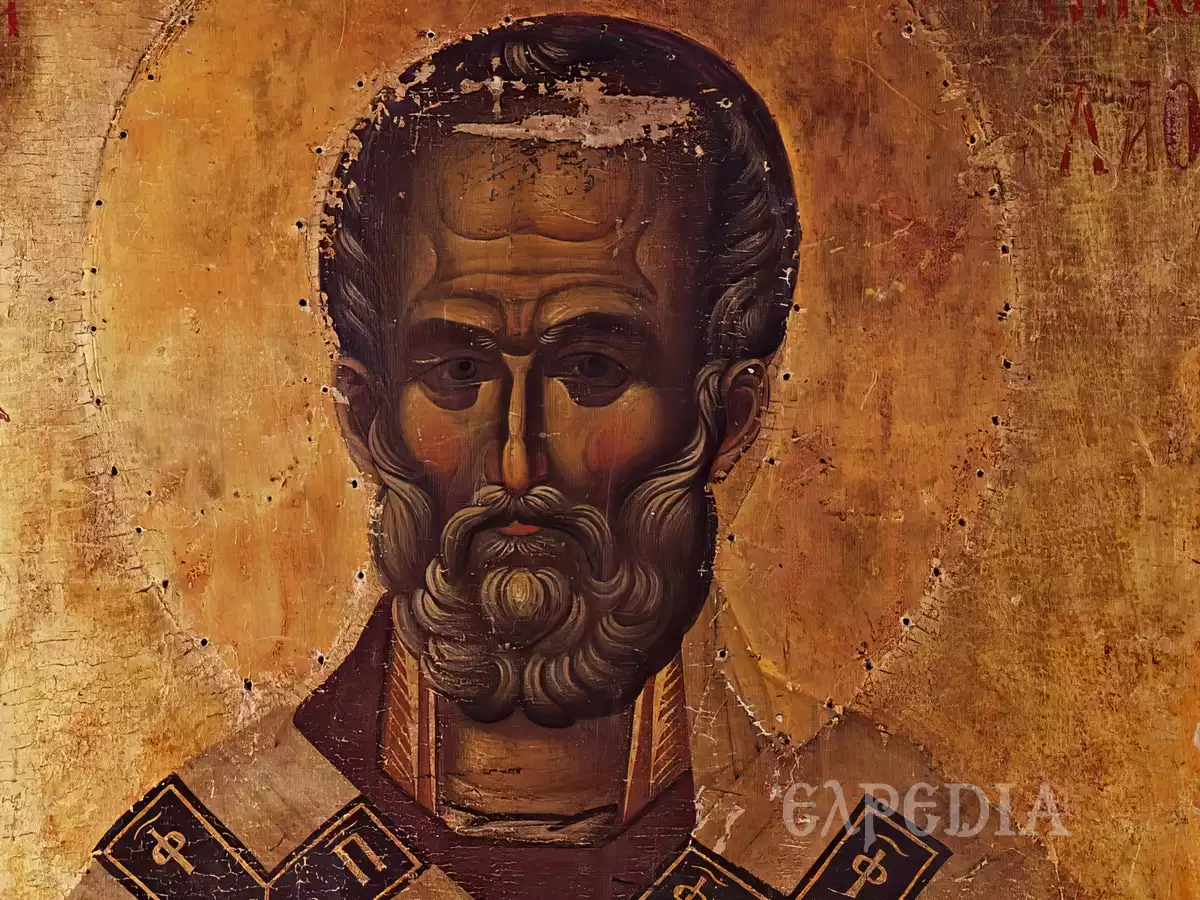
Drawing closer to the face, the coarse schematisation of the body gives way to an extremely careful rendering of physiognomy. Three horizontal wrinkles cross the forehead, deep, almost linear, above thick eyebrows that shade eyes deep-set, dark, with a gaze that does not seek out the viewer but receives him.
The nose long, straight, determines the axis of symmetry of the face. The hair, grey, thinning at the crown, forms two tufts beside the temples, while the beard, tangled into tight curls, descends in two uneven streams.
The rendering of the flesh follows the typical Byzantine method of the dark ochre underpainting, with lighter highlights on the forehead, the nose, and the cheekbones, and a discreet reddish tinge on the cheeks that brings the face to life without embellishing it. This is not a portrait of a particular person. It is a type, fixed for centuries throughout Byzantine iconography, the elderly hierarch bearing the weight of severity and tenderness together, recognisable in every corner of the Orthodox world without need of an inscription.
The monastery of Hilandar preserves dozens of such figures, some better known, others almost unremarked upon the shelves of its treasury. This icon of Saint Nicholas does not occupy the prominent place of the monastery’s great, much-discussed icons, such as that of the Tricherousa. It remains, nonetheless, a document of rare value for understanding the manner in which Serbian rule, in the years of Milutin, sustained and renewed one of the most important centres of Orthodox art in the Eastern Mediterranean.
What remains of the gold, the cracks, the small holes in the wood, does not weaken the figure. On the contrary, it places it within a time that is definite, measurable in centuries, which the very surface of the icon bears upon itself like an imprint. An iconographer without a name, in a workshop on Mount Athos, gave to a piece of wood forty-two centimetres in size the form of an elderly man whom the Orthodox tradition recognises from Myra of Lycia to the Serbia of Milutin and to the present-day treasury of Hilandar, without altering almost anything in the basic features of his face.
(This is a translation from the Greek original; the translation was made by K. Pappas.)

