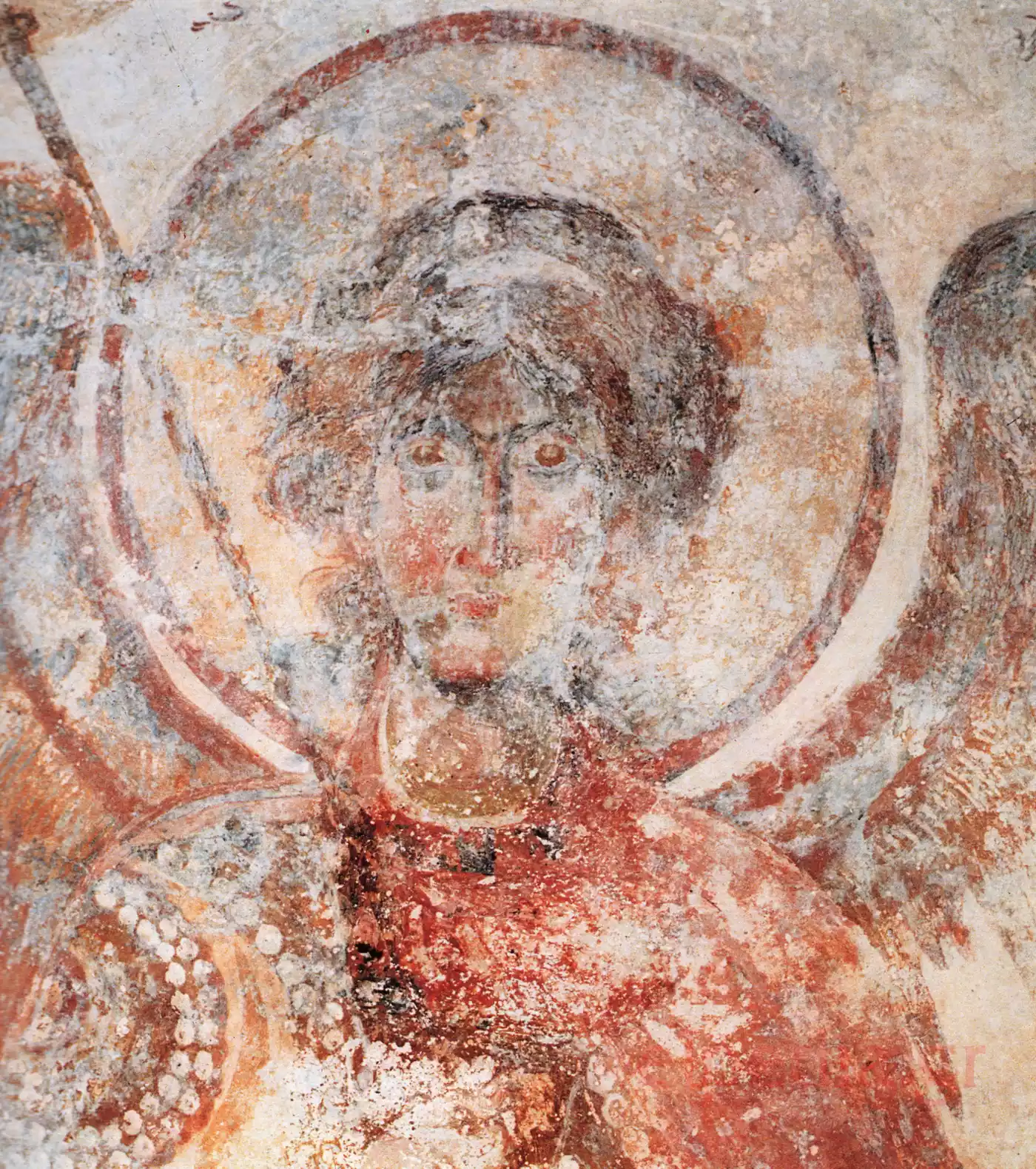
On the soffit of the eastern arch of the catholicon of Panagia Drosiani, on Naxos, there is preserved the form of an archangel dating to the 7th century AD, and considered by most scholars one of the most important examples of early Byzantine wall-painting. The painter remains anonymous, as is the case, moreover, with the greater part of ecclesiastical painting of the early Byzantine centuries.
The monastery, built most probably in the 6th century in a valley of Drymalia, is numbered among the oldest monastic foundations of the Balkans, a fact which renders its decoration a precious testimony to the development of Christian iconography before Iconoclasm. Decades of research into the earliest wall-paintings of the church have attempted to restore the chronological sequence of the successive painted layers that covered, until recently, its interior.
Beneath decorations of the 12th, 13th and 14th centuries, in the dome, in the apse of the sanctuary and in the northern apse, there was uncovered the most complete surviving iconographic programme of the pre-Iconoclastic period, together with dedicatory inscriptions attesting the patronage of numerous donors, among them a bishop by the name of Sisinios, a fact which situates the composition within a specific ecclesiastical and social context, and not within an abstract, nameless tradition. Naxos, for its part, gathers an unusually large number of Byzantine churches and chapels, many of which preserve, beneath later layers, their own fragments of early painting.
Drosiani stands out among them not only for its age but also for the extent and good state of preservation of its original programme. The church is single-chambered, triconch, with a dome of an almost conical profile, built with rough-hewn stones in the Aegean manner, without the technical refinement one would encounter in the larger urban monuments of the period.
Within this austere, almost unpractised architectural shell, the form of the archangel retains its monumentality intact, despite the extensive losses of the plaster. The text that follows examines the face, the wings and the garment of the representation, as these are preserved today, with emphasis on the style and on the traces of the technical execution.
The Archangel of Drosiani: Form, Wings and Technique
The Face and the Gaze
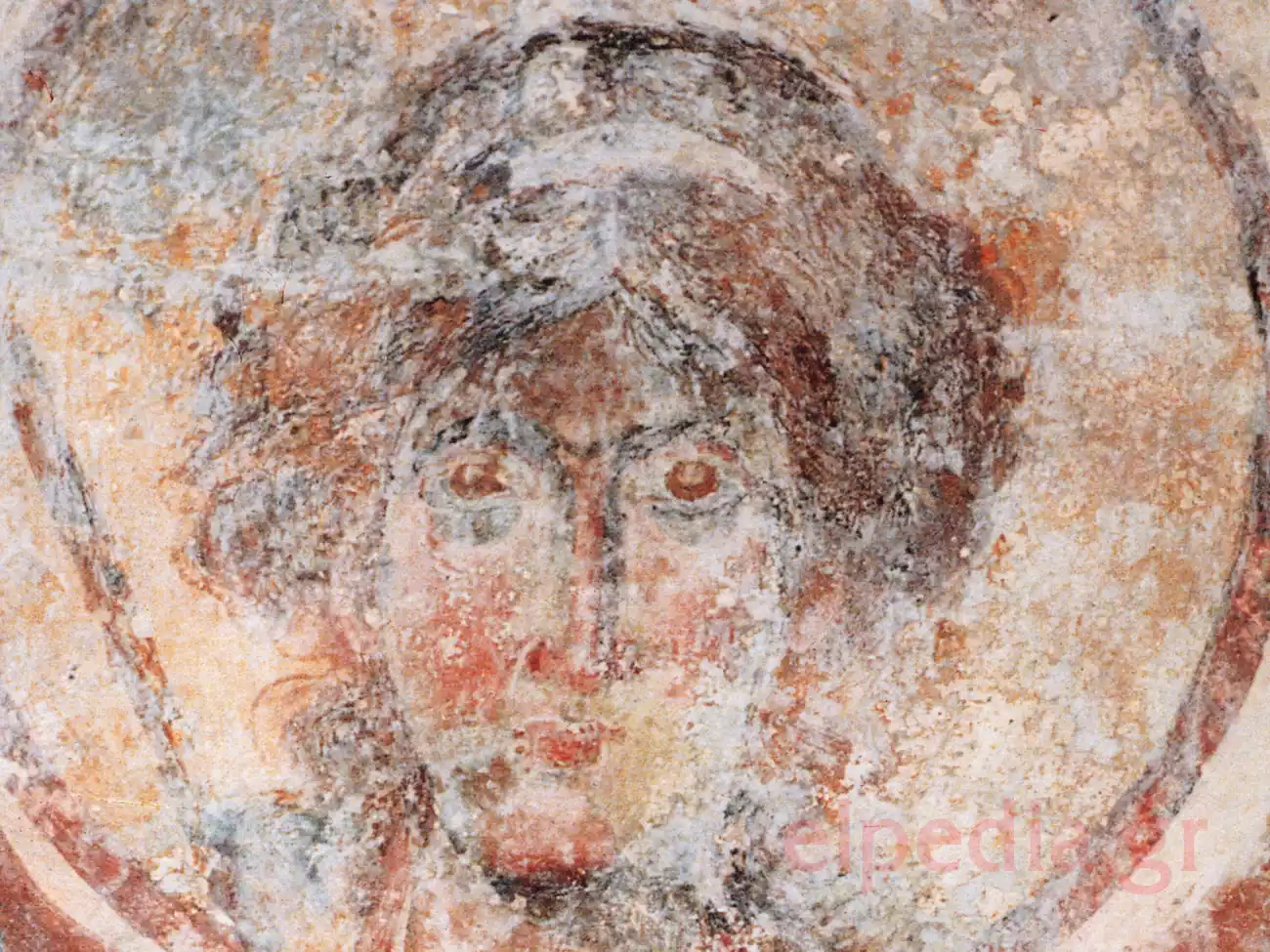
The face of the archangel is dominated by two large, almond-shaped eyes, with a dark outline and a bright, brown iris, turned directly upon the beholder. This is not a gaze calm and detached. The pupils, set slightly towards the inner corners of the eyes, create a tension that is almost anguished, reinforced by the high, almost joined eyebrows above the nose. The nose, long and straight, divides the face into two symmetrical hemispheres, while the small, fleshy mouth, painted in an intense red, stands in contrast to the pale, off-white base of the skin.
On the cheeks may be discerned broad brushstrokes of reddish ochre — a technique which gave volume and vitality to the face, following the models of the Hellenistic portrait tradition that early Byzantine painting had not yet entirely abandoned. The hair falls in dense, dark locks on either side of the face, held by a thin band across the forehead, an element which recalls imperial or angelic models of late antiquity. The halo, a double circle with an outer border in reddish colour, inscribes the figure within a space symbolic, not physical.
This insistence upon the human, almost portrait-like gaze is not the accidental choice of a provincial workshop. It recalls, in its own way, the Fayum funerary portraits and the Roman tradition of the direct, almost photographic rendering of the face — a tradition which the Christian art of the early centuries did not reject but gradually transformed, until it arrived, centuries later, at the familiar hieratic stillness of mature Byzantine iconography. At Drosiani, this transition has not yet been completed. The gaze remains alive, almost personal, in a manner that would seem strange to a viewer accustomed to the strict, frontal saints of the 12th or 13th century.
Analogous forms, though more rarely so well preserved, are to be found also in other churches of the island with pre-Iconoclastic remains, such as Panagia Protothroni and Panagia Kera, where iconographic peculiarities of the corresponding period are not met with in any other known monument of the Greek lands. The coexistence of so many early ensembles within so small a radius attests an artistic environment active and relatively prosperous already before the 8th century — something one would not easily expect of an island far from the great urban centres of the empire.
The plaster has suffered serious losses. In many places the colour has come away, leaving visible the light-coloured substrate of the render, with the result that the face today appears almost incised upon a surface of stone and light. This wear, however much it deprives the composition of detail, brings out at the same time something of the construction of the image: the drawing beneath the colour, the line before the surface.
The Wings, the Tunic, and the Wear of Time
The archangel wears a tunic of a deep, almost crimson red, a colour which in Byzantine art is often associated with courtly and angelic dress. The fabric is rendered in broad, unified fields of colour, without the complexity of folds that will characterise later, Palaiologan compositions. The wings, extended on either side of the body, are rendered by successive rows of small, round spots — a convention which recalls grapes or snowflakes, and suggests the plumage without describing it in detail.
At the edge of the composition may be discerned traces of a second figure, probably another holy person of the same iconographic programme, as well as a vertical, slender element which might belong to a rod or a sceptre. Such details, fragmentary as they are, do not allow of secure conclusions, but they attest that the figure of the archangel did not stand alone upon the wall, but was incorporated within a broader narrative of images which covered the whole of the sanctuary bema.
As regards the technique, the work follows the familiar Byzantine practice of fresco, with the colours applied upon the plaster while still wet, so that they might bind chemically with it. The earthy colours — the ochre, the red, the dark shades of brown — correspond to a palette economical, adapted to the possibilities of a provincial workshop, far from the luxury of lapis lazuli or of gold that one would encounter in courtly commissions of Constantinople. It is precisely this austerity, however, that allows the drawing to be discerned more clearly: the gesture of the painter, the manner in which the line builds the volume.
The choice of wall-painting instead of mosaic was not, in this instance, a matter of aesthetic preference but of practical necessity. A remote provincial catholicon did not possess the resources for the splendour of the golden ground and the glass tesserae that adorned the great imperial churches. Fresco, quicker in execution and incomparably cheaper, allowed a local painter, with limited means, to render equally ambitious theological programmes, bringing to the village what under other circumstances would have remained the privilege of the capital.
For centuries, none of this was visible. A large part of the monastic complex remained buried until the 1970s, when systematic excavations were carried out, whereas until then only the main church was visible. Within the interior, the same logic of concealment had already been at work earlier, with later painters covering, layer upon layer, the early decoration, perhaps without even knowing what exactly they were hiding beneath their new whitewash. The stripping away of these later layers — a task slow and hazardous for the very surface it sought to save — is what brought back into the light the face that we see today.
The wear of time has left the colour to function fragmentarily, like islets upon a sea of white and ochre. We no longer read the composition as one, but in sections, in much the same way, perhaps, as the Byzantine visitors to the church themselves once read it, in the half-darkness beneath the low dome, with the candles illuminating fragmentarily a form that was never revealed whole at a single glance.
Epilogue
Should one ask what exactly one is looking at today before this figure, the answer is not simple. One does not see an icon in the present-day sense of the term, complete and self-sufficient, but a remnant, a trace of something far greater that once covered the entire interior of the church. The face of the archangel, with its persistent gaze, seems to endure precisely because it no longer seeks to persuade anyone of anything, only to remain.
This figure is not often discussed in the international literature to the extent that its rarity would justify. It belongs to a handful of wall-paintings of the pre-Iconoclastic period that have survived across the whole of the Mediterranean, alongside examples from Rome and Ravenna, where the transition from Greco-Roman naturalism to Byzantine abstraction has not yet been completed. The gaze remains human, almost anguished, before this tension is channelled, in the following centuries, into the strict, hieratic stillness that will characterise mature Byzantine iconography.
One would hardly say that this is a major, much-discussed work, on the model of the great monuments of Constantinople or Thessaloniki. Yet it is precisely this remoteness from the great centres that explains, in part, why it survived. A provincial chapel, built hastily in a valley of Naxos, never attracted the interest that would have led to large-scale renovations or to the complete destruction of the old decoration. Obscurity, in other words, functioned in the end as a form of protection.
Today the monument stands under the protection of the competent services of the Ministry of Culture and remains accessible to the public — something that was by no means a given for an ensemble of wall-paintings that spent centuries hidden beneath whitewash and later colour. This protection does not undo the decay; it merely slows it, leaving future visitors approximately what we too see today.
What has remained of the archangel of Drosiani is not, in the end, a complete icon but a residue of dialogue, between the colour that departed and the drawing that stayed, between the anonymous painter of the 7th century and those who stand today beneath the same arch, attempting mentally to supply what time has taken away.
(This is a translation of the original Greek text; the translation was made by K. Pappas.)

