
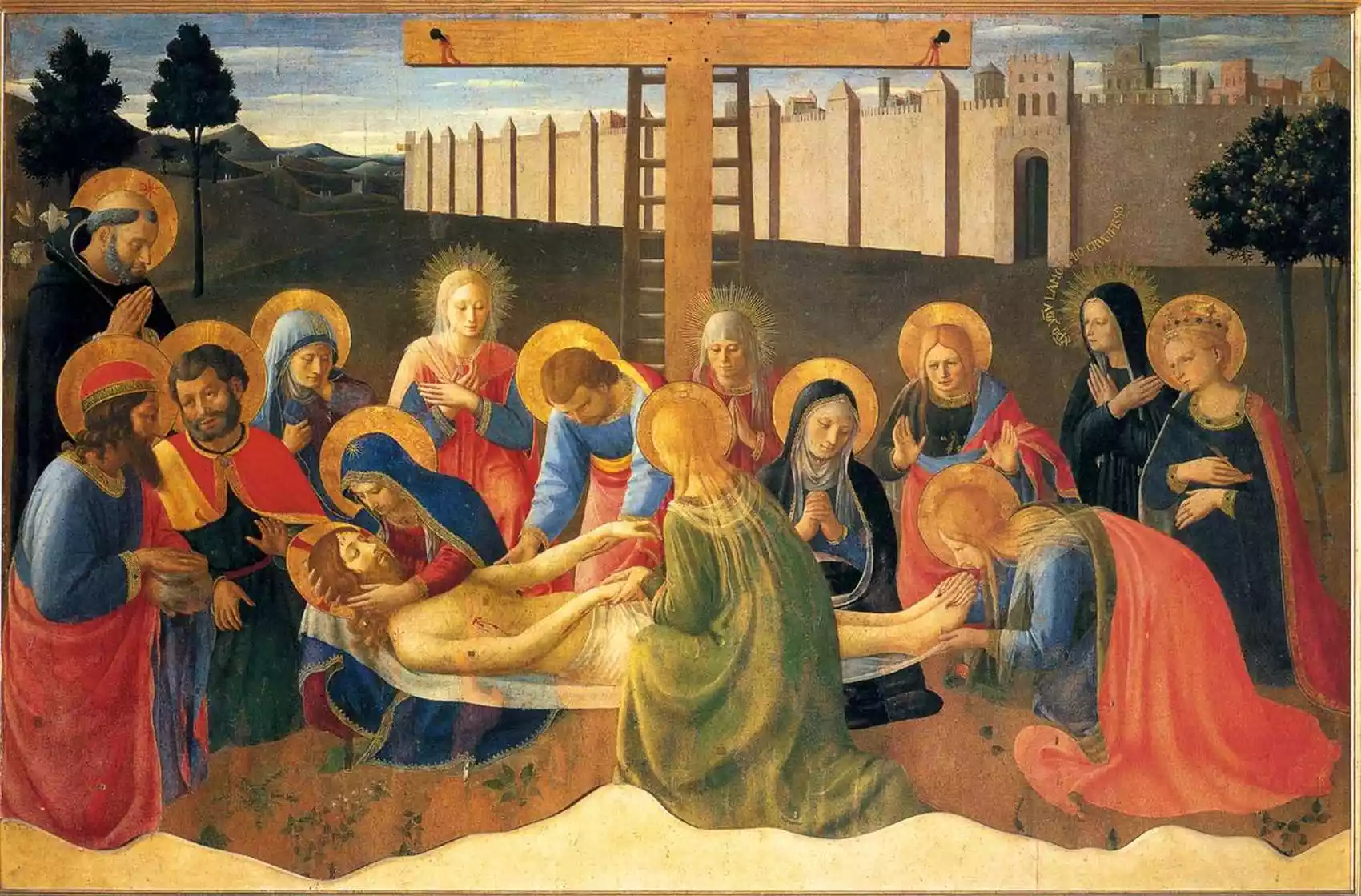
The Lamentation over the Dead Christ is one of the most mature works of Fra Angelico, executed around 1436 to 1441, in tempera and gold leaf on wood. The artist, in the world Guido di Pietro, was born around 1395 near Fiesole and became a Dominican friar long before he emerged as one of the most significant painters of the early Renaissance. The work is preserved today in the Museum of San Marco in Florence, in the very monastery where the painter lived and worked for years, leaving upon the walls of the cells dozens of frescoes intended for the brethren of the order.
The composition shows the body of Christ laid out upon a white shroud, shortly after the Deposition, surrounded by some fifteen figures, each with a golden halo and each grief rendered in its own way. Behind them the cross still stands upright, the ladder of the Deposition leaning against it, while in the background a fortified city with towers extends, calling to mind the walls of Jerusalem. The relation of this iconography to the dogmatic and spiritual tradition of the Dominican order has occupied relatively few scholars, as is recorded in a theological interpretation that attempts to read the painter’s work through its philosophical and theological background, beyond its purely artistic worth.
The Composition of the Lamentation over the Dead Christ
The body of Christ occupies the centre of the composition, laid diagonally upon a white cloth that touches the ground. Around him, the figures form two solid arcs, one to the left and one to the right, between them the Virgin, who holds the head of her son. The garments move across a scale from deep red and lapis-lazuli blue to pink and olive-green, colours heavy and saturated, standing in contrast to the pale, almost translucent skin of the dead body. Each halo bears rays incised into the gold leaf, a technique the painter had inherited from the Byzantine tradition of the icon and which here coexists, without friction, with the Renaissance disposition towards depth and volume.
Behind the mourners rises the wooden cross, empty now, the nails still visible and the ladder used for the Deposition leaning against its horizontal beam. Two dark cypresses stand to the left, a tree with dense foliage to the right, and between them opens the view towards a city with beige walls, turrets, and a gate — a landscape the viewer recognises as Jerusalem without its being named outright. The pale-blue sky, with a few small clouds, gives the scene a calm that stands in contrast to the drama of the foreground. Above the mourners, a golden inscription in Latin capital letters names the scene explicitly as a lamentation over the Crucified, an element that reinforces the didactic character of the work for those who would behold it within the monastery.
At the left edge, kneeling and in profile, a friar in the black-and-white habit of the Dominicans watches the scene with his hands joined in prayer. Above his forehead a small star may be discerned, the traditional distinguishing mark of Saint Dominic, founder of the order. Fra Angelico repeated this convention in many of the frescoes of San Marco, introducing the founder of the order as a silent witness within scenes of the Passion — not as a historical figure present at the events but as a model of recollection for the younger friars. His presence here is not explained by history; it is explained by the function that the work itself was called upon to perform within monastic life.
The Face of Christ in the Arms of the Virgin
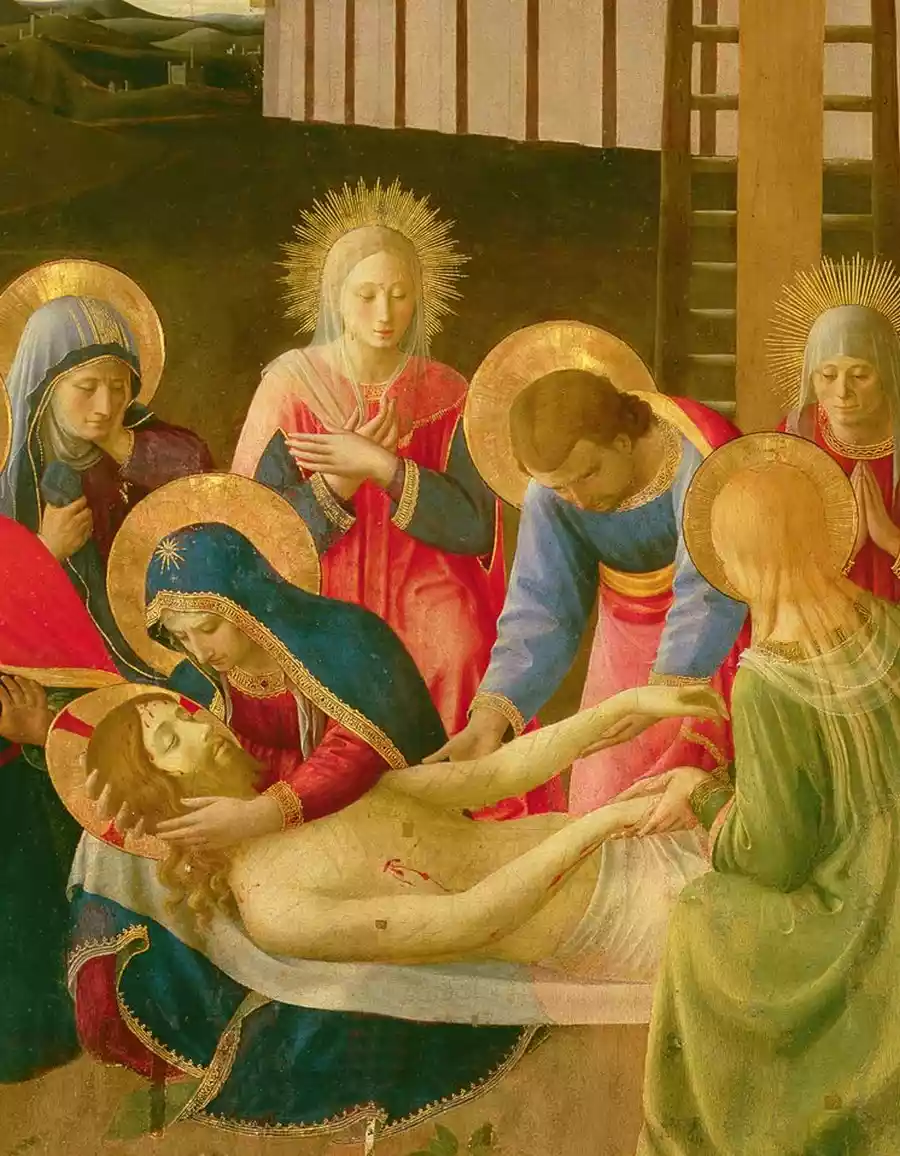
At the very centre of the composition, the head of Christ rests upon the hands of his mother. His eyes are closed, his features slack, without the slightest exaggeration in the rendering of pain. A few red marks upon the chest and small lines upon the brow, remnants of the crown of thorns, are the only traces of violence the painter allowed himself. The beard is sparse, the hair falls in brown curls, and the whole face appears wrapped in a calm that calls to mind sleep rather more than death.
The Virgin, her deep-blue veil bearing a small golden star upon the shoulder, bows her head downward, in a grief restrained, without dramatic gesture. This star, a symbol traditionally bound to her title as Stella Maris, recurs in many of the painter’s works and functions here almost as a signature. Behind her, a female figure in an orange garment, her hands crossed upon her breast, expresses anguish more intensely, while beside her a man in a pale-blue tunic, probably John, bends to touch the arm of the dead man. His movement holds nothing theatrical; it resembles rather a gesture of tending than an expression of despair.
An elderly woman in a greyish veil watches from the left, her hands joined, her gaze fixed upon the face of the dead man. At the right edge of the frame the back of a female figure in a green garment may be discerned, a thread that connects this portion of the composition with what is taking place at the feet of Christ. The soft gradation of tones in the skin, without harsh shadows, remains among the most recognisable features of the manner in which Fra Angelico rendered the human face.
The Feet of Christ and the Lament of Mary Magdalene
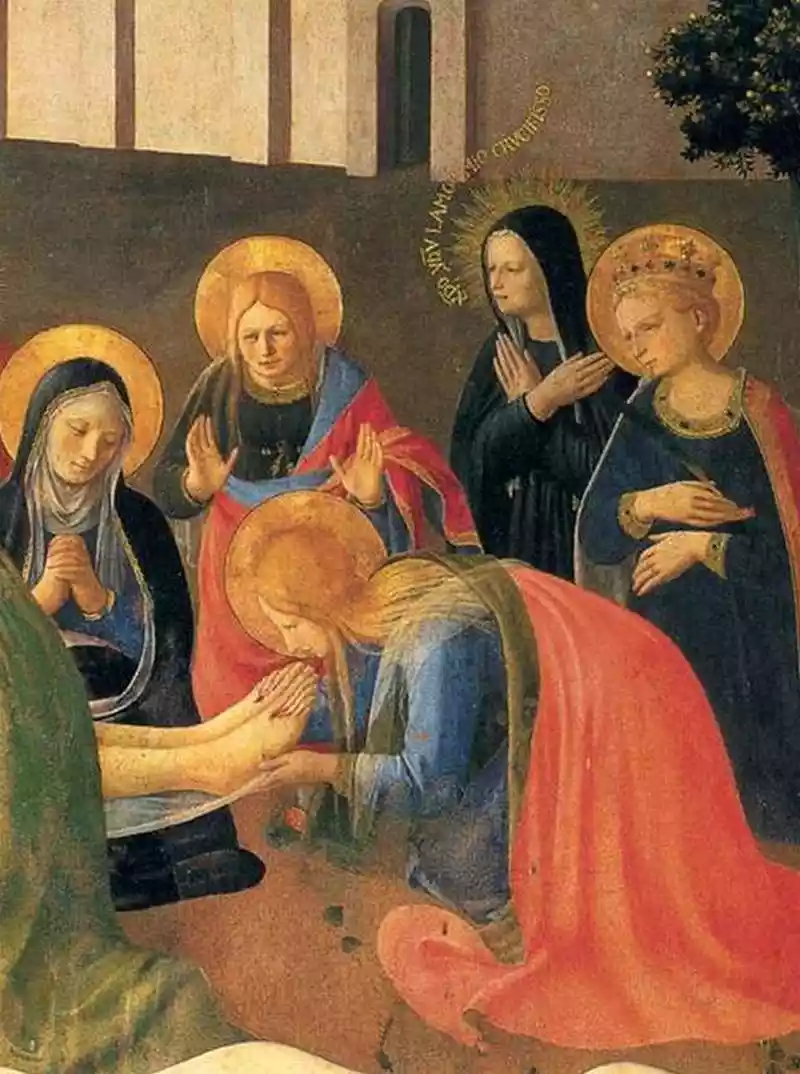
At the opposite end of the shroud, a kneeling female figure bends low over the feet of Christ, holds them and kisses them, her fair hair loosed and falling upon her shoulders. The absence of any covering upon the head, unusual among the remaining female figures, all of whom wear veils, constitutes the traditional iconographic element that leads to her identification as Mary Magdalene. Her deep-red mantle, cast over a pale-blue garment, creates the most intense chromatic note in the whole composition.
The feet of Christ bear two small red wounds near the sole, traces of the nails, rendered with the same discreet restraint that marks the remaining details of the body. Behind the kneeling figure, a group of women watches, standing. One elderly woman in a dark-toned veil has her hands joined in prayer; another, in a red garment, raises hers in a more open gesture of lamentation; while a third, in a black veil, stands silent. At the far right, a figure crowned and richly dressed in red and gold likewise bears a halo, probably some saint of royal descent, though her identity cannot be established with certainty from what survives in the work.
Above their heads, the golden inscription naming the lamentation continues, written in Latin capitals upon the wall of the city, between narrow openings typical of fortified architecture and a tree projecting above the wall. This detail, often overlooked at a first glance over the work as a whole, functions like a label explaining to the viewer precisely what he beholds, in accordance with a practice common in the religious painting of the period.
The Lamentation over the Dead Christ gathers up much of what made Fra Angelico a landmark in the history of Florentine painting. The Byzantine inheritance of the icon, with its golden haloes and the flat brilliance of the background, coexists with a new conception of space, in which the landscape acquires depth and the figures volume — elements that scarcely any painter before him had managed to combine with such naturalness. The choice to incorporate a friar of his own order within a scene of the Passion is no mere artistic convention. It reflects the manner in which painting itself functioned within a monastery, as an instrument of recollection and prayer for the brethren who passed before it daily.
The restraint in the rendering of pain, both in the face of Christ and in the gestures of the mourners, sets the work apart from many contemporary depictions of the same subject in other regions of Italy, where dramatisation often reached extremes. Fra Angelico preferred a version of the lamentation restrained, almost silent, in which anguish passes through the gaze and the bearing of the body rather than through emphatic gestures. This choice, which many scholars connect with the spirit of Dominican spirituality and its emphasis upon inward recollection, explains in part why the work continues to be studied not only as an artistic document but also as a source for understanding the theological thought that shaped one of the most significant painters of the early Renaissance.
(Translation from the original Greek text, by K. Pappas.)

