
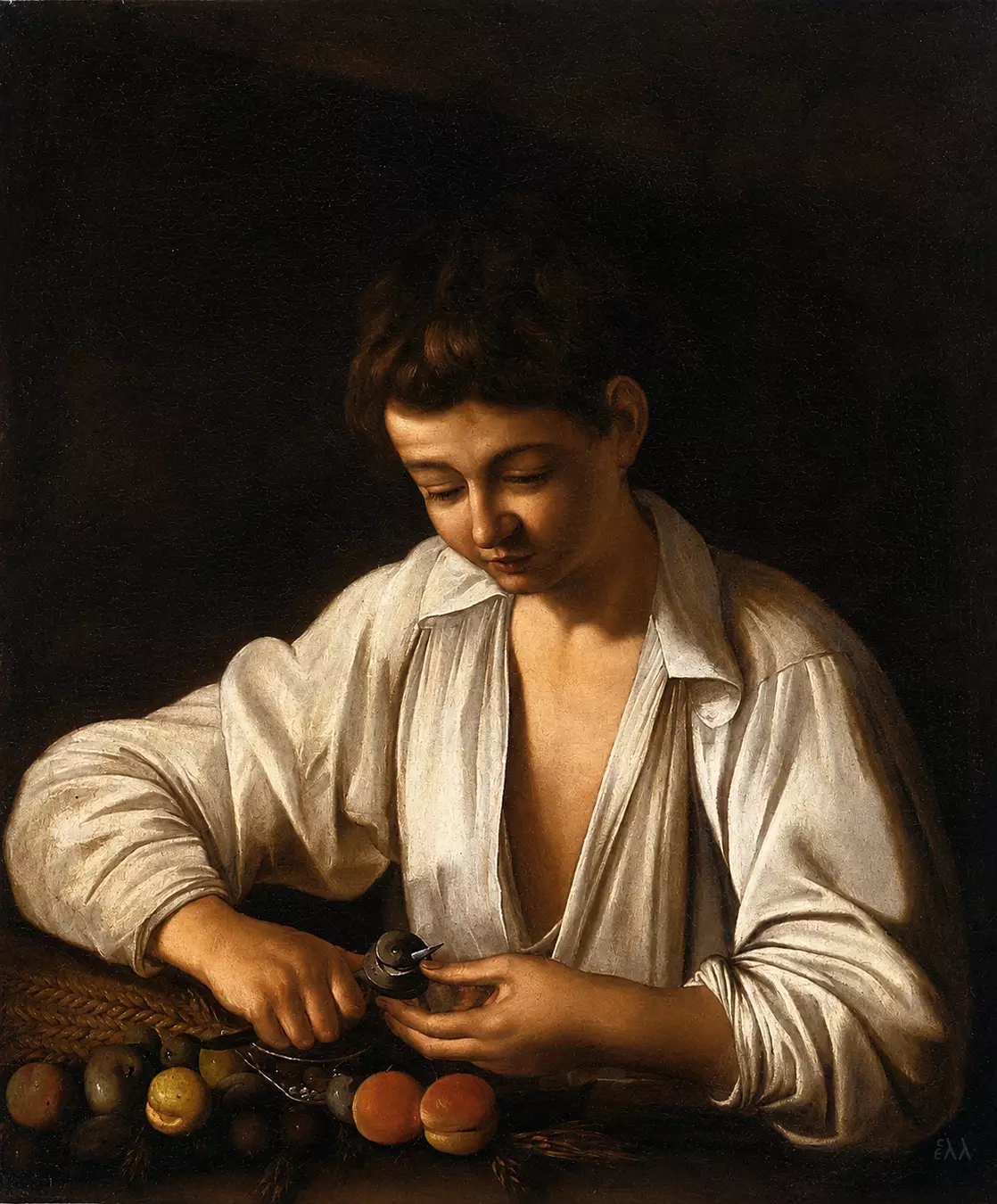
A boy bends over a dark table, his fingers wrapped around a fruit, as he intently watches the blade of a knife slide beneath the peel. This is Boy Peeling Fruit, a work painted by Michelangelo Merisi, known as Caravaggio, around 1593, shortly after his arrival in Rome from his native Milan. It is considered—according to several scholars—the oldest known work of the artist, executed in oil on canvas measuring 76 by 64 centimetres, and is kept today in the Roberto Longhi Foundation for the History of Art in Florence. The composition, far from any religious or mythological pretext, records a simple, daily gesture: an adolescent absorbed in his labour, illuminated by a source that remains unseen, while around him the darkness spreads almost absolute.
The shirt, open at the chest, slips upon the shoulder of the youth with a naturalness that already betrays the disposition of the painter to observe the body without beautification; an element that will seal the entirety of his work in the years to come.
Boy Peeling Fruit: Observation and Technique in the Early Art of Caravaggio
The light falls obliquely from the left, licking the forehead, the cheeks, and the curly locks of the boy, before it is lost in a background that reveals nothing; neither wall, nor window, nor trace of space. The face, calm and utterly concentrated, does not look at the spectator. It looks at the fruit.
The Garment and the Movement of the Body
The shirt of the boy, white and light, slips from the right shoulder revealing part of the chest. The sleeves, puffed and full of folds, attest to the capacity of the young Caravaggio to render the fabric with a density almost sculptural. The posture of the body, slightly oblique, creates a diagonal line that leads the gaze from the shoulder unto the hands—the point where all the action of the composition is concentrated.
The Fruits and the Detail of the Knife
Concentrated in the foreground, upon a straw mat, various fruits have been spread: dark plums, a pale fruit resembling a pear, two round fruits in a strong red-orange tone. The identity of the fruit that the boy peels remains, unto today, an object of debate among scholars; some propose that it is a pear, others incline towards a citrus. The knife, held tightly between the fingers, gleams discreetly as it reflects the very light that bathes the face, binding visually the two points of the composition which could, in less dexterous hands, remain unconnected. In this work is recognised today the first mature attempt of Caravaggio to combine portrait and still life in a unified composition, a practice he will repeat, shortly after, in Boy with a Basket of Fruit. The painter has merely arrived in Rome, working perhaps still on behalf of the Cavaliere d’Arpino, and this work—modest in dimensions but by no means secondary in its technique—seems to have functioned as a token of ability upon canvas.
(This is a translation from the Greek text and the translation was done by K. Pappas.)


