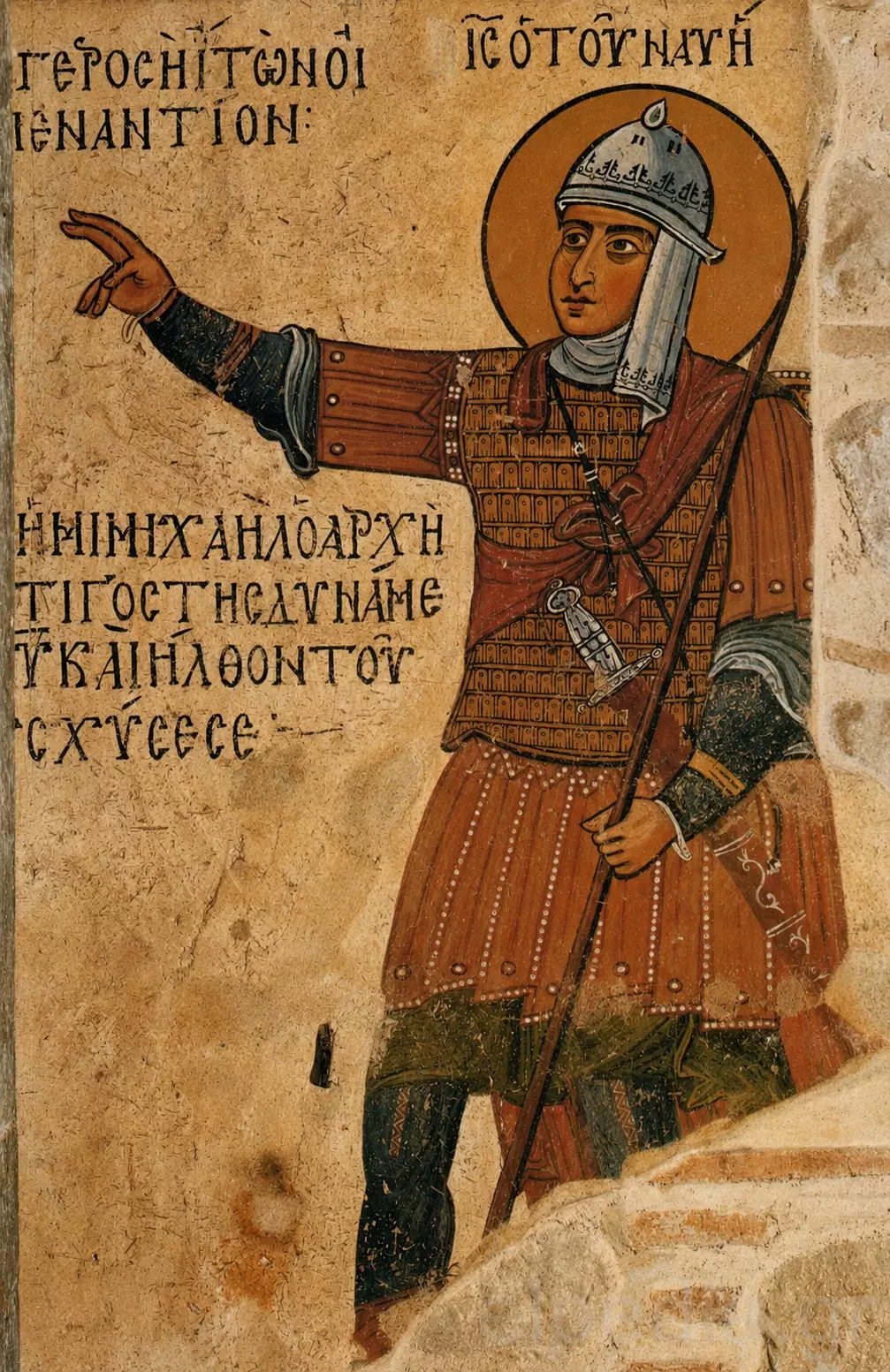
Beneath the marble slabs that covered for centuries the eastern wall of the northern cross-arm, in the katholikon of the monastery of Hosios Loukas in Phocis, was revealed the oldest fresco that survives today in the monastery. The armed youth with the halo and the silver helmet, who is depicted in a moment of intense dialogue with an invisible person, is identified with Joshua son of Nun, the successor of Moses in the leadership of the Israelite people, shortly before the siege of Jericho. Dated to the second half of the 10th century, the composition belonged initially to the decoration of an older and smaller church dedicated to the Virgin Mary, which functioned beside the shrine of the tomb of the venerable one, before this church was incorporated, around 1011, into the large octagonal katholikon that we admire today.
Painted initially upon an external surface, at the southern end of a two-columned narthex, the representation remained unknown until the restoration of 1964 brought it once again to light. The episode which it illustrates, the appearance of the archangel Michael to the young military commander, is drawn from the homonymous book of the Old Testament and is connected, according to the tradition of the monastery, with a prophecy that Hosios Loukas himself had formulated concerning the liberation of Crete from the Arabs in 961. It is not an image of devotional use in the usual sense, so much as a piece of documentary evidence of high-level middle Byzantine painting, which reveals a direct kinship with a workshop of Constantinople and converses, in the delicacy of its execution, with the rich sculptural decoration of the same church.
Joshua son of Nun: Byzantine Art and Iconography at Hosios Loukas
Upon a whitish ground, without the deep blue that will be established later as the conventional background of Byzantine compositions, the figure of the young military commander stands erect. He wears a military uniform embellished with pearls, a cuirass of overlapping scales, a belt with a sword at the waist and a shield hung back upon his shoulder, while he holds the spear in a comfortable, almost relaxed posture with the one hand, the other raised in a gesture of speech towards the archangel Michael, who is no longer preserved in the section that has survived.
The painter renders him with youthful vigour and the beauty of a monumental, flawlessly modelled figure, elements that refer to the serene mood and the classical harmony which characterise the art of the 10th century. Above his head, among fragmentary inscriptions that once conveyed the dialogue between the two persons, the identifying inscription ‘IS TOU NAVI’ is read clearly, while in another point of the composition there survive verses that refer to the power of Michael and to the invincible army of the Lord, without however one being able today to reconstruct with certainty the full text of the dialogue.
The subject, beloved in the 10th and the 11th century, is not rare in fresco cycles dedicated to the archangel Michael. It signifies, in its essence, the spirit of triumph of victorious campaigns, something which explains why it was chosen here, in a space connected with prophetic acts of the founder of the monastery. Joshua son of Nun, as a warrior of the faith whose help was considered efficacious in the wars against the Arabs, fits conceptually with the memory of the recapture of Crete, an event that Hosios Loukas had foretold many years before it was realised. The pseudo-Kufic ornaments that run across the helmet and the neck-guard, imitating Arabic calligraphy without semantic value, belong to the same conception of decoration that floods the splendid sculptural decoration of the church of the Virgin Mary, a fact that strengthens the hypothesis that the painter of this section had a direct relationship with the capital.
Detail of the Face: The Gaze and the Helmet of the Warrior
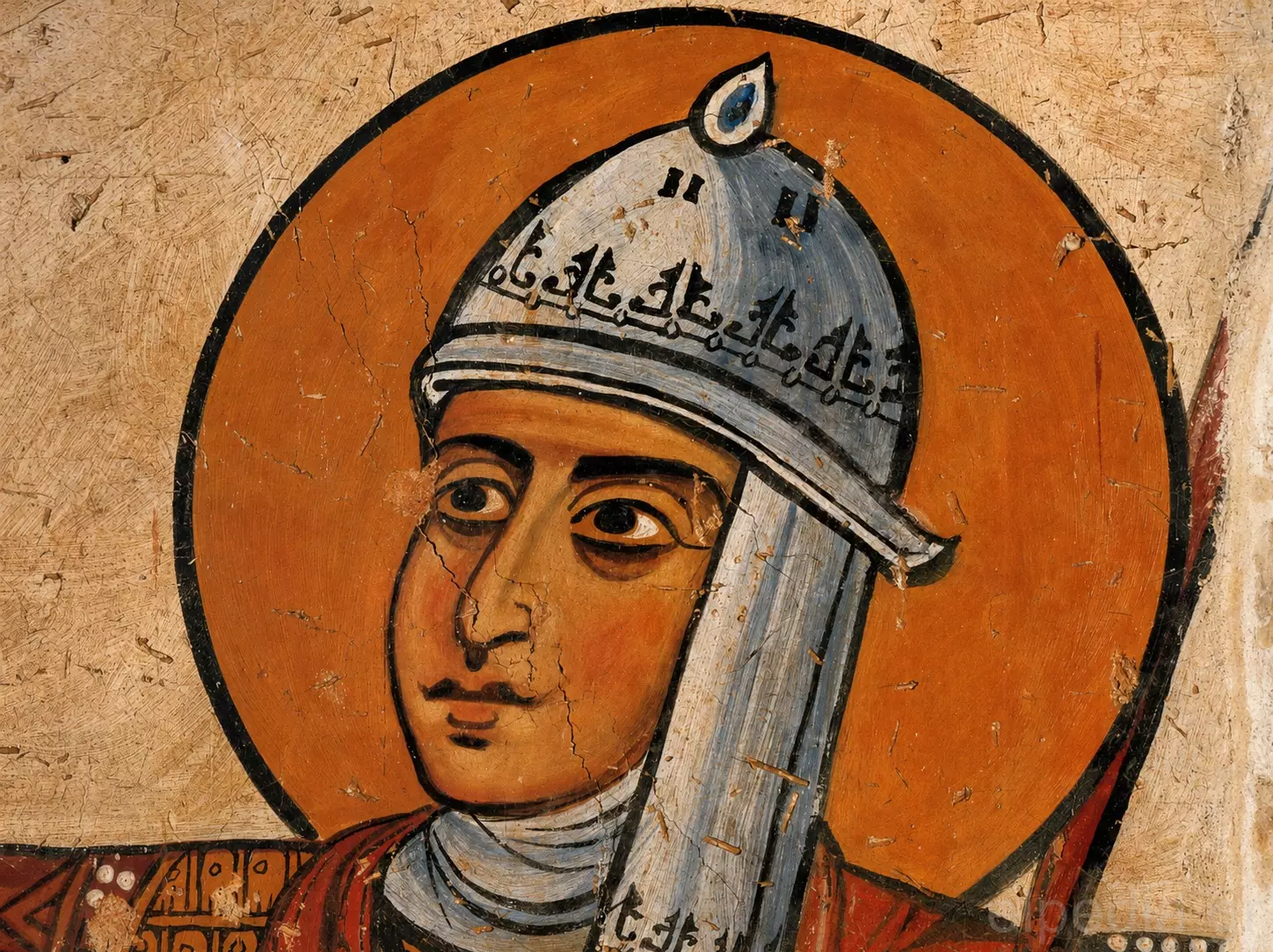
Approaching the face, one discerns a work of subtle chromatic gradation, where the chestnut-red of the complexion passes, on the cheeks and around the eyes, into darker tones that model the volume without harsh contour lines. The eyes, large and almond-shaped, with a pronounced black outline on the eyelids, look sideways, with an expression of attention that does not reach the intensity of fear; it is the gaze of someone who listens, not of someone who is frightened.
The mouth, small and closed, with slightly fleshy lips, completes a physiognomy where youth is rendered more through the softness of the modelling rather than through some explicit anatomical element. The helmet, conical and pointed, culminates in a small peak in the shape of a teardrop, while a narrow ribbon with the same pseudo-Kufic motifs runs across its base, exactly above the forehead. At the side are discerned two small rectangular symbols, perhaps remnants of a decorative inscription or simply stylised ornaments, without their secure reading being possible today.
A long, silver neck-guard falls at the side of the neck, covering the nape in a manner that recalls a precious fabric more than a metallic protection, a detail that reveals how much the painter was interested in rendering the luxury of the equipment as much as its function. The red ground of the halo, intense and warm, envelops the whole of the head like a solar disc, visually emphasising the holiness of a person whom the Old Testament presents primarily as a leader and a military man.
This composition, the unique surviving specimen of fresco from the first phase of decoration of the monastery, remains among the very few pieces of documentary evidence that permit the pictorial production of Constantinople in the 10th century to be discussed with some certainty, an epoch for which surviving monumental works are exceptionally rare. Its juxtaposition with the mosaics and the sculptural decoration of the same complex shows an artistic world internally coherent, where the same aesthetic conception passed from the one material to the other without perceptible rupture.
(Translated from the Greek text by K. Pappas)


