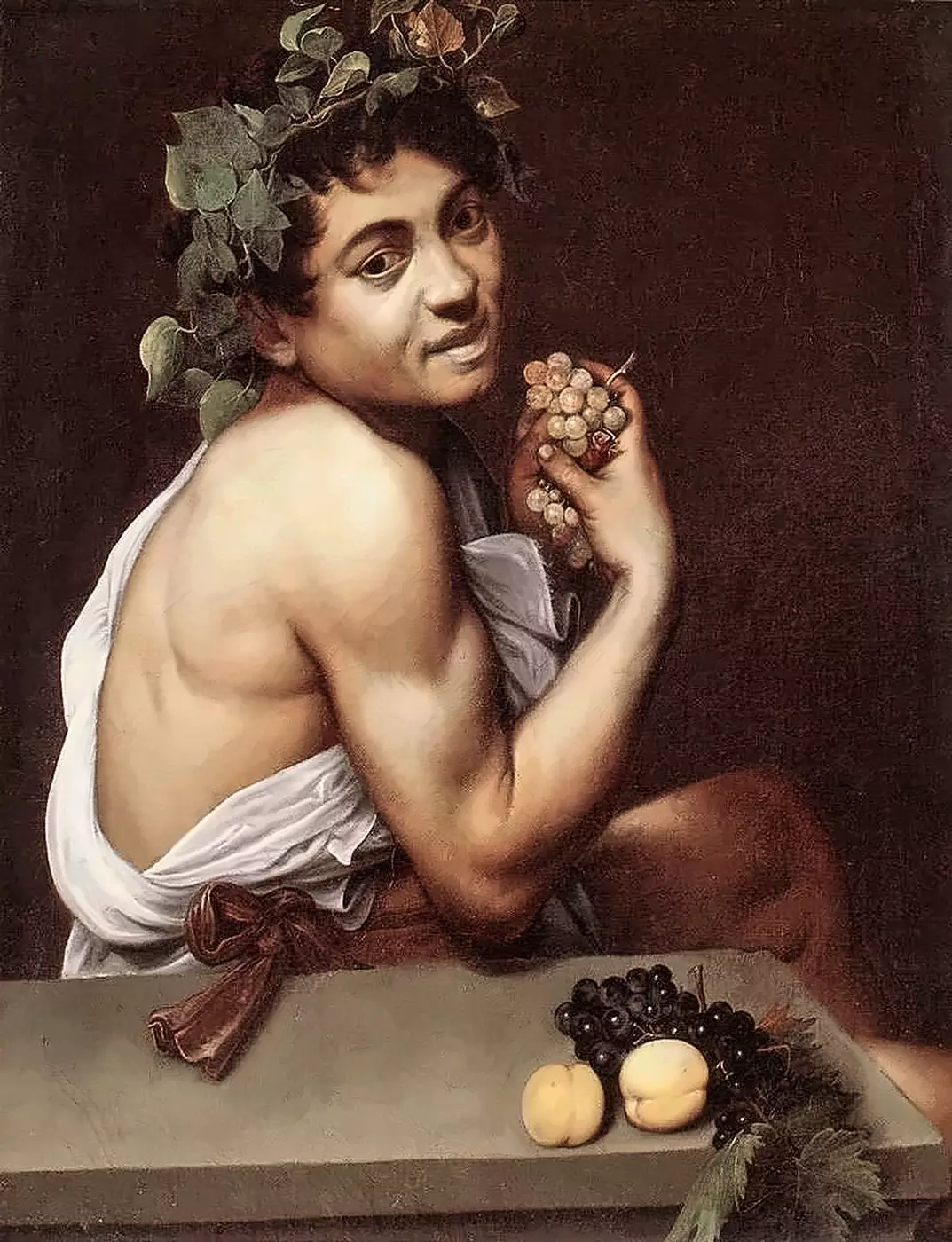
A youth with curly black hair and a wreath of ivy leaves turns his head toward the viewer, whilst his naked body, pale and almost greenish, betrays something unsuited to the image of a god. This is the Sick Bacchus—known in Italian as Bacchino Malato, a work painted by Michelangelo Merisi, Caravaggio, around 1593 during his early years in Rome—kept today, an oil on canvas measuring 67 by 53 centimetres, in the Galleria Borghese.
In one hand the youth holds a bunch of grapes; a white cloth covers part of his torso, tied with a dark ribbon at the waist. The identity of the youth has occupied art historians for decades; many consider it to be a self-portrait, executed possibly with the aid of a mirror, as the first biographer of the artist, Giovanni Baglione, records. The work belonged initially to the collection of Giuseppe Cesari, known also as Cavaliere d’Arpino, employer of Caravaggio at that period, before ending up in the collection of Cardinal Scipione Borghese.
The Sick Bacchus as a Portrait of a Difficult Era
Shortly after his arrival in Rome from Milan, around the middle of 1592, Caravaggio spent a period of hospitalisation in the hospital of Santa Maria della Consolazione.
With this hospitalisation, art historians, Roberto Longhi among them, have connected the peculiar skin colour on the face of Bacchus, assuming the painter recorded himself whilst recovering, probably from malaria. It is not the mythological radiance that dominates here, but something more human, almost awkward.
The Face and the Gaze
The gaze of the youth does not look straight ahead; it is turned sideways, the lips half-open in an expression oscillating between a smile and discomfort. Beneath the eyes a slight recession of the skin is discerned, whilst the colour of the face takes on a yellowish tone that intensifies at the neck. The wreath of ivy leaves, a characteristic symbol of Bacchus and his retinue, is wrapped around the dark hair with a negligence that appears deliberate, almost as if it had only just been placed there. Nothing is embellished here by the painter. Not even himself.
The torso twists in a manner leaving his right shoulder bare, whilst the head turns back over it, creating a torsion reminiscent of a snapshot rather than a staged pose. From the shoulder the white cloth slips and falls loosely around the waist, tied there with a rust-coloured ribbon. A rust-coloured ribbon that is rarely commented upon, yet adds to the whole a sense of improvisational haste, as though the garment were hastily wrapped around a body lacking the time or inclination for anything more formal.
The Hand with the Grapes and the Still Life
Near the chin the left hand rises, holding a bunch of grapes in shades of green and pink, with a few berries having already fallen and hanging loosely. The stem is gripped by the fingers with a naturalness departing from the rigidity of early portraits of the period.
Spread out in the foreground, upon the stone surface, are two peaches and a bunch of dark grapes, beside a leaf that appears half-withered at its edge. The rendering of the light upon the skin of the fruit already heralds techniques the artist would later evolve in works such as the Boy with a Basket of Fruit, where the still life acquires greater precision and plasticity.
The Art of Caravaggio behind the Sick Bacchus
Dark, almost impenetrable, remains the background—a technique Caravaggio would make a trademark of his painting in the ensuing years. The light falls obliquely, intensely illuminating the face and the shoulder, whilst leaving the remainder in a shadow not fully explained. This is not yet the mature, dramatic chiaroscuro of his later religious compositions, but the seed is already here. Some scholars have proposed that the figure could be identified with a satyr rather than with Bacchus himself, given that the ivy wreath constituted a common feature of the god’s retinue.
Whatever the precise identity of the figure, the work functioned in all probability also as a demonstration of skill, a calling card of the young painter to potential patrons, proving he could handle with equal conviction the portrait, the still life, and the classical theme of antiquity. Amidst all its physical imperfection, the Sick Bacchus remains one of the most honest works the artist left us of himself.
(This is a translation from the Greek text, translated by K. Pappas.)


