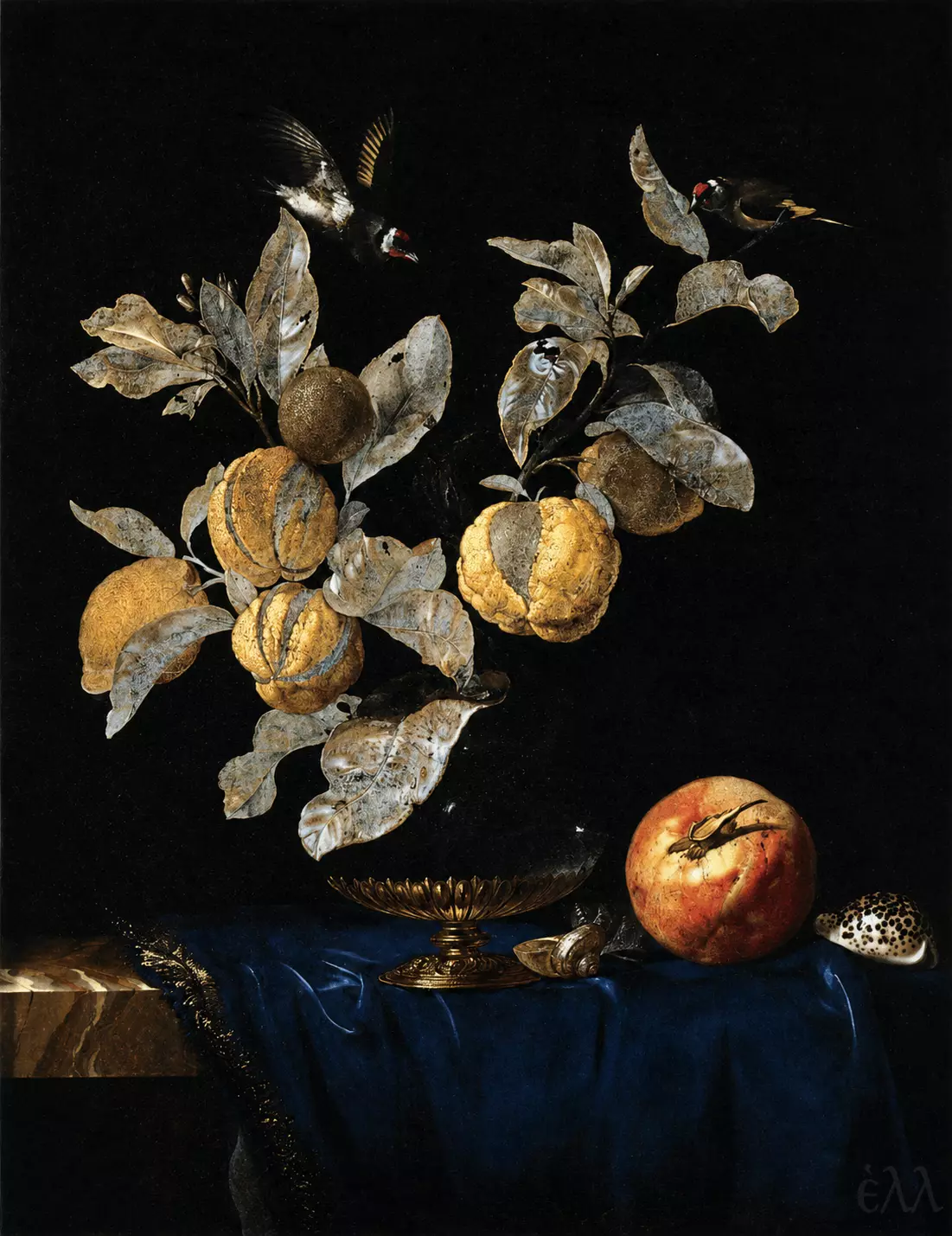
Into a nearly black field rises a branch laden with heavy citrus fruit, its pale leaves and rough skins interrupted by the sudden movement of small goldfinches. Willem van Aelst built this unusually spare arrangement in Still-Life with Fruit, painted in 1664 and now in the Museo Thyssen-Bornemisza, Madrid. The oil on canvas, measuring 67 × 52 cm, belongs to the mature phase of a painter who had made the still life one of the most technically exacting forms of seventeenth-century Dutch painting.
Little occupies the lower half of the canvas, yet very little feels empty. A deep blue cloth falls across the table, catching light in narrow folds; above it stands a low vessel whose glass bowl and metal mounting answer light in different ways. To the right lie a large reddish-yellow fruit and a spotted cowrie shell. From the vessel the composition expands abruptly upwards. Citrus branches extend diagonally, bearing wrinkled yellow fruit, darker rounded forms and leaves turned at different angles, some catching a cold silvery illumination, others almost disappearing into the background.
Van Aelst’s control of such materials and his preference for carefully balanced yet asymmetrical arrangements belong among the qualities explored in the 2012 monographic catalogue devoted to his still-life painting. In this canvas the refinement is evident, though refinement does not mean immobility. Fruit weighs down the branches; birds dart through them; leaves turn, overlap, recede. Beneath all this movement, the blue cloth and narrow table edge establish a low, quiet horizontal base.
Still-Life with Fruit: asymmetry, light and material contrast
The composition depends upon an imbalance calculated with considerable precision. Van Aelst does not establish a conventional central bouquet whose mass expands evenly towards both sides. The principal cluster bends towards the left before separating into thinner branches above, while a second extension rises towards the upper right. Between them opens a broad interval of darkness. What might have been treated merely as background becomes an active part of the pictorial structure, separating forms, sharpening contours and allowing the smallest movements to register.
Most striking is the relation between weight and suspension. The citrus fruit appears dense, irregular, almost cumbersome. Several specimens hang so heavily that the branches supporting them are difficult to follow once they enter the dark ground. Leaves, by contrast, seem exceptionally light. Their surfaces alternate between grey-green, brown and pale silver according to their angle to the illumination, and their curling edges break the larger masses of fruit into a succession of smaller rhythms. At the top, the goldfinches carry that fragmentation further. One rises with wings spread; another is caught in lateral movement; others occupy branches or pass between them. Their red, black and white head markings punctuate an otherwise restricted chromatic range.
The effect is not disorder. Across the apparently irregular distribution of branches runs a sequence of diagonals that repeatedly directs the eye towards the centre and then releases it towards the upper corners. Van Aelst could therefore maintain a composition open and asymmetrical without allowing it to lose equilibrium. Dark passages are particularly important, since a branch disappears and re-emerges, a leaf projects strongly while the next almost dissolves, and visibility itself becomes something the painter treats as variable rather than fixed.
Below, the character of the painting changes. The blue cloth forms a concentrated zone of colour, saturated but kept largely in shadow. Its folds are neither numerous nor theatrically enlarged. They provide a soft surface against which the hard reflective materials of the vessel become legible: transparent glass above, metal below, each receiving a different kind of highlight. Beside them the spotted shell introduces another surface altogether, smooth, compact, patterned with minute dark markings. The large fruit nearby, warm in colour and marked by an irregular opening at its upper surface, serves as the strongest chromatic counterweight to the citrus suspended above.
These changes of substance are central to Van Aelst’s pictorial language. Glass, metal, textile, rind, foliage, feathers, shell: each asks for a different handling of paint, and each remains recognisably distinct without being isolated from the whole. The blue cloth reflects faintly into neighbouring shadows, pale leaves echo the cool lustre of the glass, and warm yellow fruit finds a quieter response in the reddish form below, so that material description and compositional organisation proceed together rather than as separate concerns.
At the far left, only a small section of the supporting table becomes visible beneath the cloth. Its polished, veined surface and turned support emerge briefly before darkness absorbs them. Van Aelst has brought the objects close to the front edge, making the lower boundary of the still life unexpectedly precarious. Above this narrow foothold rises an arrangement increasingly dispersed, airy, animated, so that support below gives way to instability above, and concentrated colour below opens onto scattered points of light among the branches.
Nothing requires the individual objects to be forced into a fixed symbolic programme. Their visual relationships already carry considerable meaning as painting. Fruit at different stages of ripeness, leaves blemished and folded, active birds, luxury materials, a shell placed almost ceremonially upon blue cloth — the ensemble invites sustained looking before interpretation. What Van Aelst makes dominant is the act of discrimination itself: one texture from another, one degree of light from the next, forms solid and forms nearly lost in darkness.
(The translation was edited by N. Jones.)