
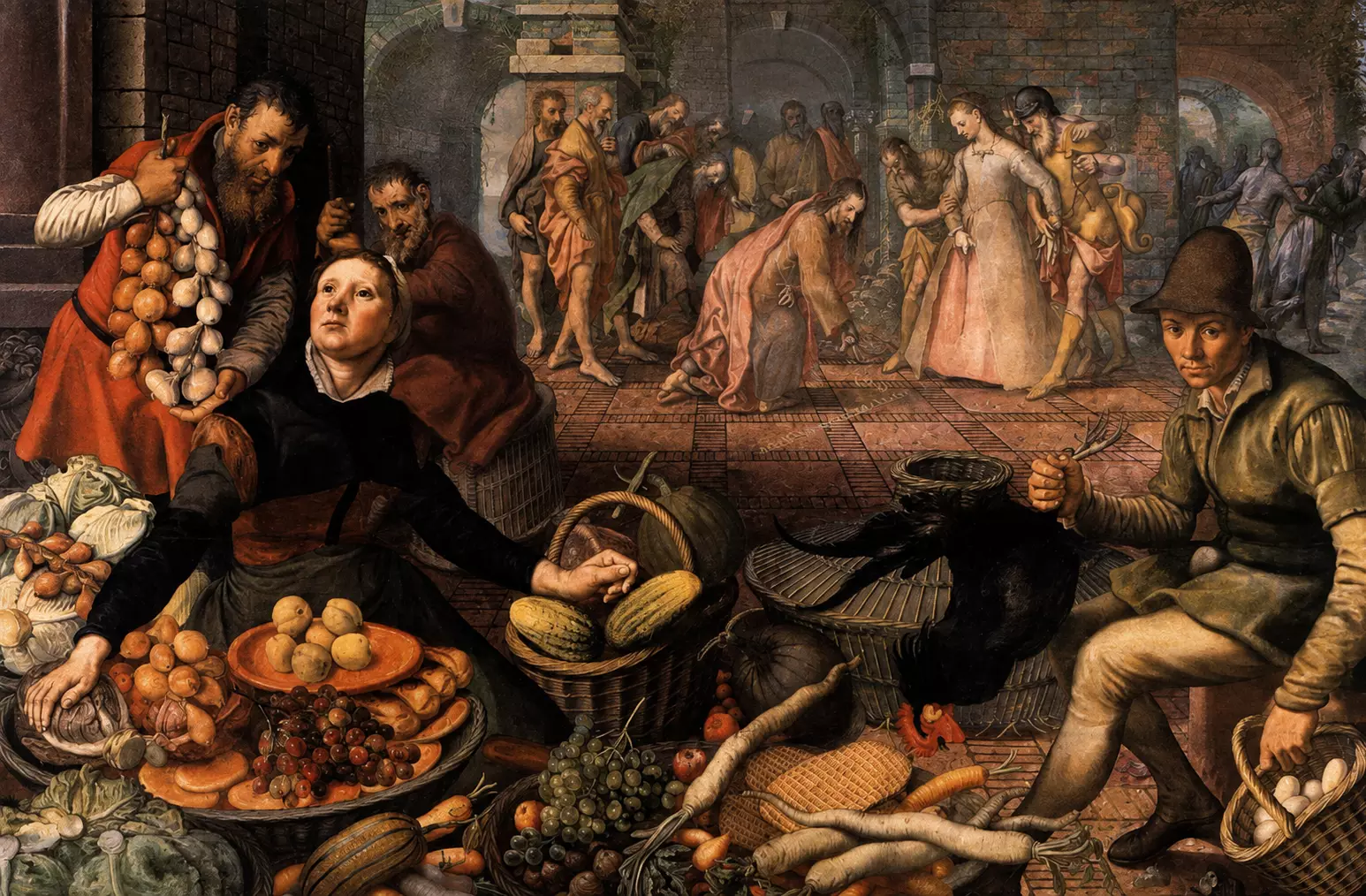
Overwhelming the visual field before any narrative context can be established, a chaotic accumulation of harvest produce demands immediate attention. In Pieter Aertsen’s Christ and the Adulteress, executed in 1557–58 and currently housed in the Nationalmuseum in Stockholm, the conventional hierarchy of Northern Renaissance painting is deliberately overturned. The panel, measuring a substantial 122 by 178 centimetres, belongs to a radical pictorial tradition pioneered by Aertsen, commonly referred to as the inverted still life. Here, the ostensible biblical subject is relegated to the distant background, while the foreground is entirely consumed by a monumental, aggressively secular market scene. Woven baskets, heavy earthen pots, vegetables, fruit, bread, eggs and poultry obstruct the eye before the spiritual focal point of the composition can be found.
This compositional inversion creates a profound visual friction. The viewer is suspended between the tangible, meticulously rendered reality of earthly provisions and the remote, hushed gravity of the sacred narrative. Painted in oil on wood, the work evokes the restless dynamism of a sixteenth-century market, projecting a sensory immediacy that threatens to eclipse the theological episode concealed within its architectural depths. During this period, Antwerp was a flourishing centre of international commerce, a city in which wealth circulated through an expanding trade in commodities. Against this urban culture of abundance, Aertsen’s pictorial innovation turns objects of appetite into vehicles of moral scrutiny. The painting offers no simple, unified reading. Material attraction occupies the foreground; spiritual judgement, the distance.
The Architecture of Abundance: The Foreground Marketplace
Across the uneven brick floor, beneath the shadow of a heavy masonry archway, amid baskets, platters and scattered goods, market produce spills out in overwhelming abundance. Aertsen constructs what is almost an architectural barrier of commodities, forcing the viewer to confront the materiality of the physical world before reaching the smaller narrative beyond. Huge, pale green cabbages anchor the lower left corner, their crinkled leaves painted with sharp, nearly tactile precision. Beside them, root vegetables, carrots and dense gourds form a formidable barricade, cascading towards the lower edge of the panel. Monumental in scale, these objects dwarf many of the distant human figures and determine the spatial weight of the entire lower register. Their irregular shapes also interrupt any smooth recession into depth: rounded melons, long roots, folded leaves, wicker rims, all pressing towards the picture plane.
To the right of this agricultural deluge sits a young vendor on a low wooden block. He wears a muted green doublet and a dark, soft-brimmed hat. With his right hand he grasps the legs of a large black rooster, while his left supports a woven basket filled with pale eggs. His posture is relaxed but attentive, his gaze directed outward and obliquely towards the viewer. The rooster has been interpreted as a sexual allusion within the erotic vocabulary of Aertsen’s market imagery, sharpening the moral undertone of the surrounding abundance. Between the young man and the sprawling vegetables, the space is crammed with a bewildering variety of goods. A flat woven platter holds rounded loaves of bread, their crusts dry and matte; bunches of dark grapes, apples and other fruit press against baskets and shadows. Nearby, the bird’s dark plumage cuts through the lighter vegetables and wicker. Almost no empty space survives in the foreground, a compression that contrasts sharply with the recession of the courtyard behind.
Detail Analysis: The Market Vendors and Earthly Provision
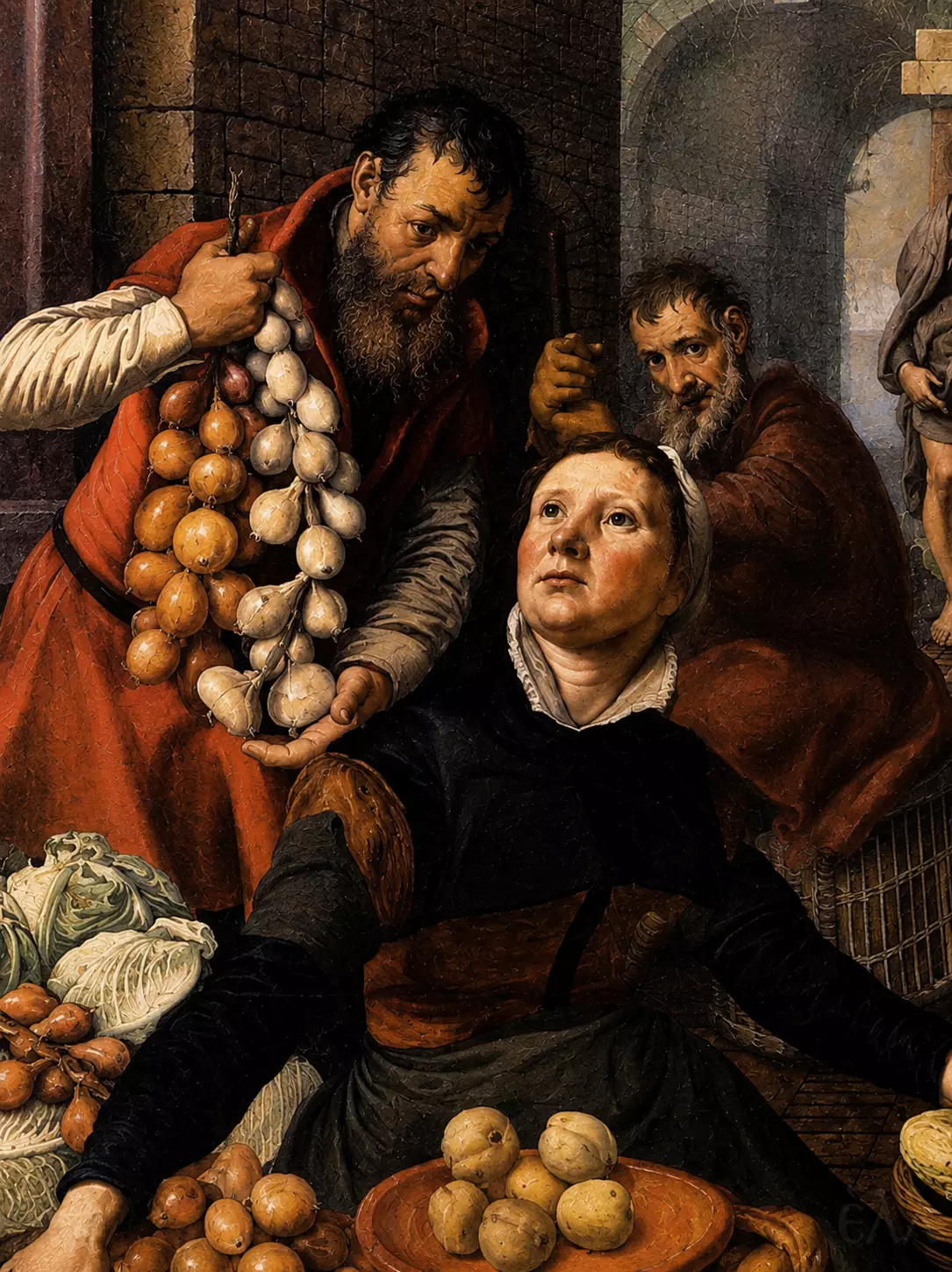
The left side of the foreground is anchored by a complex figural group, heavily integrated into the surrounding still life. A seated woman, leaning slightly backwards, dominates this section. Her face is turned upward and slightly to her own left, her expression caught in an ambiguous moment of contemplation or silent inquiry. Her pale skin and the crisp white linen of her fitted cap and collar stand against the saturated reds and dark earth tones around her. Her left arm extends towards the large basket of ribbed melons beside her, the hand resting among the produce; her right arm reaches down towards the lower left corner, perhaps adjusting her position among the goods.
Directly behind her stands an older bearded man, his weathered features strongly individualised and without classical idealisation. He is draped in a striking crimson garment, whose heavy folds suggest a coarse, practical fabric. With his right hand he grips a massive string of onions and garlic, presenting it prominently beside the seated woman. The bulbs are painted with extraordinary realism; their dry, papery skins catch the diffused light, revealing the fragile texture of their outer layers. His gaze, intense and downward-directed, appears to fall towards the woman or the goods immediately below.
Behind this pair, emerging from the dark, brick-lined shadow of the archway, a third man is partially visible. His features are subdued by the gloom, while one hand rises close to the seated woman’s head and a vertical object remains partly concealed beside him. The precise action is difficult to determine from the visible forms. Yet his partial concealment adds depth and crowded activity to the group, while the arch behind him establishes a threshold between the near market and the more open courtyard. Bodies, baskets, hanging bulbs, folded cloth, fruit: the accumulation resists an easy passage into the distance and keeps the eye for some time within the vendors’ world.
The Sacred Background: The Biblical Narrative
Pieter Aertsen Christ and the Adulteress in the Background
Framed by the large archway that divides the composition, the distant middle ground reveals the nominal subject of the painting: Christ and the woman taken in adultery (John 8:3–11). Here the visual clamour of the market recedes. Christ stoops low towards the pavement, extending his right hand to write on the ground (John 8:6, 8), while the surrounding figures gather around him. He wears a flowing reddish mantle, and his lowered body becomes the gravitational centre of the small biblical group. The Gospel does not state what he wrote. The gesture itself, rather than any invented inscription, therefore forms the theological hinge of the depicted episode, placing silent action at the centre of a scene otherwise defined by accusation and public scrutiny.
To Christ’s left stands the accused woman, exposed before the surrounding group. Her pale, luminous gown catches the light, and one arm appears to be held by a male figure immediately behind her. Scribes, Pharisees, accusers and attendants cluster around the pair in muted greys, ochres and faded rose tones, their smaller scale and softened definition pushing the episode deeper into pictorial space. The visual hierarchy is peculiar by design: the figures upon whom the narrative depends occupy less space than a single basket of vegetables in the foreground.
Behind them rises a classically inflected architectural setting of arches, galleries, columns and vaulted passages. Its ordered geometry contrasts with the organic sprawl of vegetables and market wares below. Repeated openings create successive pockets of depth, and the paved ground draws the eye towards the centre even as the foreground goods resist that movement. The biblical event is therefore not merely small; it is spatially delayed, enclosed within a setting that must be sought through the foreground abundance. What Pieter Aertsen’s Christ and the Adulteress makes difficult is immediate access to the sacred narrative. The eye encounters appetite first, judgement later, and this sequence gives the composition much of its tension.
Synthesising the Sacred and the Profane
The juxtaposition of the aggressive, sensory still life and the distant moral narrative supports a theological reading. Aertsen’s structure reflects the cultural conditions of sixteenth-century Antwerp, where market abundance and the circulation of commodities formed an increasingly visible part of urban life. By placing the beholder close to food, vessels, bodies and traded goods, the painting turns seeing itself into part of the subject. Sensory attraction is not external to the biblical scene; it precedes it, surrounds it, competes for attention. The sacred and the profane occupy one continuous pictorial world, but they do not receive equal visual weight.
As noted in scholarly studies of the period, including those examining the rise of Peasant Scenes and Landscapes within the Antwerp art market, Aertsen’s market pictures repeatedly bring mundane abundance into contact with religious narratives. In this painting, several foreground motifs carry erotic associations rather than operating simply as generic signs of transience. Onions were linked with aphrodisiac lore, while the rooster, eggs and elongated vegetables could invite sexual readings. Such associations sharpen the relation between the woman accused of adultery and the sensually charged marketplace through which the viewer must look before reaching her. The moral field is therefore carried by the arrangement of ordinary things as much as by the distant Gospel figures.
The visual handling reinforces that distinction without requiring a speculative account of separate paint-layer procedures. Foreground objects are described through firmer contours, denser local colour and insistent differences of surface: papery onion skins, cabbage leaves, wicker, bread crust, feathers. The biblical group, smaller and more muted, recedes through scale, tonal restraint and spatial distance. Foreground: abundance, texture, appetite; background: accusation, reflection, mercy. The panel accordingly demands a divided attention from its audience, requiring repeated movement between the immediate physical appeal of the market and the quieter Gospel episode beyond it. Even at the end, the onion skins remain almost tangible while the words traced upon the pavement cannot be heard.
(The translation was edited by A. Orfanos.)