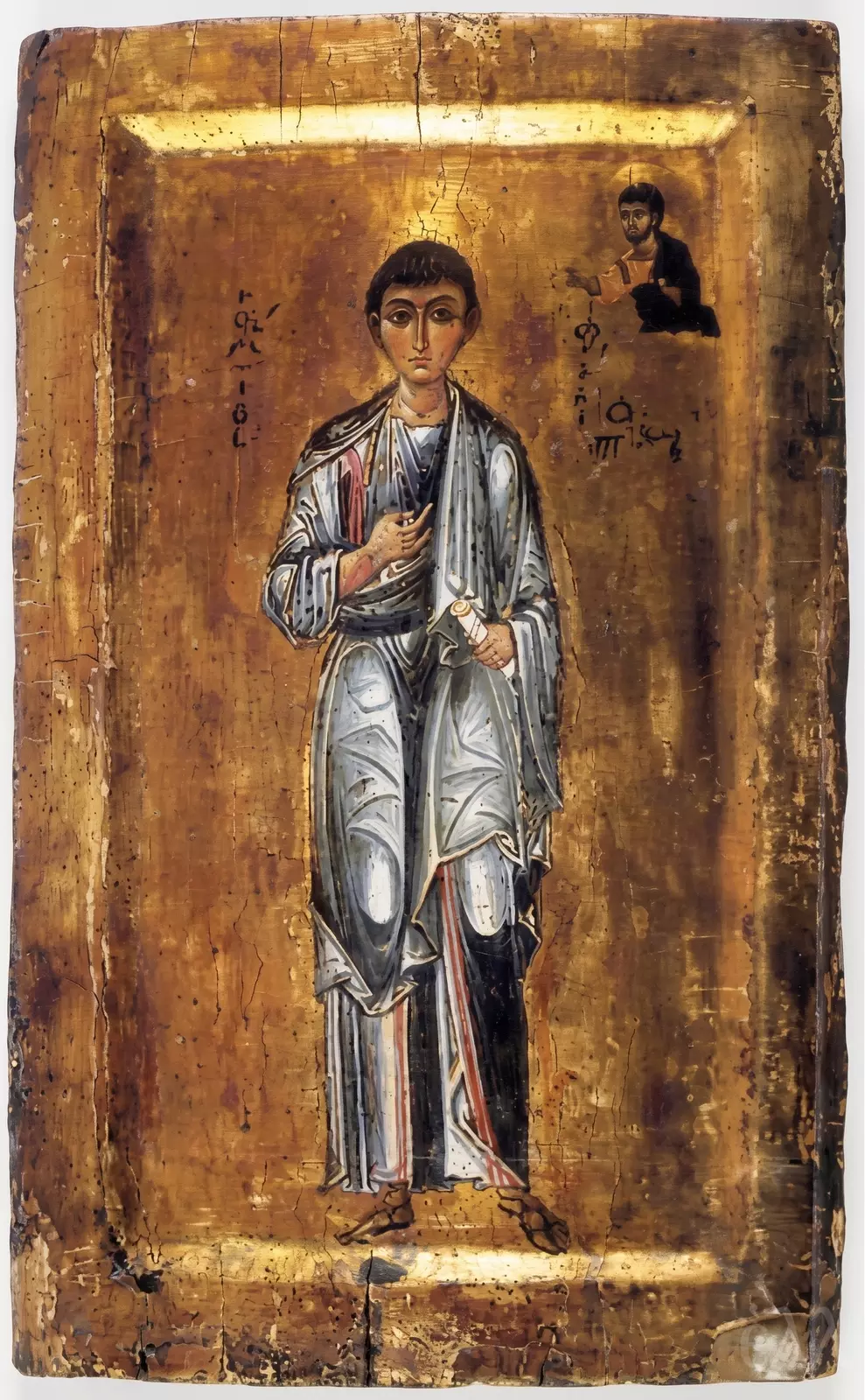
The Saint Philip Sinai icon, preserved at the Monastery of Saint Catherine and dated to the second half of the 10th century, is a small Byzantine panel of unusual visual concentration. Measuring 32.8 × 20.2 cm, it presents the youthful apostle full length against an uninterrupted gold ground, while a bust-length Christ appears above him and extends a blessing gesture. Despite its modest scale, the image retains considerable pictorial authority. Philip stands on the central axis, frontal and almost immobile, his body enclosed by long pale garments whose folds are articulated through dark contours, grey-blue passages, white highlights and occasional red accents. Nothing in the setting competes with him.
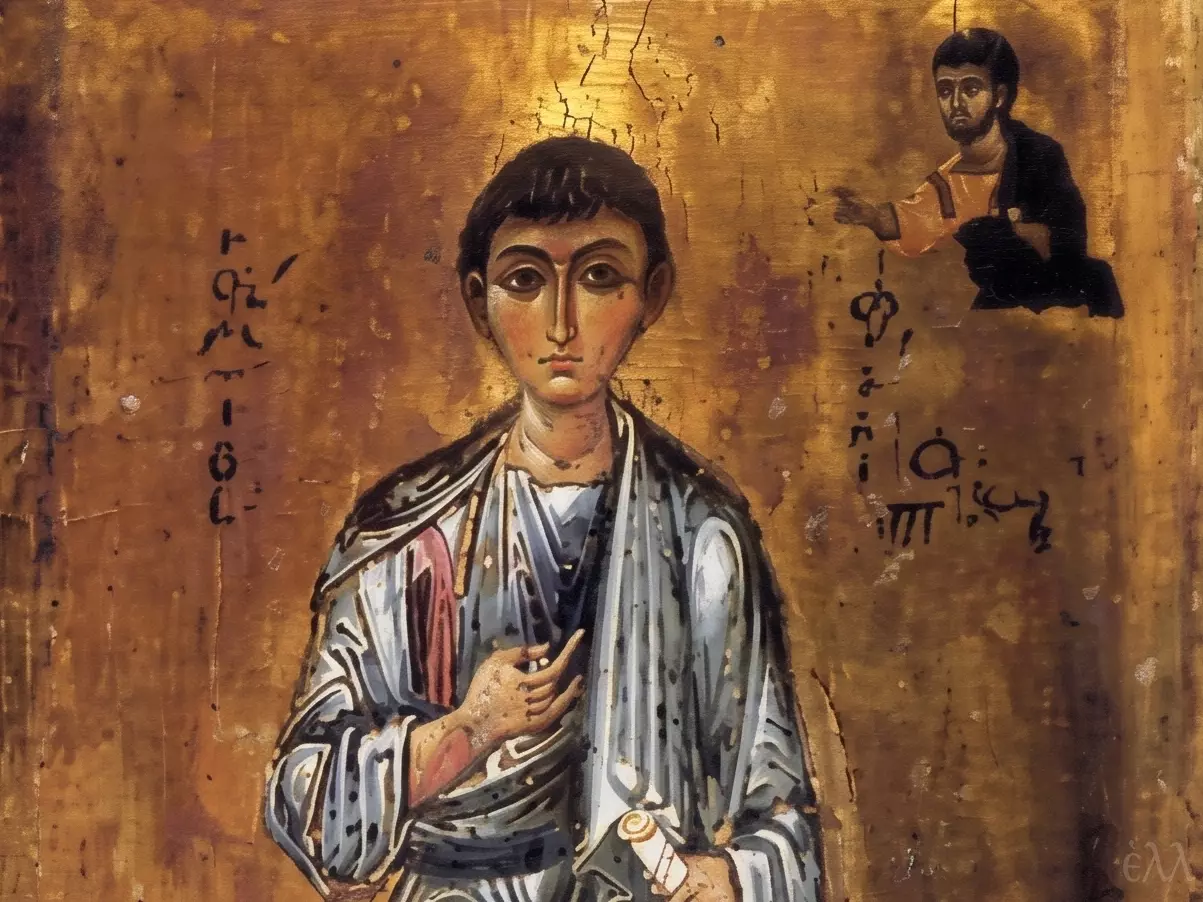
Without a conventional floor line or any architectural or landscape setting, the composition places Philip in no measurable earthly space. His sandals are visible, yet the figure seems suspended against the gold field, a formal device that intensifies the icon’s abstraction without dissolving the physical presence of the body. His face remains young and beardless, with short dark hair, large almond-shaped eyes, a narrow nose and a small, firmly drawn mouth. The direct gaze, which fixes the spectator before attention rises towards the smaller figure of Christ, is one of the strongest elements in the composition.
Saint Philip Sinai Icon: Form, Gesture, and Gold Ground
Gesture introduces a second order within this severe frontality. The apostle places his right hand across his chest; in his left hand he holds a closed scroll. The distinction is clear in a frontal figure: Philip’s right hand appears on the viewer’s left, while his left hand, holding the scroll, appears on the viewer’s right. Above, in the upper right area of the panel, Christ blesses the apostle. Yet Philip does not turn towards him. The absence of a responsive glance prevents the composition from becoming a small narrative episode and preserves the saint’s hieratic, iconic presentation. Christ’s presence establishes authority, while Philip’s stance preserves stillness.
Broad pale surfaces, broken by dark angular folds and crossed by narrow highlights along selected ridges, structure the clothing with linear precision and restrained modelling. The outer mantle falls asymmetrically and reveals touches of red beneath or within the drapery, giving the otherwise cool garment a small chromatic interruption. These accents are sparse. Through vertical fall, diagonal fold, repeated dark edge, the treatment articulates the body rhythmically rather than creating deep volumetric recession. The result is a figure slender and clearly structured, neither weightless nor fully naturalistic.
Particularly significant are the haloes. Their surfaces are visibly rougher than the surrounding gold ground, and this technical feature has been associated with a group of Sinai icons in which similarly treated haloes recur, especially during the 11th and 12th centuries. Within the documented Sinai group, this panel is important because the roughened halo treatment is regarded as its first appearance, a characteristic that would become more frequent in the monastery’s later icons. For this work, the feature has been used as evidence in favour of production connected with a workshop at Saint Catherine’s. Such a conclusion should remain measured: workshop association is a scholarly attribution, not something established from appearance alone.
The dating to the second half of the 10th century likewise depends on comparison with Byzantine ivories and manuscript painting, where related facial types, proportions and linear treatments occur. Chronologically, the panel belongs to the Middle Byzantine period, when artistic production moved freely between monumental painting, manuscripts, ivory carving and portable icons. The early Sinai corpus, when it was systematically studied in 1976, received extensive treatment in the Weitzmann catalogue devoted to icons from the sixth through the tenth century.
Age has altered the surface without destroying its visual structure. Long cracks descend through the gold field and across the panel, while abrasion, darkened areas and small losses are concentrated especially around the borders and lower zone. The damage makes the material history of the object unusually visible. It also sharpens a paradox already present in the original design: the panel is physically fragile, marked by wood, paint loss and fissure, while the figure it carries remains composed, frontal, almost untouched in psychological effect.
Within 10th-century Byzantine panel painting, the icon is notable for its economy. There is no narrative setting, no supporting group, no decorative architecture. One apostle, one blessing Christ, one scroll, gold. From these few elements the composition constructs a hierarchy of scale and attention in which the saint’s youthful physiognomy and unwavering gaze dominate the surface. The Saint Philip Sinai icon belongs securely to the Middle Byzantine world, yet its character is not exhausted by period labels. Its force lies in the disciplined relation between presence and emptiness, between the linear body and the boundless gold field surrounding it.
(The translation was edited by N. Jones.)