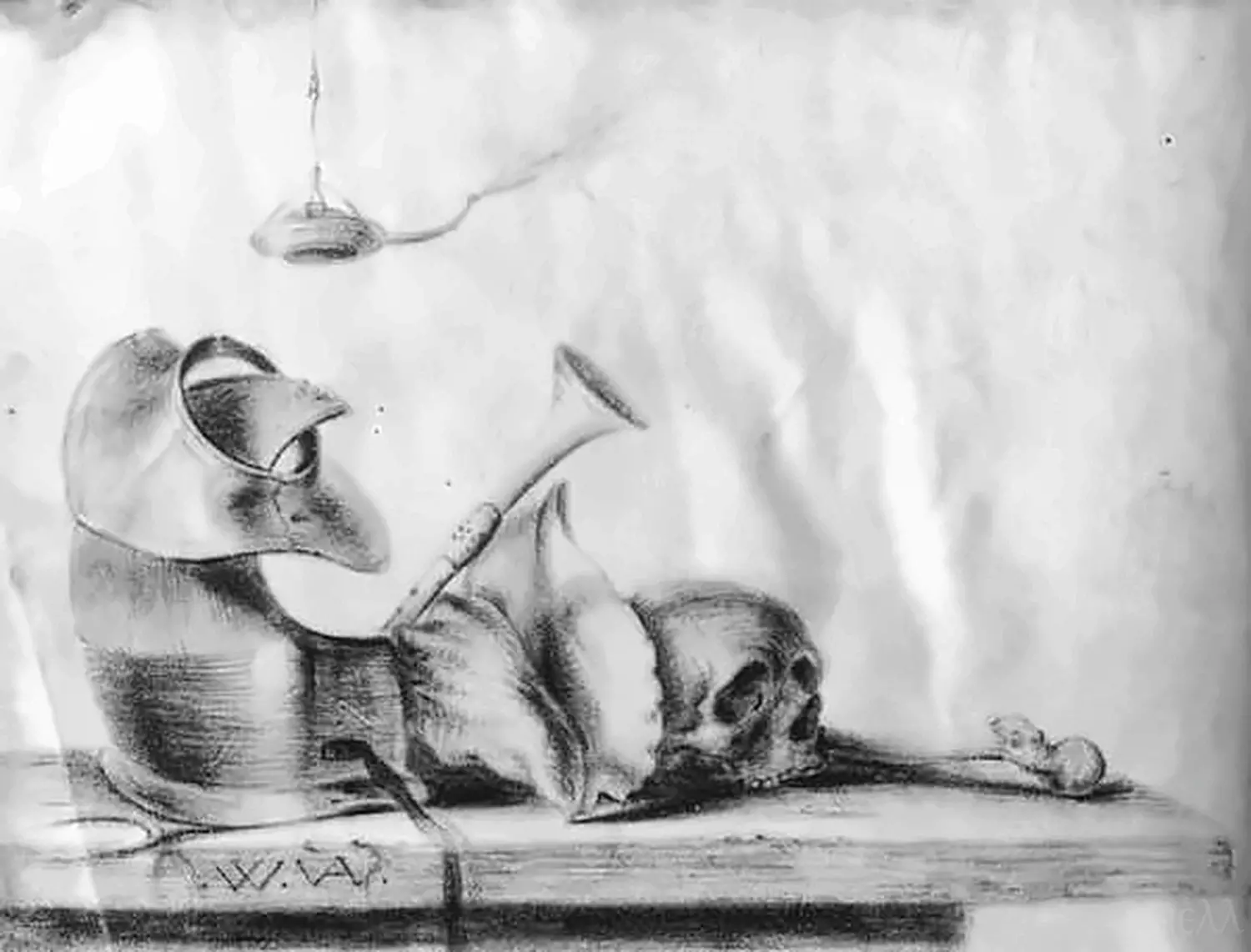
Discarded armour, a skull and a long bone occupy Willem van Aelst’s Still-Life with Armour, a black-chalk drawing on vellum dated 1635–41 and preserved in the Fogg Art Museum at Harvard University, Cambridge. The subject is austere even before its implications are considered. A compact mass of metalwork fills the lower left and centre of the sheet, while the skull lies further to the right, partly enclosed by the surrounding forms. Beyond it, the bone extends almost horizontally towards the edge. Above, most of the vellum remains open, broken only by a few narrow lines and a small suspended form.
The emptiness matters. It allows the objects to appear isolated, stripped of any narrative setting or human presence.
Van Aelst builds this arrangement almost entirely through contour, hatching and tonal pressure. The curved armour receives the densest passages of black chalk, particularly along its lower surfaces and recesses, while exposed planes are allowed to remain comparatively pale. The skull is more concentrated, its eye socket, nasal cavity and teeth sharpened by dark accents that distinguish bone from metal without requiring colour. At the bottom edge, a shallow ledge stabilises the group, and the letters “W.V.A.” are visible near the left. Nothing in the drawing has the polished surface of Van Aelst’s later oil still lifes. Its attraction lies elsewhere: in the directness of the study, the compression of heavy objects into a narrow band, and the strange quiet created by things associated with protection, violence and the body after the body itself has disappeared.
Still-Life with Armour as a Vanitas Drawing
The composition is strongly weighted to one side. Against the upright mass of armour on the left, Van Aelst sets a sequence of lower, receding shapes that lead the eye towards the skull and finally along the bone. The movement is slow but unmistakable: vertical bulk, folded metal, rounded cranium, thin horizontal extension. A diagonal form rising near the centre cuts across that progression and gives the still life a momentary lift before the eye returns to the table surface. This is a drawing of mass and interval as much as of individual objects. The broad unworked field above the cluster enlarges the sense of vacancy and makes the assembled remains appear more exposed.
Especially effective is the differentiation of surfaces. On the large armour plate at the left, parallel strokes follow the curvature of the metal and establish volume through gradual darkening rather than through a hard outline alone. Other passages are abbreviated. The skull, by contrast, depends on abrupt recesses: the blackened socket, the hollow of the nose, the dark seam below the cheekbone. Its surface is rougher, more porous in appearance. The bone at the right is barely modelled by comparison, yet its rounded end is sufficiently defined to be legible. Van Aelst therefore varies his graphic handling according to material, allowing the chalk to suggest weight, hollowness, rigidity and wear through shifts in density. On vellum, whose relatively smooth surface can sustain both soft shading and controlled linear work, these distinctions remain clear without becoming brittle.
The armour itself has been arranged as a collection of disused parts, no longer equipment ready to be worn. A helmet and a curled hunting horn can be recognised among the forms, though several overlapping elements are deliberately difficult to separate from one another. That compression is important. Metal that once offered protection and announced status is folded into an inert heap; beside it, the skull supplies the absent anatomy in literal form. The relationship between the two is visually close enough to encourage a vanitas reading. Armour can protect the living body, proclaim rank or evoke martial strength, but beside a skull and bone its promise of protection has already failed. The drawing does not need an inscription to make the contradiction intelligible.
This opposition is handled without theatrical emphasis. No candle has just gone out, no hourglass dominates the scene, no luxuriant object announces wealth before being morally cancelled. Van Aelst keeps the vocabulary narrow. Metal, bone, emptiness. The result is more severe than many later Dutch vanitas compositions because the objects do not form a richly furnished cabinet of worldly goods; they sit low on an undecorated support, exposed to the blankness around them. The skull is not even centrally enthroned. It emerges from the clustered forms, its teeth forming a brief jagged line near the table edge, while the long bone carries the composition outward. Mortality is thus embedded within the still life instead of being presented as a separate emblem.
If the stated dating of 1635–41 is retained, the sheet belongs to an exceptionally early point in Van Aelst’s development, given his birth in Delft in 1627. That chronology makes the assured organisation of the forms noteworthy, but it also advises caution: the date should be treated as the catalogue dating supplied for the work, not as something that can be established from visual examination alone. What the drawing itself demonstrates securely is an early concern with the still-life problem of how isolated things acquire meaning through adjacency. The skull changes the armour; the armour changes the skull. One becomes a failed defence, the other the measure of that failure.
Van Aelst’s Later Work and the Vocabulary of Vanitas
In his later works, Van Aelst is celebrated for a very different kind of seduction: fruit, flowers, game, glass, reflective vessels, fabrics and finely observed surfaces brought into elaborate balance through oil paint. Still-Life with Armour already shows an interest in the intelligence of arrangement, although its means are spare. The objects are not scattered casually. Their edges interlock, their shadows gather into a common dark zone, their varied curves answer one another. Even the empty upper field participates in the structure, because the low placement of the still life makes the material cluster feel compressed by absence.
The small suspended form near the upper left intensifies that unease. It is connected by a fine line — its identity impossible to fix with certainty — and is best understood formally: a minor isolated accent, hovering above the denser objects and preventing the blank field from becoming passive. Its curve echoes the rounded metal below; its thin attachment contrasts with the weight of armour and bone. Such visual correspondences give the sheet coherence without making it symmetrical.
At the lower edge, the inscribed initials introduce the artist into a composition otherwise emptied of human agency. They do not restore the absent wearer. Instead they remind us that the arrangement has been observed, selected and deliberately drawn. Still-Life with Armour therefore operates on two levels at once: as a precise graphic study of difficult materials and as a meditation suggested by their conjunction. Heavy armour, hollow skull, exposed bone—each is rendered with restraint, and together they create an image in which the material world seems momentarily durable while human life has already passed beyond it.
(The translation was edited by A. Orfanos.)