
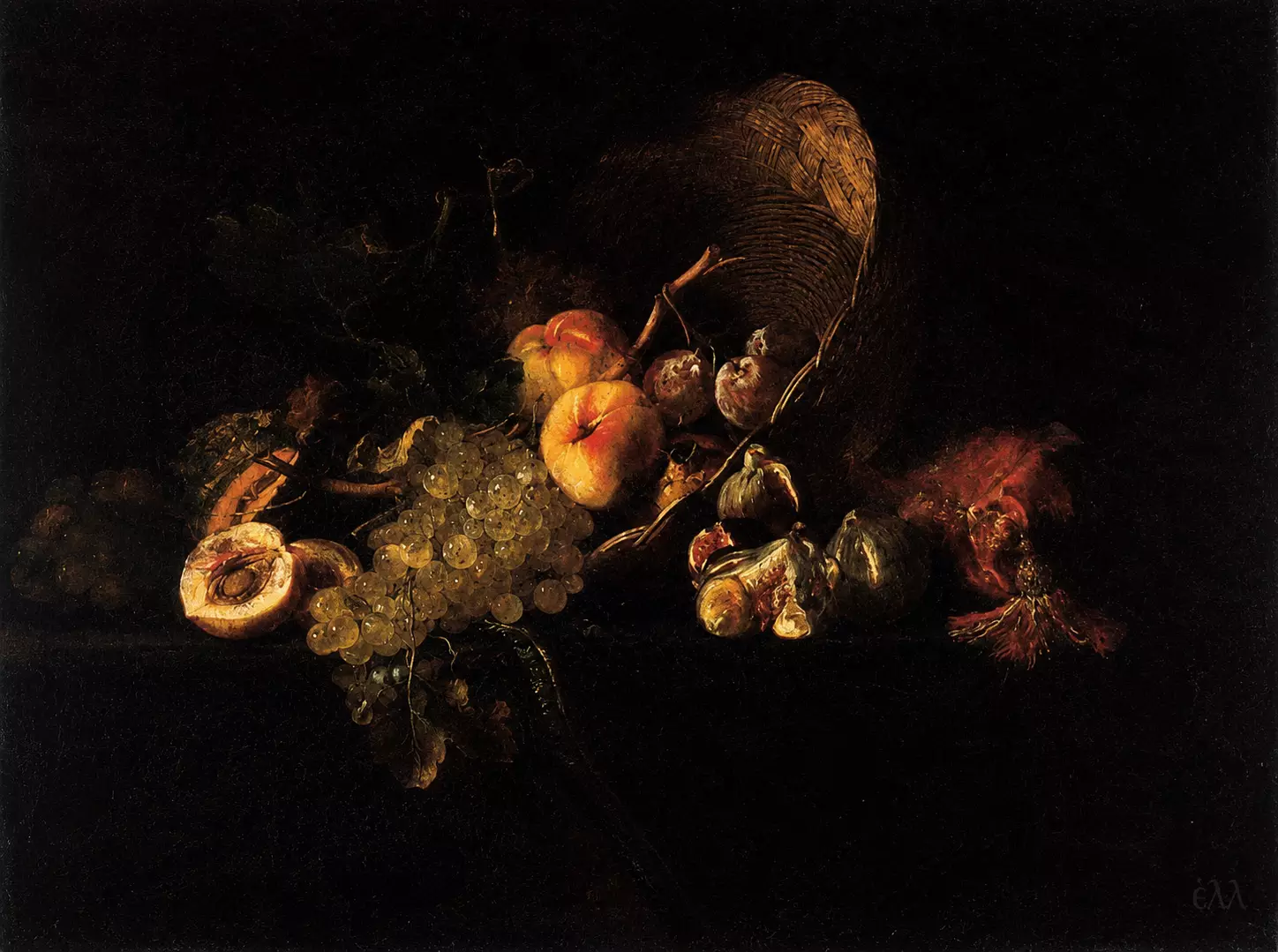
During the mid-seventeenth century, the representation of harvested abundance underwent a profound stylistic transformation across European centers. Willem van Aelst executed the oil on canvas Still-Life with Fruit around 1650, distilling complex textural observations into a highly focused pictorial field. Measuring 48 by 55 centimeters, the painting currently resides in the Galleria Palatina of the Palazzo Pitti in Florence. The artist arrived in Italy following a formative period in France, eventually establishing himself in Florence under the patronage of Ferdinando II de’ Medici, Grand Duke of Tuscany. His integration into this court environment prompted an evolution in his visual language, moving from the more restrained, tonal banquet pieces typical of Haarlem and Amsterdam toward a refined, aristocratic aesthetic.
The Medici court cultivated a distinct appreciation for Northern European precision, simultaneously demanding the dramatic optical impact favored in Italian baroque painting. Van Aelst responded by synthesizing meticulous Dutch descriptive techniques with an assertive deployment of chiaroscuro. Plunged into an almost impenetrable darkness, the background recedes so that the illuminated subjects project forward into the viewer’s space, altering his method of constructing pictorial depth.
Structural Organization and the Void
Spilling over the unforgiving edge of the stone support, a heavy cluster of white grapes establishes the primary diagonal axis of the composition. The painter constructs the visual hierarchy through isolated spheres of illumination: the gold fringe, the bruised skin of the fig, the clouded surface of the grapes. This gathering of forms eschews a uniform lighting in favor of a raking spotlight effect originating from the upper left. Such illumination isolates the central peaches, rendering their downy surfaces with acute optical fidelity while perimeter objects dissolve selectively into the shadows.
A close examination reveals the intricate handling of the woven wicker basket positioned behind the primary fruit arrangement. The container tips forward, its woven texture catching fragmented highlights before being swallowed by the dark ground. By withholding information about the depth of the space behind the ledge, van Aelst creates a compressed, theatrical arena where the dark background absorbs the contours of the foliage, leaving only primary volumes legible.
Optical Precision and Materiality
The materiality of the painted objects relies on a sophisticated layering of oil glazes over opaque underpainting. Anchoring the arrangement, the two peaches at the center provide the dominant chromatic weight with their warm yellow and red hues. Van Aelst built up the flesh of the peaches using subtle scumbling to mimic the matte, light-diffusing nature of their skin. Adjacent to these, the green grapes exhibit a remarkable translucency. The artist achieved this by applying thin glazes of verdigris or green earth over a lighter, reflective preparation, followed by sharp, localized applications of lead white to indicate the reflection of the studio window on the taut skins.
Near the left edge of the stone ledge, an opened walnut exposes its corrugated meat to the cool light beside its fractured shell.
On the right side of the composition, a contrasting material introduces a distinct narrative of luxury. A heavy red velvet cloth, finished with an elaborate gold tassel and fringe, drapes across the stone ledge. The inclusion of this textile shifts the reading of the image from an agrarian harvest to a display of imported, courtly opulence. The deep crimson of the velvet, built up with madder lake glazes, absorbs the light, contrasting with the reflective metallic threads of the fringe. This heavy fabric grounds the right side of the canvas, offering a textural counterpoint to the fragile, bruised skin of the adjacent figs.
The Condition of the Harvest
One of the figs resting near the velvet has split open, revealing its dense, seed-filled interior. This rupture introduces an element of temporal decay into an otherwise pristine arrangement, evoking the vanitas tradition that permeated seventeenth-century Dutch art. Van Aelst avoids explicit moralizing symbols like skulls, hourglasses, or extinguished candles; the transience of the subject is communicated through the organic state of the fruit itself. The split fig, the slight browning on the edges of the scattered leaves, and the precarious overhang of the grapes suggest a moment of peak ripeness that borders on the onset of rot.
Luminous against the dark background, the peaches hold the viewer’s immediate attention, yet the eye wanders to the periphery. The grape leaves weave through the negative space, their jagged edges defining the boundary between the illuminated harvest and the surrounding void. The painter pays equal attention to the mechanics of attachment, delineating the dry, woody stems that connect the grapes and leaves to show the severance of the fruit from its source of life.
The execution of Still-Life with Fruit required a deliberate calibration of paint handling. The smooth blending used for the flesh of the fruit contrasts with the thicker impasto applied to the gold fringe and the rough exterior of the walnut shell. This varied facture demands that the eye adjust to different levels of textural description. Van Aelst manipulates the perception of proximity, creating illusions of varied distances within a shallow depth of field. The stone ledge itself remains largely unarticulated, functioning as a neutral base that receives the cast shadows of the overhanging grapes. Extending along the vertical face of the stone ledge, the shadow cast by the grape cluster provides the spatial anchor, confirming the physical overhang and enhancing the trompe l’oeil effect, while the light gradually diminishes across the composition until the soft edge of the red velvet dissolves into the black ground.
(The translation was edited by E. Alexandraki)