
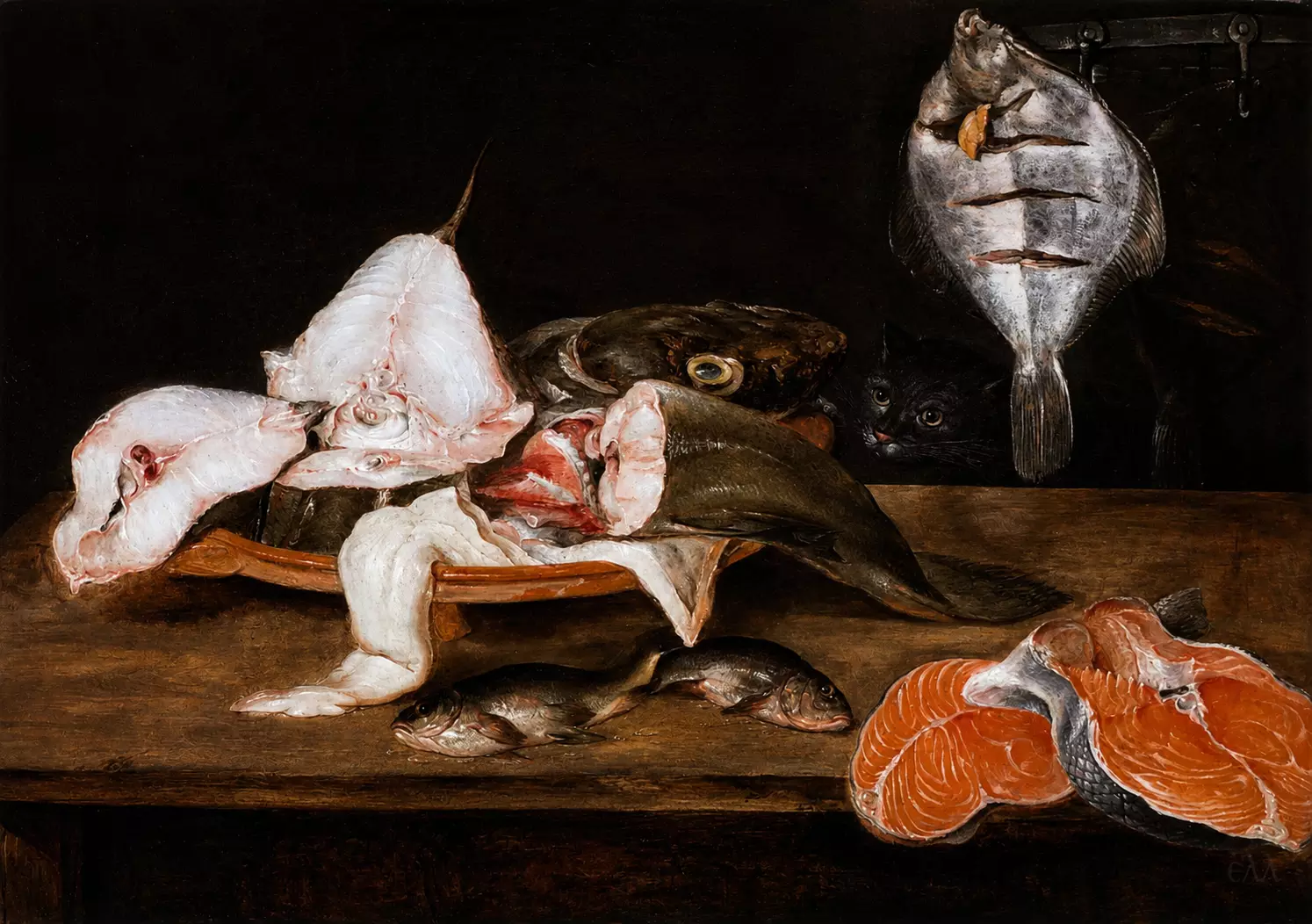
Alexander Adriaenssen’s Still-Life with Fish, painted between 1630 and 1650, concentrates an extraordinary amount of visual incident within a relatively modest oak panel measuring 55 × 76 cm. Born in Antwerp in 1587 and active there until his death in 1661, the Flemish painter places his subject on a broad wooden table and allows the food itself—whole fish, cut sections, exposed flesh, skin, scales—to determine almost every movement of the composition. The work is now in the Groeninge Museum in Bruges.
Against the dark background, the pale mass of fish at the left catches the eye first. It is bright, irregular, almost sculptural. From this concentration the composition spreads sideways through darker bodies, a folded white cloth, smaller fish near the front edge and, finally, the intensely orange flesh of the thick steaks at the lower right. Above them hangs a single fish, vertically suspended and marked by several cuts across its body. Behind the central group another presence emerges almost unnoticed: the head of a cat, its eyes directed towards the food. Adriaenssen has therefore constructed a still life whose apparent immobility contains an element of expectation, since nothing here moves outright, though something well might.
Alexander Adriaenssen Still-Life with Fish: Composition and Material Presence
The horizontal tabletop supplies the painting with its principal structural line. Across it, however, very little remains strictly horizontal. Fish overlap, turn at different angles, project towards the edge, disappear beneath one another; a strip of white fabric descends between them before spreading forward in a loose fold. The resulting arrangement is dense without becoming confused. At the left, the pale fish forms build upward into a compact mound. Toward the centre the forms become lower and darker, while the hanging fish on the right abruptly restores vertical emphasis. Then, almost outside this principal rhythm, the two large orange sections in the foreground occupy their own pictorial territory.
Such distribution gives considerable weight to the empty darkness above the table. Adriaenssen does not fill that field with architectural description, vessels or decorative accessories. Its visual function is direct: it isolates the objects. The light flesh of the fish is sharpened by the surrounding dark tones; silvery areas acquire greater luminosity; reddish cuts become more pronounced. The cat benefits from the opposite effect. Its dark head is nearly absorbed by the background, the eyes and small highlights around the face making the animal gradually visible rather than immediately declaring its presence.
The fish themselves are studied through difference. Smooth skin lies beside rougher scaled surfaces, opaque white flesh beside translucent or moist-looking red sections, broad cut planes beside intact bodies whose shapes remain legible. On the hanging specimen, the incisions interrupt the continuous surface of the skin with short dark bands. In the foreground the smaller fish have a compact silvery-grey appearance and are arranged with less ceremony, almost as incidental remnants beneath the larger display. The orange steaks at the right are quite different. Their broad exposed interiors allow Adriaenssen to delineate curved bands and changes in texture across the flesh, while the darker skin provides a narrow enclosing edge.
This insistence upon surfaces belongs to the central pictorial intelligence of the picture. Oil on oak panel gives Adriaenssen a support on which subtle transitions of value and sharply defined edges can coexist, yet it would be hazardous to reconstruct his precise sequence of paint application from appearance alone. What can be observed is the control of tonal modelling. Highlights do not fall uniformly. Some parts are strongly illuminated, others recede quickly, and several fish merge partially with their neighbours. The painter consequently prevents the display from becoming a row of individually isolated specimens. One body leads into another, pale into dark, rounded form into cut surface.
The white cloth plays a quieter but important role. It crosses the central zone without competing with the fish, and its folds introduce a material that responds differently to light. Softness now appears among slick skin, exposed flesh and the harder plane of the table. Equally necessary is the table itself: its warm brown surface provides the middle register between the nearly black background and the much lighter food, while its front edge establishes a firm boundary close to the viewer. Several objects approach this edge closely. The effect compresses pictorial space and makes the arrangement seem physically immediate.
Still-life painting invites precisely this kind of attention to objects and to the meanings that their selection may acquire. In his study Still Life, Norbert Schneider asks how the things represented in such paintings can reflect the customs, ideas and aspirations of their period. Adriaenssen’s panel permits that question, although the visual evidence advises some restraint. Fish dominate the composition absolutely; they are prepared in different ways and presented at different stages between intact body and edible portion. The painting therefore addresses food as material presence, commodity and prepared substance at once. Claims of a more exact social or symbolic programme would require evidence beyond the image supplied.
Abundance, however, is visible. It arises not from an enormous quantity of luxurious accessories but from concentration: one fish upon another, cut flesh beside whole bodies, large forms accompanied by small ones. The eye cannot settle on a single specimen for long. This accumulation is carefully disciplined by colour. The left half is dominated by pale cream, white and subdued pink; dark browns and greys thicken around the centre; orange-red suddenly becomes dominant at the right foreground. Colour thus performs compositional work. It prevents the long table from reading as an undifferentiated horizontal band and creates points of unequal emphasis.
Especially effective is the relationship between the hanging fish and the orange steaks beneath it. One is vertical, intact in outline despite the cuts across its body; the others are broad, low and emphatically sectioned. Between these two areas lies dark space. Adriaenssen does not need an additional object to connect them because their opposition is sufficient: suspension and weight, grey-white skin and orange flesh, narrow silhouette and expansive cut surface. The right side, initially seeming less crowded than the left, becomes visually forceful through these contrasts.
Then there is the cat. Small in relation to the displayed fish and partially concealed, it alters the psychological temperature of the painting. Its position behind the food makes it an observer within a genre usually built from objects incapable of observation. The viewer looks at the fish; the cat does too. That simple correspondence introduces a mild narrative tension into the static arrangement. The animal does not pounce, touch or disturb anything. Its alert eyes are enough. Adriaenssen allows an anticipated action to remain suspended in the same way as the fish above it.
The painting’s darker passages are therefore active parts of the composition, not empty intervals. Forms enter them and lose clarity; the cat emerges from one; the upper edge of the hanging fish remains surrounded by another. A more uniformly illuminated treatment would have made every object equally available, but Adriaenssen establishes hierarchy through visibility. Some things are immediately legible, others discovered. The large pale fish demands recognition at once. The smaller fish require a closer look. The cat may be noticed only after the principal food display has already been read.
At 55 × 76 cm, Still-Life with Fish achieves its effect without monumental scale. Its force depends upon proximity and compression: the low table, the shallow accumulation of objects, the abrupt dark ground, the food brought almost to the front boundary of the panel. Adriaenssen turns ordinary physical distinctions—wet and dry, pale and dark, intact and cut, soft cloth and hard wood—into the organizing principles of the image. The subject remains resolutely material, but the handling of that material is exacting.
Most memorable, perhaps, is the uneasy balance between stillness and interruption. The bodies lie motionless. The hanging fish fixes a vertical accent above them; the cat watches; the exposed orange flesh advances towards the viewer with a chromatic intensity absent from the quieter centre. Across the oak panel, Alexander Adriaenssen builds his still life through accumulation, tonal contrast and carefully withheld movement. The food has been gathered, cut, displayed. For the moment, everything remains untouched.
(The translation was edited by A. Orfanos.)