
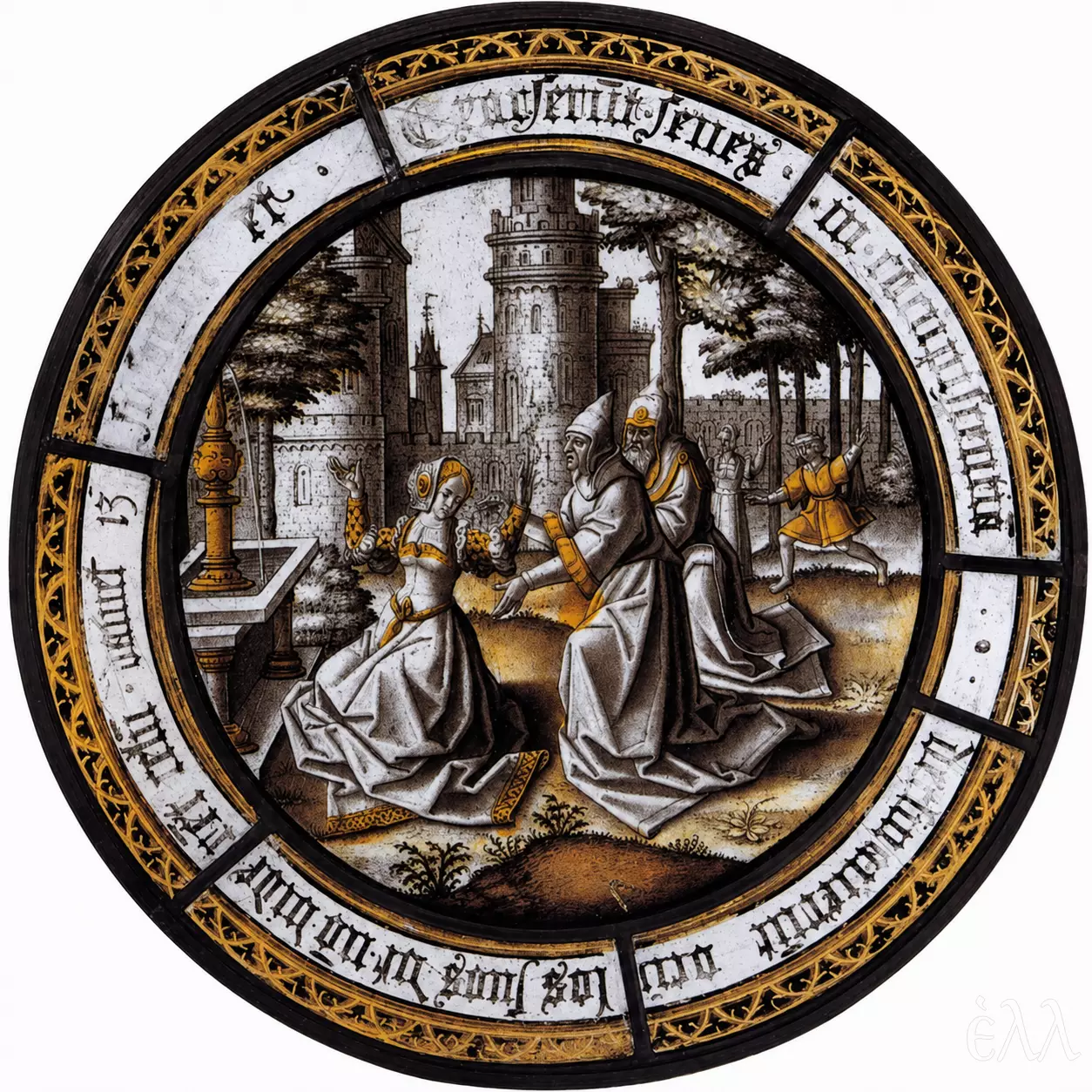
Executed with meticulous linear precision and luminous tonal modulations, the stained-glass roundel depicting the biblical narrative of Susanna and the elders embodies the refined aesthetic of early sixteenth-century Netherlandish glass painting. Produced between 1520 and 1525 and currently held in the Metropolitan Museum of Art, this intricately detailed window, measuring 24 centimetres in diameter, is attributed to Aert van Ort. The attribution places the work within a tradition in which silver stain and vitreous paint were used with exceptional control as late Gothic visual habits gave way to Renaissance sensibilities. Unlike large ecclesiastical glazing designed to be legible from a distance, domestic roundels of this type were set into clear, leaded windows in private houses, guildhalls, and related interiors. They functioned almost as transparent panel paintings, activated directly by natural light. Such proximity demanded a miniaturist’s attention to facial physiognomy, drapery folds, architectural ornament, and inscriptional detail, qualities here handled through a tightly controlled painted surface. The circular format further concentrates these effects: little space is wasted, and the dense relation between figures, architecture, foliage, and lettering rewards close viewing rather than distant legibility.
Visual Narrative in Aert van Ort Susanna and the Elders
Within the compressed pictorial space of the roundel unfolds the opening episode of the Old Testament story (Susanna 19–23), an encounter marked by sudden alarm and psychological tension. Susanna, visibly startled, drops to her knees beside the elaborately constructed fountain on the left side of the image. Departing from the widespread Renaissance convention that utilised this narrative as an occasion for depicting the female nude, the painter presents her fully clothed. Her garment, a pale, voluminous dress accented by rich yellow sleeves and a structured, closely fitted headdress, cascades around the kneeling figure in sharp, angular folds characteristic of Northern European graphic habits. She recoils from the intrusion, raising both arms defensively. Her right hand, seen on the viewer’s left, is lifted high in alarm; her left arm extends towards the approaching men, attempting to hold them back.
From the right side of the composition approach the two elders, pressing into the enclosed garden space and narrowing the distance around Susanna. The foremost figure leans heavily forward, extending his right hand towards her in an insistent appeal. Their faces are set, their gazes concentrated; Susanna, meanwhile, withdraws towards the fountain with both hands raised. Clad in heavy, enveloping robes and prominent hats, the men carry a visual weight that contrasts sharply with her recoiling posture. Their profiles direct attention back towards the kneeling woman, establishing a strong diagonal movement across the circular field. In the far-right background, two smaller figures move rapidly through the garden, one turning with his arms raised. Their precise narrative identity, however, cannot be established securely from the visual evidence alone.
Architectural Symbolism and Spatial Construction
The walled courtyard gives the scene the enclosed garden setting required by the Susanna narrative. Its visual relation to the hortus conclusus tradition may also have carried associations of chastity, though such symbolism should remain interpretive rather than assumed. Dominating the background is a tall cylindrical tower, articulated by brickwork, crenellated forms, narrow openings, and pointed turrets, which places the biblical episode within a distinctly Northern European architectural vocabulary. Trees with softly stippled foliage flank the masonry and interrupt its rigid verticals. On the left, the ornate fountain pours a thin stream of water into a geometric basin. The water is rendered as a narrow pale line against darker painted passages, a simple accent that remains clearly legible within the dense scene.
Framing the central image, and separating the biblical event from the surrounding edge of the glass, is a broad border bearing a Gothic inscription. Dense blackletter appears against a pale ground, punctuated by yellow foliate ornament and distinct dividing bands. Text and decoration therefore occupy the same circular structure: inscription around the perimeter, narrative within. The border is not merely supplemental ornament; visually, it completes the roundel and controls the transition from the pictorial field to the dark outer framework.
Material Mastery and Silver Stain Technique
The technical execution relies on the established Netherlandish combination of colourless glass, dark vitreous paint, and varying intensities of silver stain. Silver stain, produced by firing a silver compound onto the glass, can yield hues ranging from pale lemon to deeper amber. Such painted glass roundels were widely used in domestic and civic interiors throughout the Low Countries. Across the figures and architecture, hatching and cross-hatching model volume, establish shadow, and differentiate surfaces. The effect depends heavily on contrast between unpainted or lightly painted glass and denser fired pigment, allowing passages of light to remain active within the image rather than merely behind it.
Strategically distributed, the silver stain establishes a visual hierarchy across the circular format. Yellow accents mark Susanna’s sleeves and headdress, making her immediately prominent, then recur in the elders’ hats and cuffs, the fountain finial, and the ornamental details of the inscriptional border. Repetition of the colour binds distant parts of the roundel together while preventing the dark painted passages from overwhelming the composition. In the foreground, the earthy ground is developed through dense brown washes and lighter translucent areas, while small plants and irregular contours break up the lower edge. Above them, architecture, figures, foliage, inscription: a tightly compressed network in which the enclosed setting intensifies the pressure surrounding Susanna.
(The translation was edited by A. Orfanos.)