
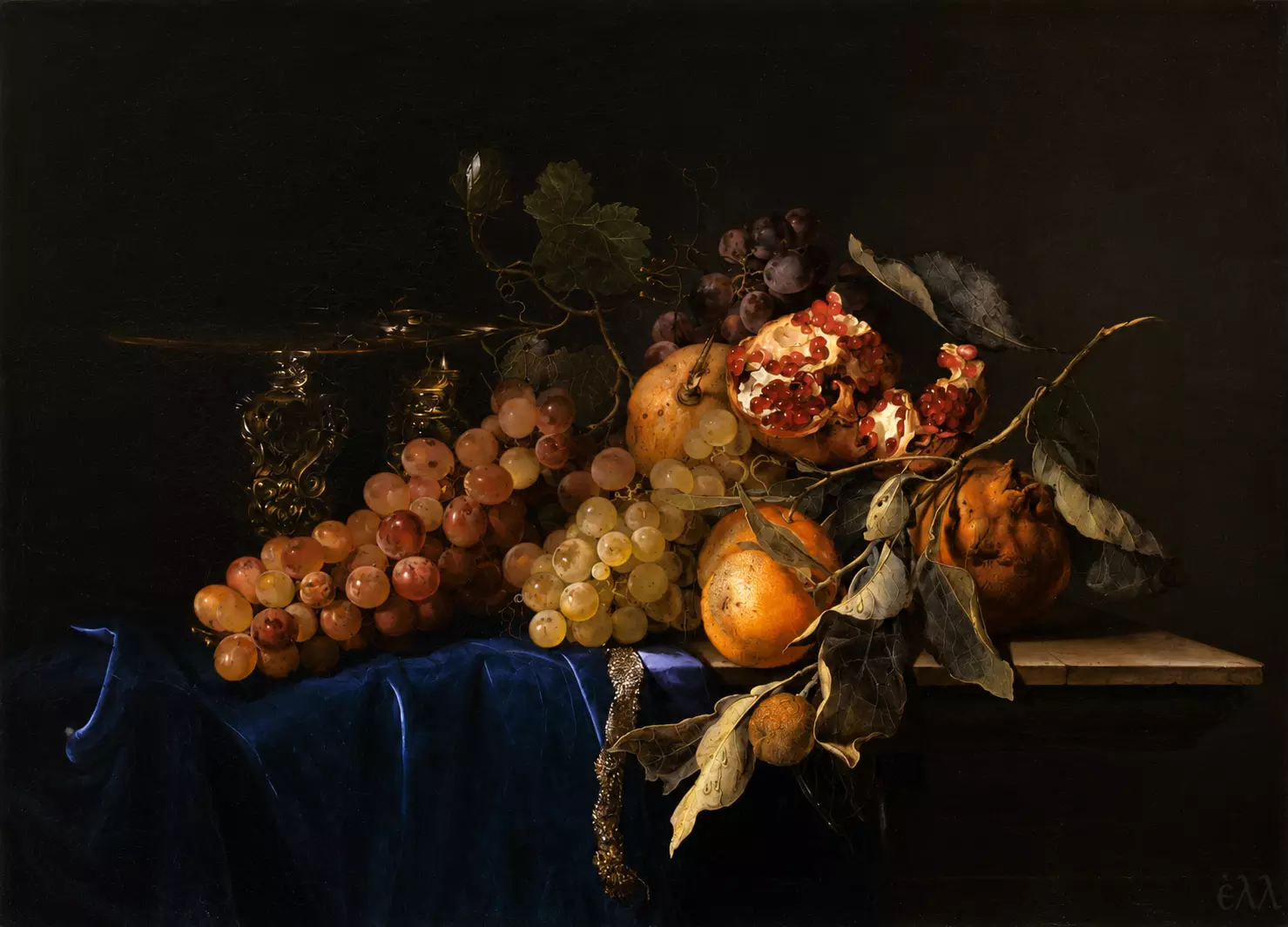
Willem van Aelst’s Still-Life with Fruit and a Crystal Vase, painted around 1650 and now in the Galleria Palatina in Florence, gathers a modest repertory of fruit, glass, foliage and fabric into a composition of unusual chromatic concentration. The painting, an oil on canvas measuring 77 × 102 cm, belongs to the early maturity of a Dutch painter born in Delft in 1627 and active until about 1683. Nothing in the arrangement is crowded for its own sake. Grapes spread heavily across the foreground, a pomegranate has been broken open, several rounded fruits emerge behind them, while a branch carrying leaves crosses the right half of the composition. At the left, almost absorbed into darkness, the crystal vessel announced by the title survives through a few sharp reflections.
Its present setting is the Galleria Palatina in Palazzo Pitti, the Florentine palace whose grand-ducal history placed it at the centre of courtly life. Yet the painting itself is strikingly reticent. Against a background dark enough that several contours disappear before gradually returning under the light, Aelst sets each object apart. Warm oranges, translucent yellows, dull reds, purplish grapes, the exposed crimson of the pomegranate; beneath them, a length of deep blue fabric. Colour accumulates by interruption, each hue surfacing at its own moment as the eye adjusts to the surrounding shadow, so that the objects seem to hold the darkness unevenly rather than all at once.
Willem van Aelst and the Precision of Still-Life Painting
The composition depends upon an asymmetry that is carefully contained. Its greatest weight lies slightly right of centre, around the opened pomegranate and the cluster of warm-coloured fruit beneath it, but the long spread of grapes carries the eye towards the left and prevents the arrangement from becoming vertically concentrated. A branch then extends in the opposite direction, travelling across the foreground fruit towards the right edge. Between these two movements — the low horizontal expansion of the grapes, the lighter and more angular path of the branch — the still life gathers a quiet internal tension that never quite settles.
At first the pomegranate seems to command the picture. Its split skin creates one of the brightest and most intricate passages in the painting: pale flesh, red casing, densely packed seeds, isolated points of reflected light. A second opened section lies immediately beside it. The effect is almost anatomical, though never harsh. Beside surfaces that remain closed and smooth, Aelst has placed an interior texture, so that the eye moves repeatedly between concealment and exposure. Around it are grapes of different tonal families. Some are pinkish or violet, others pale yellow-green; individual grapes remain distinct even when the bunches overlap heavily. Highlights are economical, often no more than a small luminous accent on a curved skin, yet they establish volume with remarkable efficiency.
The pale grapes lower in the composition are especially important. They occupy a transitional zone between the darker bunches at the left and the stronger orange and red notes towards the centre and right. Their translucency seems different from the dense opacity of the neighbouring fruit. Grape skin, pomegranate seeds, leaf, fabric, glass, fruit rind: all are subjected to this differentiation of surfaces, one of the painting’s principal visual achievements, and none of them responds identically to the same restricted illumination.
Almost hidden behind the grapes on the left is the crystal vase. Only portions of its form are immediately legible, caught by narrow glints of light against the dark background. Its presence therefore works differently from that of the fruit. The pomegranate advances through colour; the vase through reflection. One is materially abundant, opened, granular; the other elusive, transparent, registered principally at its edges. Because the glass is denied a conspicuous central position, the contrast remains understated, and only a patient viewer notices it at all.
This concealment changes the experience of the dark ground. It is not an empty black field placed behind an arrangement of brightly illuminated objects, since forms continue within it. A dark bunch of grapes rises behind the pomegranate, almost merging with the surrounding shadow; stems become visible briefly and disappear; leaves near the upper portion of the arrangement can be followed only in fragments. Depth develops through this uncertain visibility. The rear of the still life has no sharply defined boundary, and the darkness occasionally penetrates between the foreground objects themselves.
Across the lower portion of the canvas, the blue cloth supplies a colour that has no real counterpart elsewhere. Its folds descend over the front edge of the support, interrupting the comparatively warm chromatic register of the fruit. Deep enough to approach black in the folds, the blue nonetheless catches narrow ridges of light that reveal the weight and softness of the textile. A vertical strip of patterned or lighter material appears near the centre of the lower edge, partly concealed by the objects above, breaking what might otherwise read as a single continuous band across the foreground.
The right side is more exposed. A pale horizontal tabletop extends beyond the fruit, providing one of the clearest geometric lines in the painting. Against it sits a darker orange-red fruit, partly surrounded by leaves and branches. The foliage is no decorative border; its curling stems, dry-looking leaves and irregular silhouettes complicate the rounded geometry established by grapes, pomegranates and other fruit. Some leaves turn towards the light, others present darker undersides, and one small rounded form hangs lower from the branch over the blue fabric, an isolated accent that draws the composition downwards precisely at the point where the larger mass begins to disperse.
Such passages demonstrate how carefully Aelst controls visual emphasis. The brightest object is not necessarily the largest, and the largest mass is not located at the centre. Instead, attention is distributed through differences of saturation, reflectivity and contour: the exposed pomegranate intricate, the pale grapes luminous, the crystal vase intermittent, the blue textile broad and comparatively quiet.
There is also very little incidental space. At the top, darkness presses closely around the fruit. At the bottom, the cloth falls towards the edge of the canvas. On the right, the branch projects into a narrow zone of emptiness before the table terminates. Ample without becoming expansive, the whole arrangement holds its abundance within a remarkably tight frame.
Symbolism and Light in Aelst’s Still-Life Painting
The open pomegranate and ripened grapes could invite symbolic interpretation, particularly within the wider traditions of seventeenth-century still-life painting, where natural objects were capable of carrying religious, moral or temporal associations. The painting itself, however, does not require a single emblematic reading. No supplied documentation identifies such a programme, and the visible evidence is better approached first through Aelst’s sustained attention to material presence. Fruit is shown cut and uncut, smooth and granular, pale and dark; foliage fresh-looking in some passages, subdued in others. These contrasts establish sensory and temporal differences without needing to be converted into a fixed allegory.
Nor is the still life governed by perfect preservation. The surfaces possess small irregularities. Grapes vary in size and colour, the pomegranate has been torn open, leaves bend and overlap, stems cross one another with little concern for ornamental regularity. Yet these apparent accidents have been incorporated into a strongly calculated pictorial order. A branch may seem to have fallen across the fruit, but its diagonal movement leads the eye from the central mass towards the right, while grapes spilling casually forward establish, through their contour, the principal descending rhythm towards the blue cloth.
Aelst’s handling of light finally unifies these separate observations. Illumination does not spread evenly across the canvas; it selects. A grape flashes briefly, a leaf edge becomes silver-grey, the glass catches a narrow reflection, the pomegranate opens into a field of reds. Immediately beside these points, forms recede almost completely, and the resulting chiaroscuro proves less theatrical than selective, determining how long each object remains visible and how clearly its material can be understood.
This is why the dark area at the left matters as much as the brilliant centre. The crystal vase occupies that uncertain territory between presence and disappearance, while the fruit gradually grows more substantial as it approaches the principal light. Across the foreground, the blue fabric performs the reverse movement: strongly visible beneath the grapes, then sinking into deep folds towards the edge. Glass, fruit, leaf, textile, shadow — Aelst keeps them materially distinct while allowing their contours to meet and sometimes dissolve. Near the bottom of the canvas, one last fold of blue hangs over the table edge, its surface catching just enough light to remain visible before the composition returns to darkness.
(The translation was edited by D. Manou.)