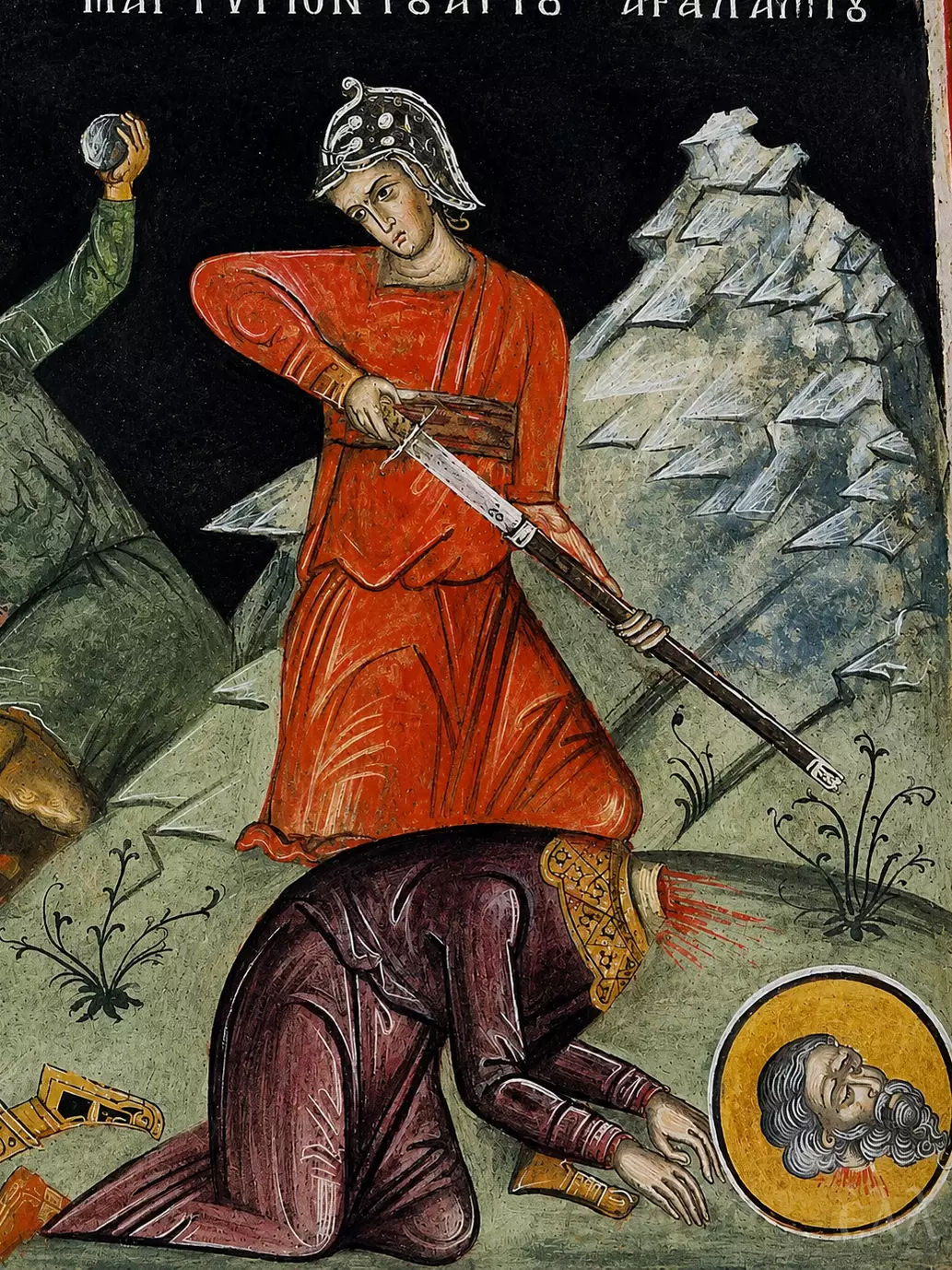
The Martyrdom of Saint Charalambos, painted in 1547 in the katholikon of Dionysiou Monastery on Mount Athos, belongs to the great sixteenth-century renewal of monumental painting associated with the Cretan painter Tzortzis and his workshop. The composition, when the eye moves from the dark upper field towards the lower foreground, concentrates the episode within a remarkably restricted pictorial space. An executioner in an intense red garment and metal helmet occupies the dominant vertical axis, while the saint’s kneeling body fills the foreground and his haloed head lies separately at the right. Across the black upper field, the Greek inscription identifies the subject as the martyrdom of the saint, so that textual designation and visual narrative operate together.
Its severity is immediate, although the painter avoids pictorial confusion. Broad areas of vermilion, purple, grey-green and black are divided by firm contours; the rocky landscape rises abruptly behind the principal figure; sparse plants punctuate the ground without turning it into a naturalistic setting. The result belongs unmistakably to the visual language of Post-Byzantine monumental painting, yet the scene remains mobile in its internal construction. One diagonal—the long sword passing across the executioner’s body—cuts against the strong vertical structure and carries the eye down towards the kneeling saint. The moment has already occurred. What remains is stillness beneath movement, the immobile body beneath the standing figure above it.
The Martyrdom of Saint Charalambos and Cretan Painting at Dionysiou
Built in 1540 following the destructive fire that had affected Dionysiou Monastery, the katholikon received its painted decoration only a few years later. Monument documentation dates the programme to 1547 and attributes it to Tzortzis, while modern research has treated the question with slightly greater caution, allowing for assistants working under the direction of the Cretan master. Panagiotis Damoulos, in a detailed doctoral study of the monastery’s wall paintings, connects the decoration with the sixteenth-century Cretan School and stresses both its relationship with the art of Theophanes the Cretan and its continued engagement with Palaiologan pictorial traditions. The same study notes that later written evidence associates the painter of Dionysiou with Tzortzis and that collaborators probably participated in the extensive undertaking.
Such qualification matters. Tzortzis should not simply be described as an imitator, still less should every feature of the painting be explained through the name of Theophanes. At Dionysiou, an organised workshop practice emerges with its own graphic discipline. The figures are firmly bounded. Drapery does not dissolve into soft transitions; it is articulated by lines, changes of plane, abrupt highlights. Faces, where preserved, are constructed through concentrated modelling in which dark passages and narrow lighter strokes bring out cheekbones, brows and noses. The landscape follows an equivalent logic: rock is presented as a sequence of angular facets, overlapping planes of blue-grey, pale green and nearly white, built upward in compressed space rather than receding towards a distant horizon.
In the Martyrdom of Saint Charalambos, colour establishes the first hierarchy. Against the black background and the cooler mountain behind him, the executioner’s saturated red tunic separates his figure decisively from its surroundings. His bent posture introduces another level of tension. Head inclined, shoulders slightly compressed, he appears as a body engaged in an action that has just reached its conclusion. The contours of the sleeves swell outward before turning sharply inward at the waist; below, the garment separates into elongated folds over the legs. Metal, cloth, flesh, rock: each receives its own linear treatment.
Lower down, the saint creates a very different shape. His dark purple garment occupies a broad curved mass, and the body remains upon the knees, bent forward with both arms extended. This continuing posture produces one of the composition’s strongest visual effects. No elaborate setting is needed to separate earthly action from sacred identity. The golden nimbus around the saint’s head carries much of that distinction. Against the comparatively subdued ground, its circular form is bright, geometrically complete; beside it, the bent body irregular, heavy, displaced. Circle and broken contour, gold and purple.
The executioner’s costume receives equal attention. His helmet, enriched by pale highlights and small circular ornaments, introduces a military specificity without developing into archaeological description. The equipment identifies function rather than an exact historical period. His long sword crosses the composition diagonally, linking the torso with the lower right zone and counteracting the vertical thrust of the standing figure. Because the surrounding landscape is comparatively stable, this diagonal becomes particularly insistent. The mountain rises in stacked facets, the ground inclines gently, small black plants curve upward. Across them the sword forms a harder, unbroken trajectory.
Within the photographed field, at the extreme left edge, another figure is only partially visible. A raised arm holds what appears to be a stone, while lower down fragments of another figure enter the frame. What lies beyond the cropped margin cannot be established from this photograph, and the precise narrative relationship of these figures to the principal episode should therefore not be pressed further. What can be said from the visible evidence is narrower: the movement at the left changes the rhythm of the field and prevents the martyrdom at the centre from being framed by empty landscape alone.
The inscription above operates differently. Large white Greek letters advance across the black ground and identify the scene as the martyrdom of Saint Charalambos. The inscription—set high above the figures and extending across the dark field—gives the upper margin an almost architectural stability, compensating for the irregular silhouette of the rocks below. Inscription, figure, landscape are held within a carefully stratified surface. Even the empty black intervals remain active, allowing the helmet, the mountain peaks and the lettering to stand apart rather than merge into one another.
This disciplined organisation belongs to the broader achievements of Cretan monumental painting on Mount Athos during the sixteenth century. Official archaeological documentation from the Antiquities Authority records that the Dionysiou katholikon was painted by Tzortzis in 1547, while scholarship places the ensemble within a larger network of Cretan painters working for major monastic foundations. A related discussion of the monastery’s later artistic environment appears in the Makedonika study devoted to the Chapel of All Saints, evidence of the continuing density of painted programmes within the Dionysiou complex.
The identity of Charalambos belongs to a much older Christian tradition. Later hagiographical accounts describe him as a priest associated with Magnesia in Asia Minor and place his martyrdom in the period of Septimius Severus. Such biography is secondary to the operation of the image itself. Tzortzis—or the painter working within his workshop—does not reconstruct Roman Magnesia or attempt a historically descriptive scene. The rocks are conventional, the costume generalised, the ground stripped of incidental detail. Through this compression of historical distance, the recognisable signs of martyr, executioner and final ordeal can be read almost immediately.
What gives the painting its particular force is this economy. The martyr’s sanctity does not depend upon accumulated symbols, the executioner is not turned into a grotesque caricature, the landscape does not compete with the human event. Gesture, colour, contour, inscription. From these few elements the narrative is formed. Even the strongest colour, the executioner’s red, draws attention downward towards the dark-robed body and the small but commanding golden circle beside it. The visual hierarchy reverses the apparent hierarchy of scale. Largest is the standing agent of the event; dominant, finally, the saint.
(The translation was edited by A. Orfanos.)