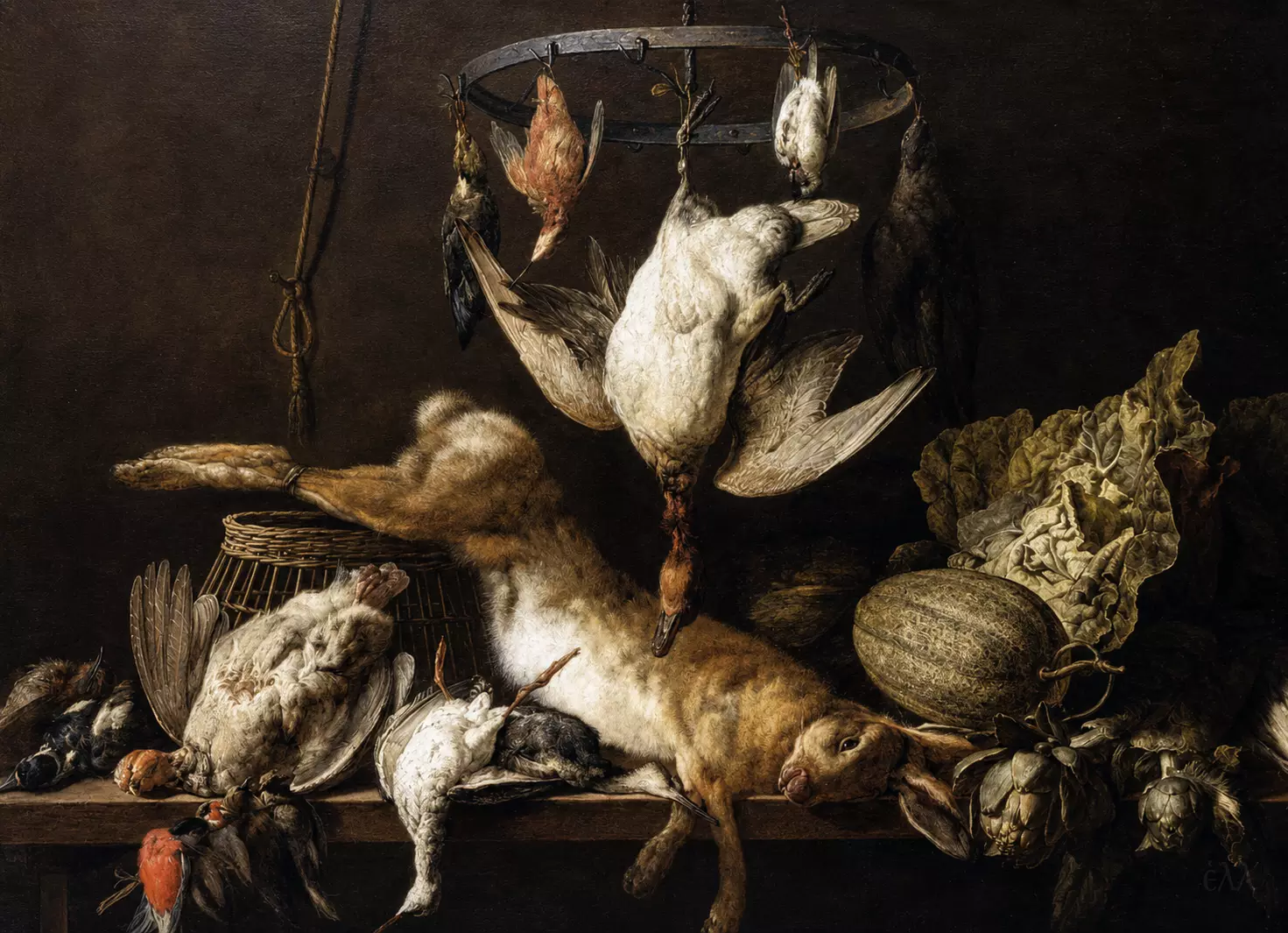
Adriaen van Utrecht’s Still-Life with Hare and Birds on a Ring, painted between 1646 and 1649, compresses the visual language of the Flemish game still life into a canvas measuring 86 by 117 centimetres. Now in the Gemäldegalerie in Dresden, the oil painting possesses a physical force that its relatively modest dimensions hardly predict. A hare extends across the lower centre, its body establishing a broad horizontal mass along the tabletop, while birds descend from the iron game ring suspended above. At the right, a melon, folded cabbage leaves and globe artichokes gather into a compact group, their hard and leafy forms answering the feathers, fur and wicker on the opposite side.
The subject belonged naturally to Van Utrecht’s Antwerp practice. Born there in 1599, trained from 1614 with Herman de Ryt, and active as a master after returning in 1625 from travels through France, Italy and Germany, he developed a career around still lifes of game, fruit, vegetables, larders and market abundance. His work stood within the orbit of Frans Snyders, though the Dresden painting belongs to a group of smaller hunting compositions associated more particularly with the example of Jan Fyt. Scale matters in this case. Van Utrecht condenses the opulence of the large Flemish pantry picture into a darker, tighter field: objects do not expand through an architectural setting but press together, suspended, piled, laid out, very close to the picture plane.
Still-Life with Hare and Birds: Game, Weight, and Texture
The iron ring provides the painting’s first structural fact. Suspended high in the centre, it creates a shallow arc from which birds hang at different levels, some almost absorbed by the brown-black background, others abruptly seized by light. One large pale bird dominates the group. Its breast and underside become the brightest area of the canvas, while the wings descend in angular diagonals on either side. Beneath it, the hare lies laterally across the table, head toward the right, the hind legs bound and raised behind. Between the hanging game and the animal below Van Utrecht establishes a crossing of axes: vertical suspension above, bodily weight below.
Weight, indeed, governs much of the visual experience. The hare sags against the tabletop; the fur thickens around its torso, one foreleg falls over the edge, and the length of its body seems to pull the composition downward. Gravity is made legible. To the left, an overturned wicker basket partly disappears beneath birds and feathers, its open lattice introducing a dry, geometric texture among much softer surfaces. Several smaller birds approach the front edge. A red-breasted bird near the lower margin produces a sudden accent before the eye moves back into shadow. Visibility is never distributed evenly.
That unevenness is deliberate. A concentrated source of light enters from the left and falls obliquely across the principal forms, while softer illumination from the opposite direction prevents the shadows from closing completely. Van Utrecht repeatedly used this double illumination to give substance to objects in his still lifes. In the Dresden painting the effect is particularly strong: breast feathers, the hare’s flank, the smooth skin of the melon and the ridged cabbage leaves detach themselves from a background capable of absorbing almost everything beyond the direct reach of light.
The resulting chiaroscuro gives the forms considerable volume, but surface remains equally important. Fur, plumage, wicker, rind, leaf, feather shafts, the dense green bracts of the artichokes—each demands a different kind of paint handling. The distinction between them is part of the subject. An artichoke cannot reflect light as the breast of a bird does; the melon answers illumination with a duller, enclosed solidity; cabbage leaves gather it in broken ridges and recesses. Van Utrecht turns edible and hunted matter into an extended exercise in optical discrimination.
Across the right half, the vegetables provide more than accompaniment to the game. They establish its compositional counterweight. The melon is a closed, heavy oval set against the irregular cabbage behind it. Beneath, the artichokes repeat smaller pointed forms, their leaves and stems interrupting the long horizontal edge of the table. The cabbage behaves differently again, opening into folds and creases, a broad mass of wrinkled matter touched by subdued highlights. Beside the dead animals these forms establish another register of nature—dense, tactile, silent. The pantry image becomes a study in substances.
Such attention to material difference belonged to the extraordinary development of still-life painting in seventeenth-century Flanders. Van Utrecht, Frans Snyders and Jan Fyt became major practitioners of paintings in which game, fruit, vegetables and other provisions could carry the visual ambition once expected from larger narrative subjects. A closely related Van Utrecht composition of 1648, now in the National Museum of Western Art in Tokyo, again combines dead game with vegetables. Two years later, in the monumental Still Life with Game, Vegetables, Fruit, and a Cockatoo in the J. Paul Getty Museum, the repertory expands yet further. Recurrent hares, birds, cabbages, artichokes and fruit supplied Van Utrecht with a flexible vocabulary through which texture, scale, colour, weight and abundance could continually be reorganised.
The Dresden painting is comparatively restrained. Browns, greys, subdued greens and pale creamy tones dominate the chromatic range, with red appearing only as a small interruption. This economy gives exceptional force to the luminous hanging bird and the exposed portions of the hare’s fur. The dark areas are active too. At the left, a suspended cord falls from the upper edge without becoming part of the principal display; the game ring itself emerges from obscurity instead of belonging to a fully described interior. A wall, a table, hanging implements: enough space to establish the setting, no more.
Compression also clarifies a characteristic of Van Utrecht’s compositional language. Prado scholarship has emphasised his tendency toward firm horizontal and vertical organisation, in contrast to the stronger diagonals associated with Snyders. The Dresden canvas demonstrates that preference with unusual clarity. The table edge fixes the lower zone. The hare repeats its horizontal direction. From the centre descends the game ring and its birds, while the vegetables create a concentrated balancing mass on the right. Wings, legs and stems introduce diagonals, but their movement disturbs an underlying structure that remains firmly controlled.
Stillness, therefore, is complicated. The animals are lifeless, although their bodies retain traces of movement: wings opened through suspension, legs bound together, feathers displaced, bodies turned and overlapping. The vegetables likewise seem handled and recently placed. No human figure appears, yet signs of human action occupy almost every part of the canvas—hunting, binding, carrying, hanging, sorting, laying out. Nature has already entered the sphere of possession and preparation.
This physical fact can encourage interpretations concerning mortality, though a specific vanitas programme is unnecessary to recognise the presence of death. The hare and birds are actual dead bodies before they become possible symbols. Van Utrecht neither disguises their condition nor relinquishes their beauty. Soft gradations of fur remain visually seductive; feathers retain their sheen and delicacy; the spread wing of the central bird catches light with almost extravagant refinement. Sensuous painting and utilitarian reality meet in the same objects.
The history of the painting introduces another, less visible complexity. Older Dresden catalogues recorded the work with attributional caution and noted that an inscription connecting it with Jan Fyt was regarded as spurious. The painting was already listed in the Dresden inventory of 1754. Modern reference sources commonly present it as a work by Adriaen van Utrecht and date it to 1646–49. The earlier hesitation is significant because the Dresden composition belongs precisely to the area in which the artistic languages of Van Utrecht and Fyt came particularly close.
At its own scale, Still-Life with Hare and Birds on a Ring remains remarkably concentrated. Its drama requires no human gesture and no narrative incident. It develops from the downward pull of the suspended birds, the long body of the hare, a melon resisting the crumpled leaves behind it, artichokes projecting across the table edge. Dominant throughout is Van Utrecht’s control of what may be seen clearly and what must remain partially withheld. Some forms flare into illumination; others withdraw almost completely into brown darkness. Between those conditions, dense and exact, the painting acquires its particular authority.
(The translation was edited by E. Alexandraki)