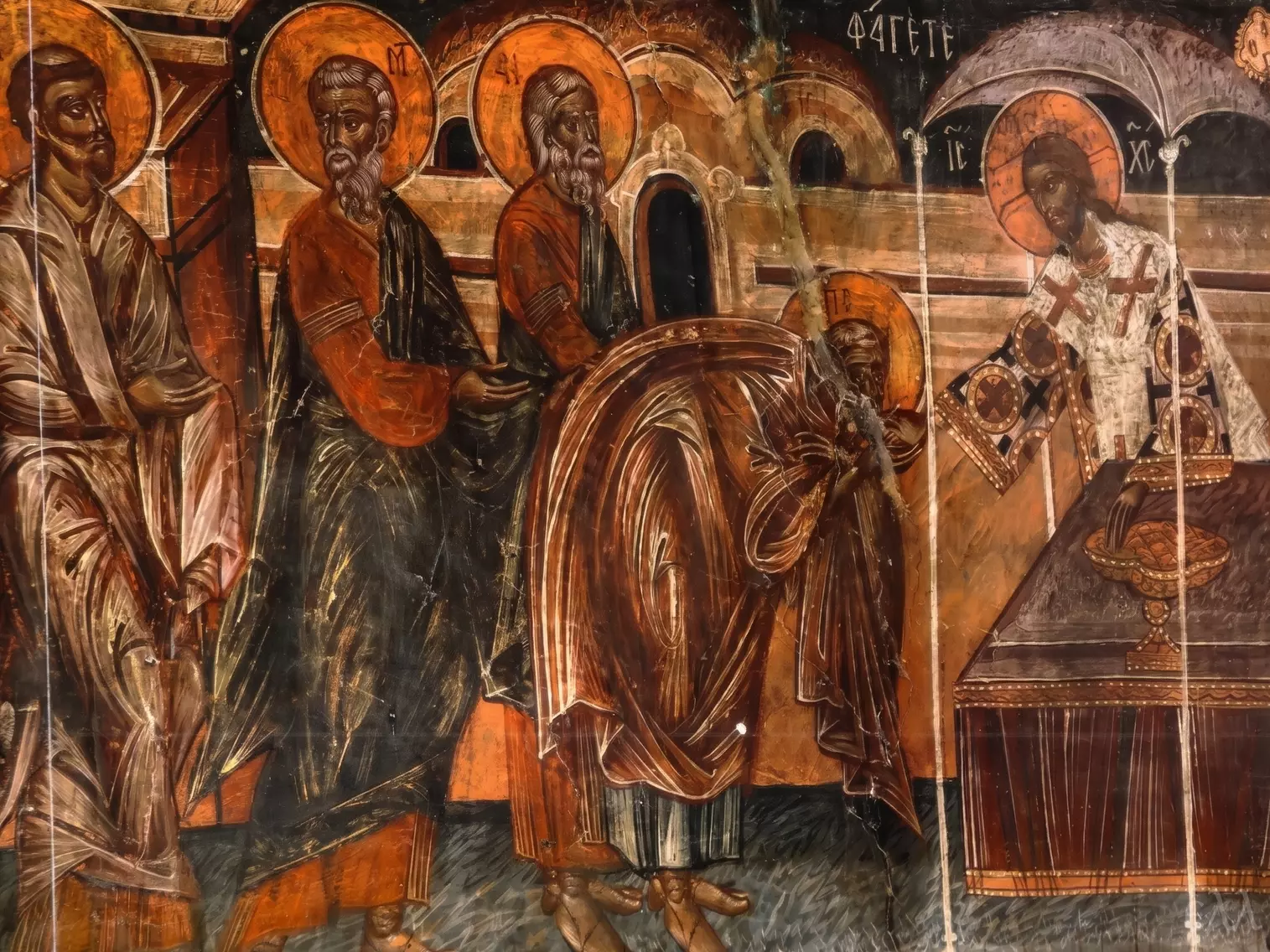
The Communion of the Apostles, painted by Georgios Moschos in 1620 for the katholikon of the Monastery of the Holy Forty Martyrs at Chrysafa in Laconia, occupies one of the most charged positions within the sanctuary decoration: immediately beneath the Heavenly Liturgy, in a zone where painted image, altar ritual and Eucharistic theology are brought into unusually close correspondence. The monastery wall paintings, securely documented as part of Moschos’s production, belong to a major monument of seventeenth-century Post-Byzantine painting in the Peloponnese. Recent research has treated the Chrysafa programme as particularly important for understanding both his individual artistic language and the wider circulation of iconographic models during this period.
Following the established Byzantine conception of the Communion, the composition expands its liturgical character with considerable insistence. Christ appears twice, vested as a high priest and standing behind the Holy Table beneath two ciboria. To one apostolic group he distributes the consecrated bread; to the other, the chalice. The duplication makes visible the twofold Eucharistic action and constructs around the altar a pictorial order governed by repetition, correspondence, approach and reception.
In the surviving section reproduced here, the movement is towards Christ. The apostles advance from the opposite side in a compact sequence; one bends deeply to receive from the chalice, the figures behind him waiting within a procession whose rhythm is deliberate, dense, almost compressed against the architectural background. Christ, pale-robed and hieratic beneath his cross-inscribed halo, provides the fixed point towards which their bodies and glances converge.
The Communion of the Apostles and the Eucharistic Image
At the centre of the complete composition stands the Holy Table, and around it Moschos organizes almost everything that gives the scene its meaning. A paten raised on a tall foot bears portions of the Eucharistic bread; a Gospel book and a vessel intended for the zeon are also represented. Between the two images of Christ, behind the altar, a monumental seraph carries two liturgical fans. Altar, Gospel, vessels, ciboria, episcopal vestments, angelic ministry: the accumulation is precise. Sacred narrative has been recast through the visual vocabulary of the Divine Liturgy.
This transformation had deep roots in Byzantine sanctuary imagery. The Communion of the Apostles had been represented since Early Christian times, acquiring an especially important place in Middle and Late Byzantine apse programmes as the Eucharistic character of sanctuary decoration became increasingly explicit. Christ does not appear here as a historical host seated with the disciples at the Last Supper (Matthew 26:20–29). He acts liturgically. The apostles approach him as communicants; the altar replaces the domestic table of the Gospel meal.
Moschos retains that essential distinction with exceptional clarity. His Christ is dressed in episcopal vestments, a visual identification of the celebrant with the Great High Priest. Within the painted sanctuary, the rite therefore seems to reproduce the rite performed before it. The real Holy Table of the church and its painted counterpart belonged to different levels of experience, yet the spatial proximity between them would have made their relationship immediate to anyone standing before the apse.
The inscription reinforces the connection. The supplied text records the words [ΛΑΒΕΤΕ] ΦΑΓΕΤΕ ΠΙΕΤΕ ΕΞ ΑΥΤΟΥ ΠΑΝΤΕΣ, combining the Eucharistic imperatives of Matthew 26:26–27: “Take, eat” and “Drink from it, all of you.” The language functions within the action itself rather than merely describing it. Image and written word meet at precisely the moment when Christ distributes the Gifts.
Moschos also identifies the individual apostles through abbreviated names placed in their halos. According to the documented description of the complete scene, Paul heads the group receiving the chalice, followed by John, Mark, Simon, James and Philip. Peter leads the opposite approach towards the Eucharistic bread, with Andrew, Matthew, Luke, Bartholomew, Thomas and Judas. Judas, carrying the portion of bread he has received, is distinguished iconographically through his departure from the group. Into an otherwise convergent composition his movement introduces a small but potent counter-direction.
Within the visible wine-communion section, that system of approach can be read with particular force. The foremost apostle bends towards the vessel held by Christ; immediately behind him, the figures rise progressively into a nearly continuous vertical mass. Little independent space remains around their bodies. Mantles overlap, halos nearly touch, dark garments merge across boundaries before quick pale highlights separate them again. The result is processional rather than episodic. Individual personality remains legible in the faces, yet it is incorporated into collective movement.
Colour intensifies the organization. Through the halos and architectural surfaces run warm ochres, burnt orange and reddish brown, while the apostolic garments alternate between deep green, brown-black and earth red. Thin, almost abrupt highlights cut across the drapery and recover forms from the dark passages. Against this chromatic density, Christ’s much lighter episcopal vestments carry exceptional visual weight. His body does not require enlarged scale to dominate the scene. Luminosity, the surrounding ciborium, the direction of apostolic movement establish the hierarchy.
Severe are the faces, with long noses, deep eye sockets, narrow cheeks, sharply articulated brows and strongly patterned hair belonging to a pictorial language in which modelling and line repeatedly compete for emphasis. Several heads turn slightly instead of presenting strict frontality. That small deviation matters, preventing the apostolic procession from becoming a row of static portraits and directing attention towards the liturgical act unfolding before them.
Much of the spatial structure remains deliberately shallow. Architectural walls, arches and openings form a continuous setting behind the figures, although they do not construct a coherent perspectival interior in the Renaissance sense. They establish sanctuary architecture as a sign, provide measured divisions across the pictorial field and frame Christ beneath the ciborium. Across the wall the composition consequently moves more strongly than it recedes into it; figures, architecture and altar objects occupy successive but tightly compressed planes.
The paint surface itself now interrupts that order. Vertical fissures and areas of abrasion cut through garments, halos and architectural passages; elsewhere, the darker tonal structure survives with striking strength. These disruptions leave the principal compositional logic readily legible. From the standing apostles, towards the bowed communicant, finally towards Christ, the broad movement remains clear.
A larger iconographic context surrounds the scene. Above the Communion, Moschos painted the Heavenly Liturgy, introducing the extraordinary representation of a painted templon into the sanctuary imagery. Agoritsa Tseliga-Antouraki has emphasized the unusual character of this invention in Post-Byzantine monumental painting and has related Moschos’s formulation to comparable material associated with Georgios Klontzas. Her scholarly study discusses the Chrysafa apse specifically, while a recent doctoral thesis situates the decoration within the painter’s broader production and seventeenth-century Peloponnesian wall painting.
The possible relationship with Klontzas is significant because it points towards artistic transmission across different media. Comparable arrangements appear in manuscripts and portable icons associated with the Cretan painter, while another rare painted continuation of an iconostasis occurs in the old katholikon of the Monastery of the Archangel Michael Roukouniotis on Symi, a work connected with a Cretan workshop. Such parallels need not imply mechanical copying. Models travelled, were reformulated, passed from manuscript into panel painting and from portable image into monumental decoration. At Chrysafa, Moschos was capable of absorbing that visual material and altering its function within an extensive sanctuary programme.
Its historical setting adds another dimension. Seventeenth-century Orthodox painting developed during a period when discussion of the Eucharist had acquired renewed confessional urgency in the aftermath of the Reformation and Counter-Reformation. Scholarship has therefore considered the exceptional imagery above the Communion in relation to contemporary debates concerning the Eucharistic Gifts and the Orthodox articulation of sacramental doctrine. The pictorial programme, however, carries its theological emphasis through more than polemical reference alone. The painted altar, the repeated Christ, the communion processions and the liturgical objects already establish that emphasis through their placement and visual correspondence.
That correspondence is perhaps the most distinctive quality of the Communion of the Apostles at Chrysafa. What Moschos paints is a biblical event remembered by the Church, an established Byzantine iconographic type, a representation of liturgical action and, through its position inside the sanctuary, an image continually encountered beside the actual celebration of the Eucharist. The figures advance; Christ receives them. Behind, architecture closes the space; before them, the altar opens its meaning. A scene inherited from centuries of Byzantine art remains recognizably traditional, yet within the dense programme of 1620 it acquires an articulation distinctly Post-Byzantine—liturgical, monumental, immediate.
(The translation was edited by K. Pappas.)