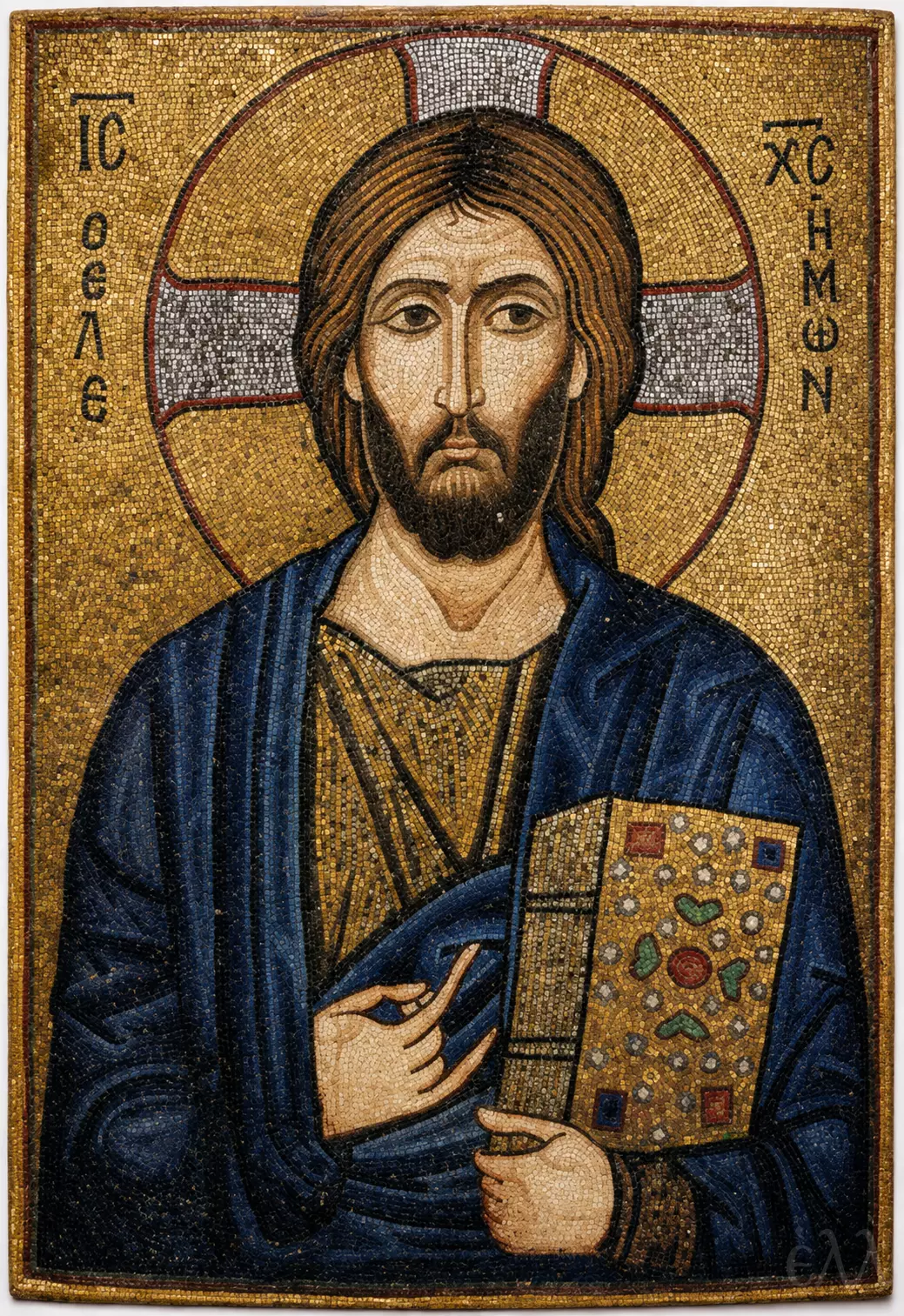
The Christ the Merciful mosaic icon in Berlin is one of the rare large-scale portable mosaics to survive from Middle Byzantine art. Measuring 74.5 × 52.5 cm and preserved in the Museum für Byzantinische Kunst at the Bode-Museum under inventory number 6430, the panel presents Christ in the familiar half-length Pantokrator type: frontal, grave, visually commanding, yet softened by an expression that seems more inward than severe. The work has been dated to the first half of the twelfth century, while the museum’s current record narrows the dating to the first quarter and associates its production with Constantinople. Its size has also encouraged the plausible suggestion that it once occupied a prominent position on a church templon.
Gold dominates the field, though it does not reduce the figure to ornament. Christ’s dark blue mantle descends in broad, controlled folds around a lighter chiton, while the cruciform halo expands behind the head as an imposing circular structure. The Greek inscription identifies both the sacred figure and the epithet: IC XC and Ο ΕΛΕΗΜΩΝ, “Jesus Christ, the Merciful.” A closed, richly ornamented Gospel book rests against his left arm; his right hand, raised before the chest, forms a compact gesture that has been described as both oratorical and benedictory. The distinction is slight but useful, since the hand participates in the communicative force of the image, poised between speech, blessing, and authority.
Christ the Merciful mosaic icon: tesserae, presence, and Komnenian style
From a distance the composition is almost austere. Closer examination changes the character of the object. The face is built from extraordinarily small stone tesserae placed so tightly that the interstices become difficult to perceive; across the hair, stone and glass elements follow the curving strands in ordered rows, while the garments and gold background employ glass tesserae whose changing orientation activates the surface. Light catches one cube, passes over another, breaks against a differently angled tessera, then reappears around the halo or the Gospel cover. The image consequently alters, if only slightly, as the spectator changes position. Matter remains emphatically present; the reflective mosaic surface, dense and shifting, never becomes inert.
The museum identifies the technique more precisely as glass and natural-stone mosaic set into a wax bedding on a wooden panel. Such construction separates the work from monumental wall mosaic, whose tesserae are normally embedded in mortar, and places it within the rare tradition of portable Byzantine mosaic icons. Otto Demus emphasised the rarity and precious character of such objects in his foundational Demus study; more recent scholarship, including Robert S. Nelson’s Nelson study, has continued to examine the exceptional labour required by minute tesserae set into wax-based grounds. The Berlin icon is emphatically not miniature in scale. Its dimensions bring the density and refinement of a portable mosaic into a format capable of addressing an ecclesiastical interior with considerable visual authority.
The face holds the centre. A high forehead, long nose, dark beard, and centrally divided hair establish the canonical physiognomy of Christ Pantokrator, but the mosaicist avoids rigidly diagrammatic treatment. Around the cheeks and eyes, slight tonal changes give volume to the flesh; beneath the brows, narrow bands of shadow deepen the gaze without making it theatrical. The eyes do not merely confront the spectator. Their direction is subtly displaced, introducing a faint psychological tension into an otherwise frontal image. The mouth is small, closed. The contours remain firm, but modelling around the nose and upper lip introduces small transitions rather than abrupt tonal blocks. Across forehead, nose, eyelids, moustache, and beard, the tesseral arrangement behaves almost like drawing, each sequence defining a contour or carrying a tonal transition. It is a face solemn, restrained, intensely worked.
This concentration belongs comfortably within the artistic climate of the early Komnenian period. Twelfth-century Byzantine art inherited the monumental and hieratic structures of the eleventh century while increasingly exploring psychological inflection, flexible linear rhythms, and the expressive capacity of the human figure. The Berlin Christ does not yet possess the agitated drapery or heightened emotional register encountered in later Komnenian monuments. Its energy is held back. Within that restraint survives an older monumental language, although the countenance already possesses something of the inward tension that the later twelfth century would develop with considerably greater intensity.
The epithet “the Merciful” introduces another dimension. Authority and mercy need not be separated into competing identities within the Pantokrator type. The broad cross-inscribed halo declares Christ’s sacred identity; the Gospel book evokes teaching and divine law; the elevated right hand makes the otherwise static figure active within the encounter with the beholder. Yet the slightly contracted brows, the subdued mouth, the careful tonal modelling of the cheeks temper the image’s majesty. Mercy receives no narrative illustration here. Its first explicit statement lies in the inscription, while the physiognomy gives that title a quieter visual register.
Particular attention has been given to the closed Gospel book. Its cover, surrounded by dense ornamental bands, is articulated through red, blue, green, white, and gold elements arranged as gemstones, pearls, and a central rosette-like motif. Against the expansive dark blue mantle, the codex becomes a compact field of colour, almost an object within the object. Christ’s left hand supports it from below with curved fingers; his right, by contrast, opens the lower composition through its raised gesture. Book and hand establish a restrained diagonal across the panel, preventing the powerful frontality of the head and shoulders from becoming immobile. The asymmetry remains slight, carefully measured.
Even the halo takes part in this structural balance. Its golden circumference is crossed by broad arms of cool, silvery tesserae bounded by dark red lines, a chromatic interruption that gives the cruciform nimbus unusual weight. Beyond it stretches the densely tessellated gold field. Minute changes in orientation cause the background to flicker instead of reading as a single metallic plane. Within an ecclesiastical interior, exposed to daylight, oil lamps, and candlelight, the appearance of such a surface would never have been entirely fixed. Around the head, across the field, at the edge of the Gospel, reflected light would have shifted with the spectator and with the source illuminating the panel.
Its probable association with a templon deserves attention for precisely that reason. At 74.5 cm high, the icon is considerably larger than the later micromosaic panels generally linked with personal devotion. Positioned within or close to a sanctuary screen, its half-length frontal figure could have assumed a clear architectural and liturgical presence, while the costly mosaic medium distinguished it from ordinary painted panels. The museum catalogue likewise considers the dimensions evidence for a prominent position on a templon. A particular church, however, cannot be reconstructed from the surviving evidence. Constantinopolitan place of production and hypothetical original setting remain separate questions.
What survives is an object of exceptional technical refinement. Stone tesserae soften the flesh; glass intensifies the garments; gold converts the background into shifting light; the jewelled Gospel compresses several brilliant colours into a small rectangular field. Monumental image and portable object, established iconographic type and minute material invention meet within the Christ the Merciful mosaic icon. Its effects accumulate slowly—in the tiny tesserae surrounding the eyes, the broken reflections of the gold field, the controlled movement of the raised right hand.
(The translation was edited by E. Wilson.)