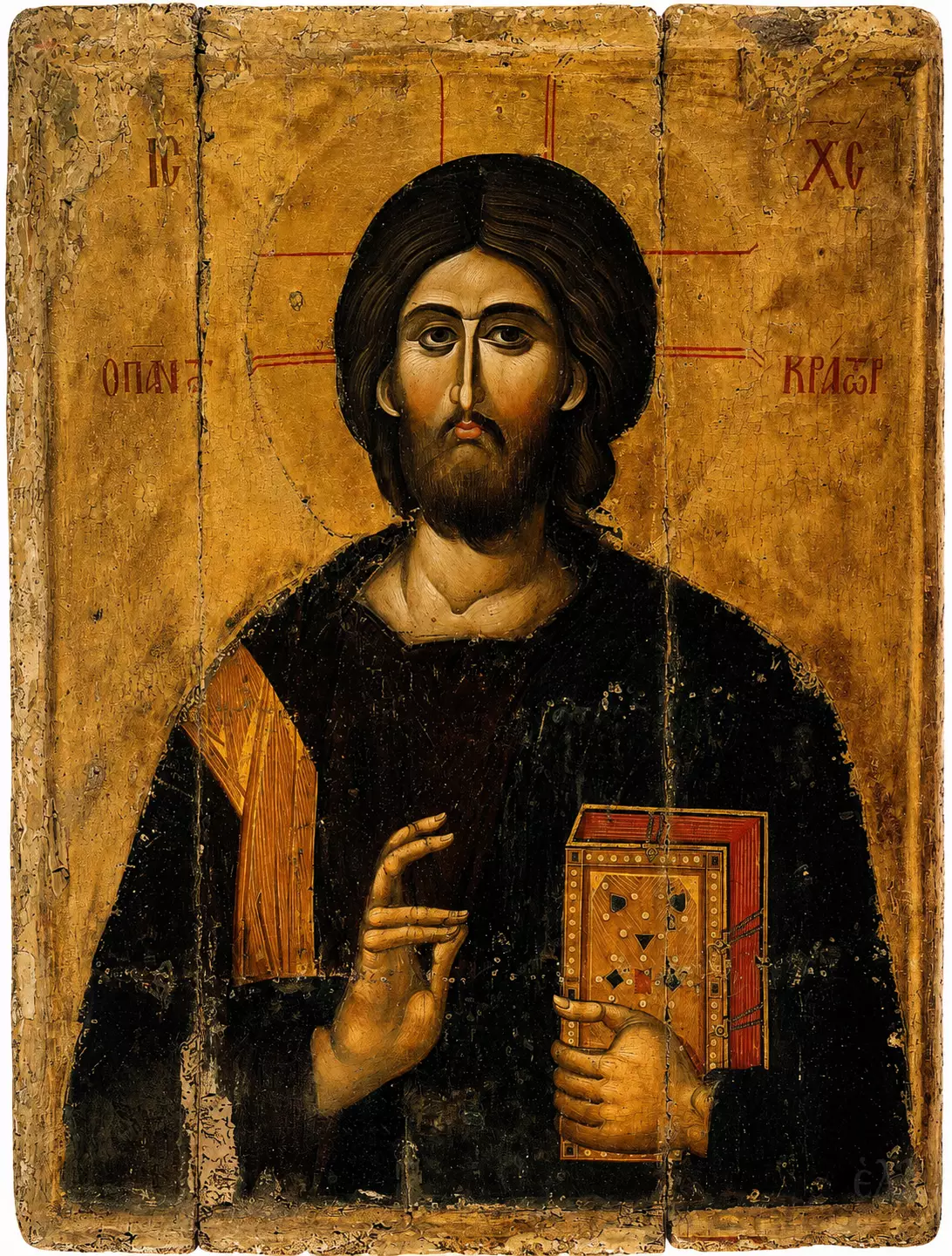
The monumental Sinai Pantokrator icon, preserved at the Monastery of Saint Catherine, presents Christ in the established Byzantine type of the sovereign ruler and judge, his frontal figure emerging with unusual intensity against an expansive gold ground. Painted by an anonymous artist in the closing decades of the fourteenth century, the panel measures approximately 1.30 metres in height and belongs to the extraordinary body of Byzantine icons preserved at Sinai. Christ raises his right hand in a gesture of benediction; with the left he supports a closed Gospel book, its red binding covered by a carefully ordered network of jewel-like ornaments. The attributes are familiar. Their treatment is less predictable.
A nearly axial arrangement governs the figure, yet strict geometrical balance is softened by small variations in the face, hands and fall of the garments. The dark clothing forms a broad mass across the lower field, interrupted by the warm ochre-red sleeve and its fine linear highlights. Above this compressed zone, the head acquires exceptional visual authority. Dark hair, centrally parted and falling towards the shoulders, surrounds an elongated face with a narrow nose, strongly articulated brows and large eyes directed outward. The cruciform halo is indicated by restrained red lines crossing the golden field, while the surviving Greek inscriptions include the abbreviated IC XC and the title identifying Christ as Pantokrator.
The icon follows a Constantinopolitan model whose visual language had long established the Pantokrator as one of the most commanding formulations of Christ in Byzantine art. Its anonymous painter, however, did not turn inherited convention into mechanical repetition. Within a type defined by continuity, the expression has been made markedly introspective.
The Sinai Pantokrator Icon and the Authority of the Face
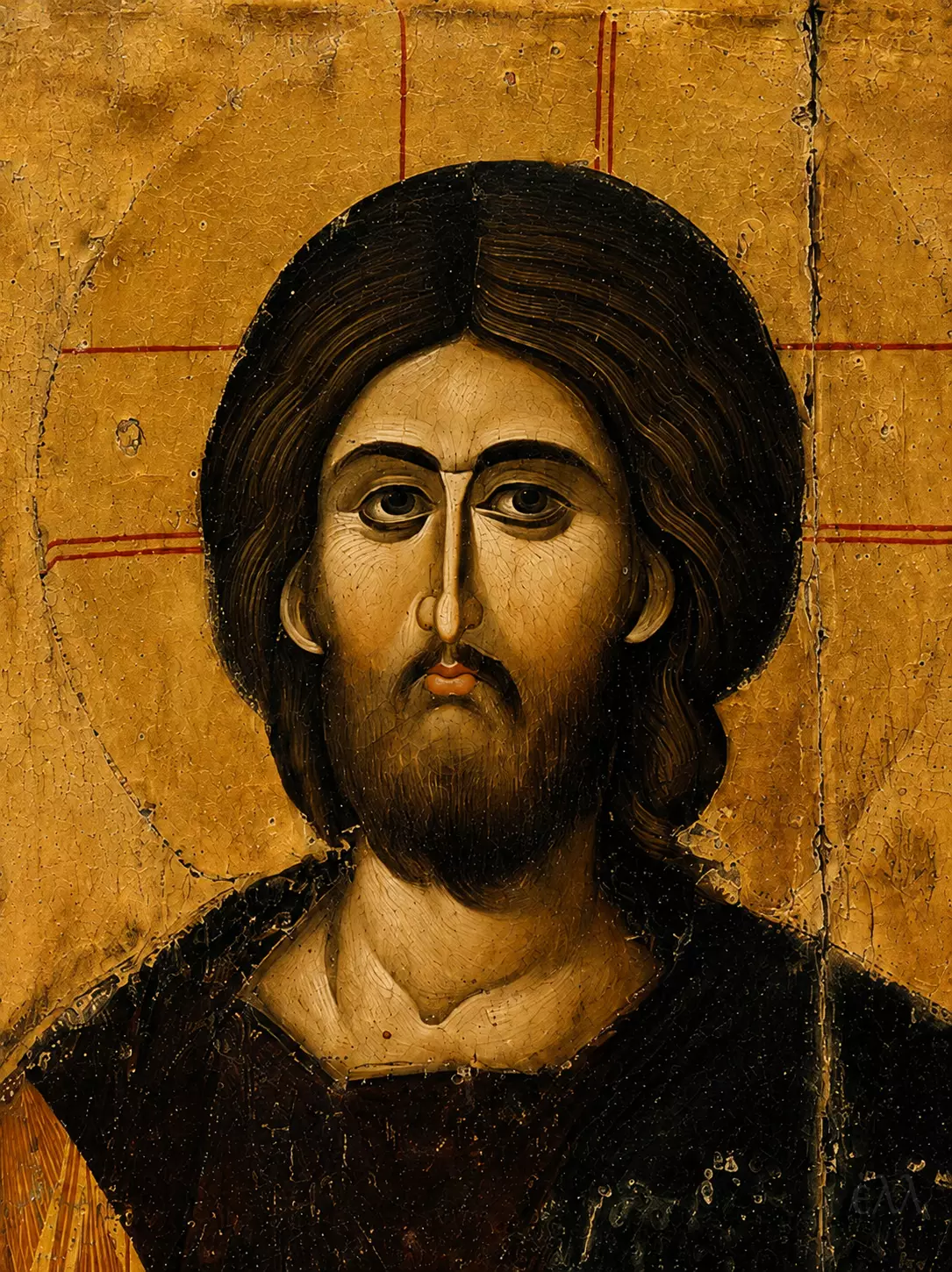
At close range the countenance controls almost everything. The blessing hand, Gospel book, inscriptions and dark garment remain necessary to the iconographic identification, but attention repeatedly returns to the eyes: deep-set, heavily outlined, slightly unequal in their configuration, fixed upon the spectator without the hard immobility that absolute symmetry might have produced. Beneath the arched brows, fine tonal transitions construct the orbital areas and cheeks. Thin linear strokes move across the forehead, around the eyes and beside the nose, giving structure to a physiognomy that remains stylized while retaining a surprising sense of corporeal presence.
The painter has built the flesh through a restricted range of warm ochres, olive-brown shadows and narrow passages of lighter modelling. Around the cheeks the transition is relatively soft; along the nose it becomes abrupt, almost graphic. A small vermilion mouth interrupts the brown beard, an accent minute in scale yet visually insistent. Hair and beard are treated through repeated fine lines that describe direction without dissolving the compact silhouette of the head. What emerges is a face at once highly ordered and subtly unsettled, solemn, observant, inward-looking.
Such asymmetry has sometimes encouraged elaborate interpretations of Pantokrator imagery, especially attempts to read different aspects of Christ’s nature into contrasting facial halves. The visible evidence of this panel calls for greater restraint. Slight differences between the eyes, shadows and contours certainly affect the psychological force of the image; they do not by themselves establish a specific theological programme. What can be observed is more compelling: absolute frontality is disturbed just enough to prevent the face from becoming impersonal.
Across the complete panel, this concentration upon the countenance is reinforced by an unusually economical spatial structure. There is no architectural setting, landscape or narrative episode. Gold occupies the surrounding field; Christ, the centre. The richly decorated Gospel introduces a second focus lower in the composition, its rectilinear form set against the broad darkness of the garment. Small circles, coloured stones and geometric devices articulate the binding with almost miniature precision. The raised hand answers it on the opposite side through a completely different rhythm—curving fingers, open intervals, a sequence of controlled gestures.
Age has become visually inseparable from the icon. Vertical fissures traverse portions of the wooden support, the gold ground is abraded, and numerous losses interrupt the painted surface, particularly around the shoulders, edges and lower part of the panel. These disruptions do not create the formal language of the work, yet they now condition its appearance. Smooth passages coexist with exposed and scarred areas; the regular lines of the halo encounter cracks, worn inscriptions, surviving fragments of colour.
Against that altered surface the face remains remarkably commanding. It also carries the feature that most clearly distinguishes this fourteenth-century Pantokrator within the broader continuity of the type: the gaze does not communicate severity alone. A contemplative, almost melancholic quality enters it, difficult to reduce to any single facial feature and equally difficult to overlook. In a monastery containing images separated from one another by many centuries, the painter worked within an ancient iconographic tradition while giving its central figure a presence distinctly his own—controlled in gesture, monumental in conception, unexpectedly vulnerable in expression.
(The translation was edited by A. Orfanos.)