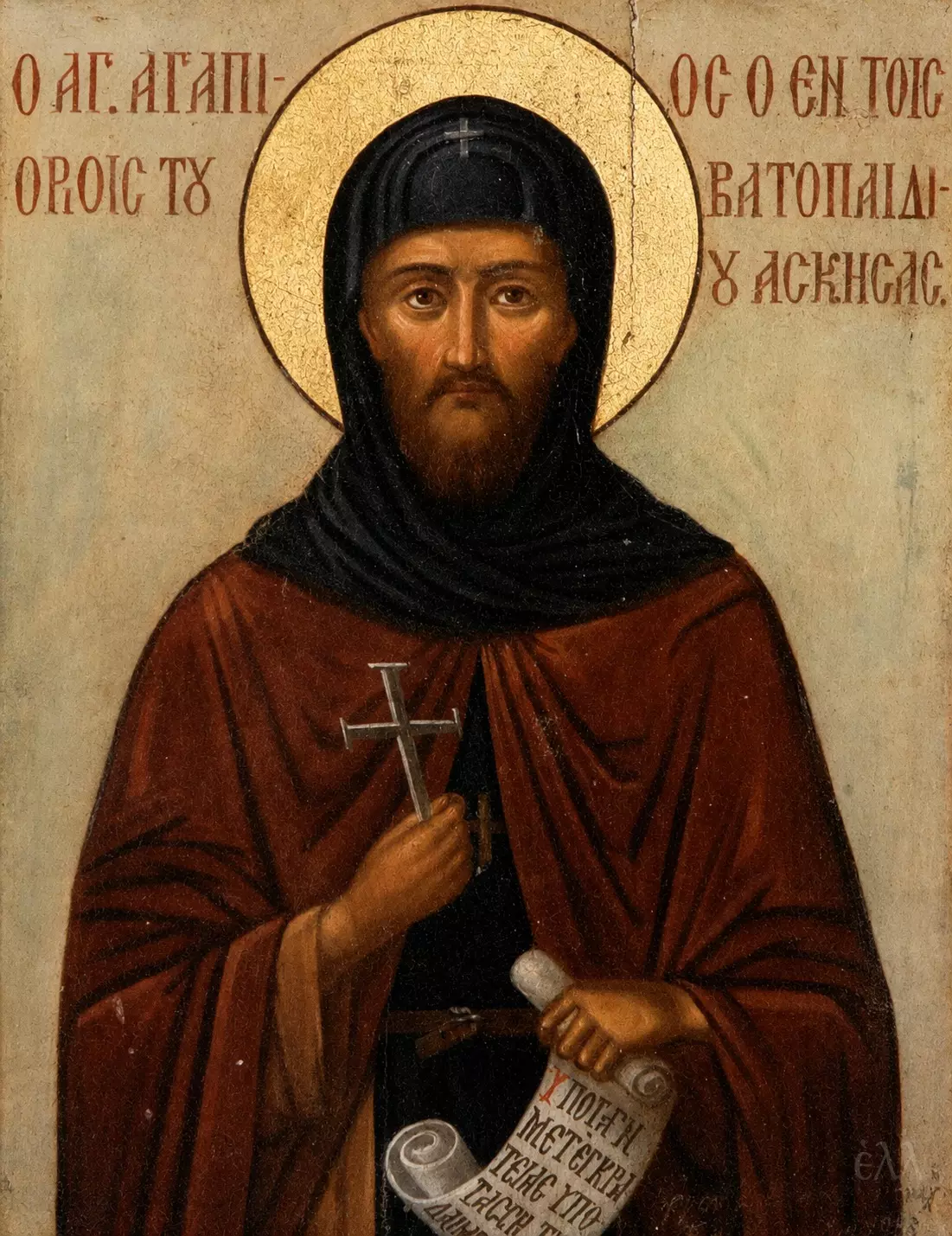
A solemn ascetic figure emerges from the pale, neutral ground of this portable panel, serving as a direct visual embodiment of the enduring spiritual lineage of Mount Athos. Painted in 1943 by an anonymous monastic artist, the work portrays Saint Agapios, an ascetic whose historical tradition anchors him to the immediate vicinity of the Holy Great Monastery of Vatopedi. Preserved within the collection of the Karakallou Monastery, this panel functions as an important document of local hagiographical memory. The painter has rigidly adhered to the established Post-Byzantine stylistic conventions of the region, consciously replicating the formal vocabulary of earlier centuries. The preservation of such specific local veneration through painted panels demonstrates how Athonite monasteries sustained continuous narratives of sanctity. These works gave prominence to figures who, while perhaps lacking broader pan-Orthodox recognition, remained important intercessors within the specific spiritual topography of the Holy Mountain.
The Formative Language of the Osios Agapios Vatopedinos Icon
The stylistic execution of the Osios Agapios Vatopedinos icon illustrates the remarkable conservatism and deliberate continuity characteristic of twentieth-century Athonite workshops. The saint’s physiognomy, dominated by deep-set eyes, arched brows and a dense, bifurcated brown beard, is rendered with stark linear austerity. His expression projects a profound, silent introspection that commands the pictorial space. A striking chromatic juxtaposition defines the entire composition. Deep, almost impenetrable black characterises the monastic head covering, absorbing the surrounding light and framing the face with heavy severity; against it, the warm, saturated red-brown of the heavy mantle draped over his shoulders. The lines rigid, the transitions abrupt, the emotional restraint absolute. The facial modelling proceeds from a dark proplasmos, with successive, tightly controlled layers of lighter ochre defining the features. Final sharp white highlights articulate the bone structure, specifically emphasising the cheekbones and the bridge of the narrow nose.
Through such conservative stylistic choices, the painting differs markedly from the more naturalistic tendencies that had entered other areas of Athonite workshop production during the late nineteenth and early twentieth centuries. The drapery folds of the mantle are executed with geometric rigidity. They descend in rhythmic, V-shaped patterns rather than falling with fully naturalistic weight, giving the saint’s body a schematic and deliberately restrained presence. No landscape setting is offered. No architectural frame confines the figure. Within the shallow, non-illusionistic pictorial space, the ascetic is detached from any specific historical setting. During a decade when the broader world was engulfed in global conflict, this 1943 production remains visually removed from temporal crisis, focused instead upon the inherited devotional language of the peninsula.
Iconographic Attributes and Epigraphic Evidence
Examining the specific attributes reveals the painter’s close adherence to the established representation of ascetic saints. In his right hand the saint holds a small cross, an attribute associated with ascetic self-denial and a life understood through spiritual crucifixion. His left hand secures an open scroll bearing a Greek text, its lettering descending in carefully ordered majuscule forms, with the thumb resting prominently against the rolled parchment. The visible text is only partly legible in the photograph, though its dark lettering forms a strong graphic element against the light surface of the scroll. Direct and frontal is the saint’s gaze, engaging the viewer while preserving the severe stillness of the figure.
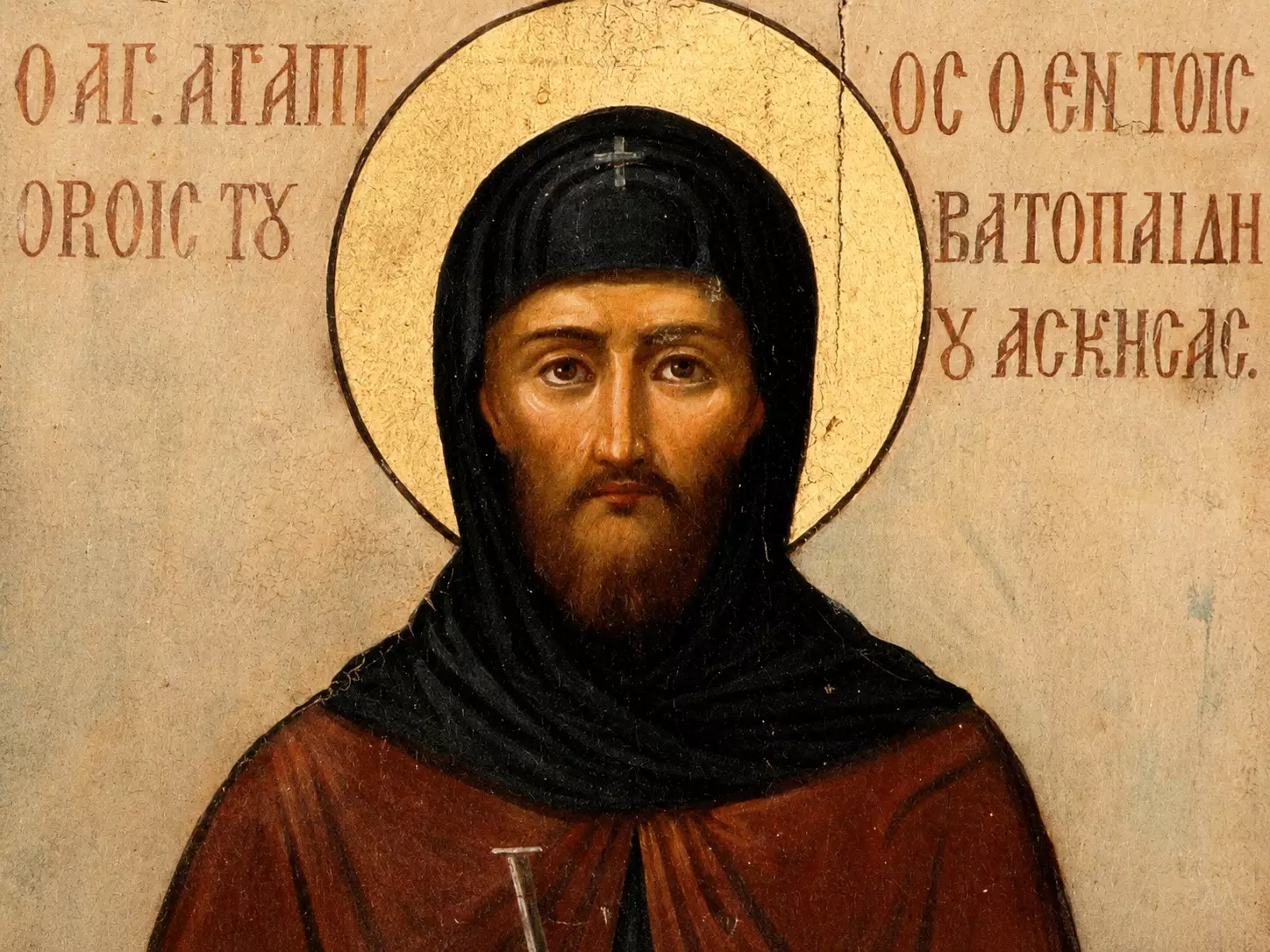
The background of the panel is painted in a flat, muted cream tone, while the halo forms a luminous gold field that isolates the head from the neutral ground. This halo intersects the prominent identifying inscription painted directly onto the background in a faded reddish-brown pigment. Divided on either side of the figure, the inscription reads: “Ο ΑΓ. ΑΓΑΠΙΟC Ο ΕΝ ΤΟΙC ΟΡΟΙC ΤȢ ΒΑΤΟΠΑΙΔΙȢ ΑCΚΗCΑC” (“Saint Agapios who practised asceticism within the boundaries of Vatopedi”). Its lettering preserves abbreviations and contracted forms characteristic of traditional Byzantine and Post-Byzantine icon inscriptions. Partial abrasion is visible in the inscriptional field, alongside vertical fissures running down the wooden support, one of them cutting through the right side of the halo. In the upper-right area these surface disruptions expose small portions of the underlying ground.
(The translation was edited by E. Wilson.)