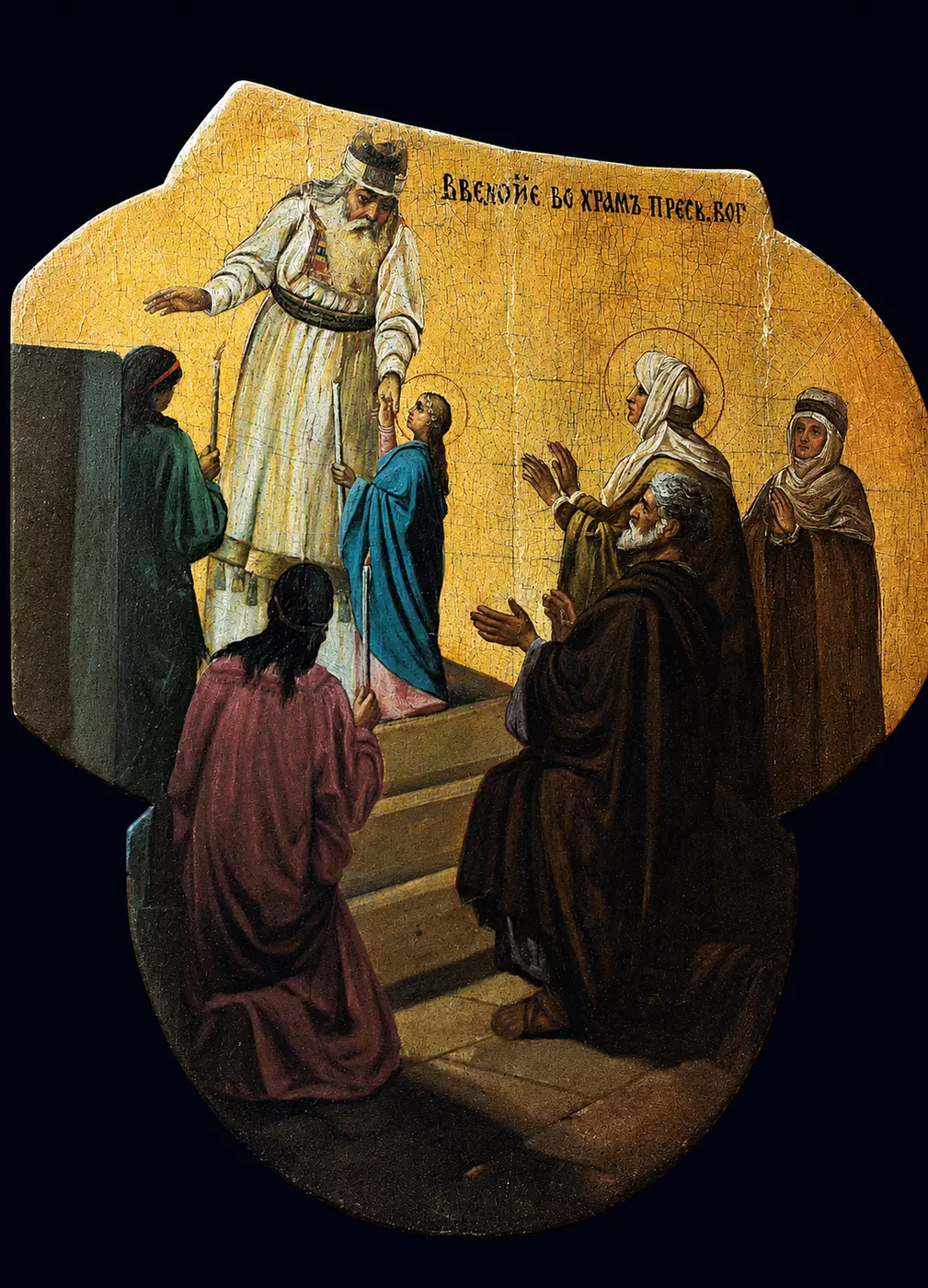
Across a broad golden ground, heavily marked by craquelure and interrupted at the perimeter by the irregular surviving contour of the wooden support, an anonymous 18th-century Russian painter set out the Presentation of the Virgin icon as a compact ceremonial encounter. The panel, associated with southern Russia, represents the three-year-old Mary ascending the steps of the Temple to be received by the priest Zacharias. Its Church Slavonic titulus survives across the upper field in abbreviated form, identifying the subject as the Entry of the Most Holy Theotokos into the Temple. The inscription is part of the pictorial field rather than an ornamental addition: black lettering cuts sharply into the extensive gold, occupying the otherwise unarticulated space above the figures.
The subject belonged to an old Byzantine iconographic tradition and became established among representations of the major Marian feasts. Its narrative ultimately draws upon the Protoevangelium of James, while Byzantine and later Orthodox imagery developed a recognisable scheme in which the young Virgin approaches Zacharias, accompanied by Joachim, Anna and maidens carrying lamps or candles. Surviving examples occur in monumental painting, manuscript illumination and festal icons, and the composition continued through Post-Byzantine and Russian artistic practice with considerable local variation. The present panel retains that inherited narrative structure, although its painter reduces architectural setting almost to disappearance. Gold replaces building.
The Presentation of the Virgin Icon and Its Post-Byzantine Composition
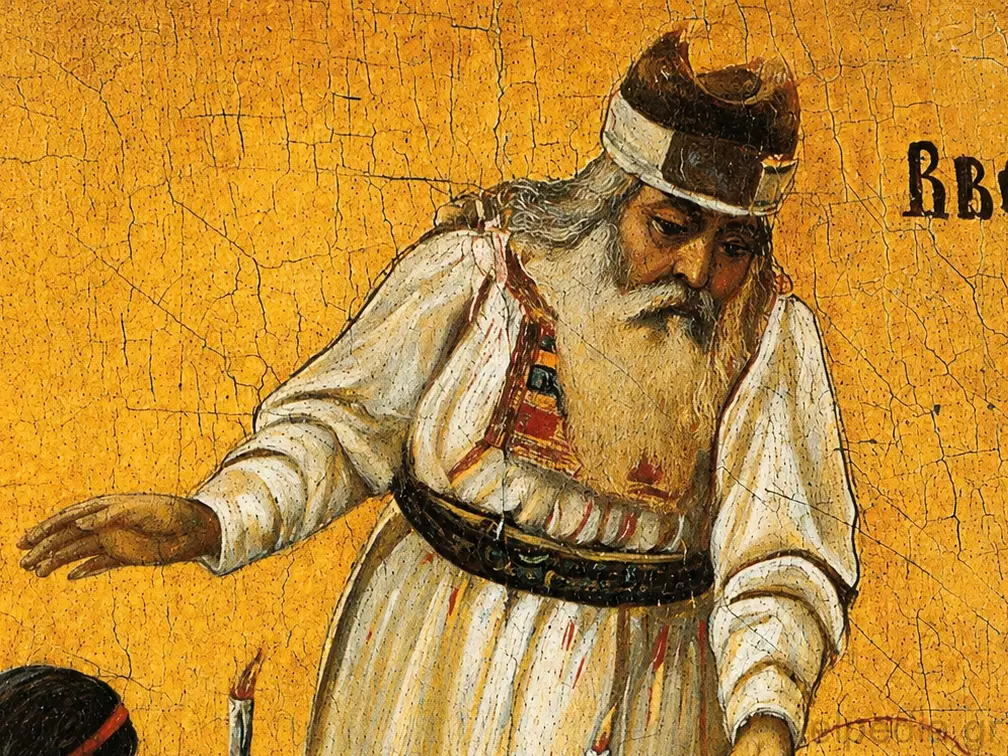
Dominating the upper half of the composition is Zacharias. His scale, considerably greater than that of the child before him, establishes the first visual hierarchy, yet his bent posture prevents the difference in size from becoming static. The elderly priest inclines his torso forward and lowers one arm towards Mary; the other extends outward in a broad, almost horizontal gesture. Grey hair spreads over his shoulders, while the long white beard is modelled with closely drawn strands of darker grey and cream. Across his forehead sits a light band beneath a dark, unusually high head covering. Nothing in this costume attempts archaeological reconstruction in a modern sense. It is an archaising invention, a painterly means of making the priest belong to an ancient sacred order.
The white garment is handled differently. Long vertical folds descend from the waist and are interrupted by touches of ochre, grey and muted red, producing a surface that remains linear even when the artist attempts volume. At the chest a rectangular ornament, divided into strong red, dark and light sections, introduces one of the most concentrated passages of colour. A black belt then cuts across the figure. Zacharias consequently occupies the gold field as a pale vertical mass, broad above, narrowing towards the steps.
Mary is minute beside him. Her blue mantle, falling in relatively simple folds over a pink garment, gives the child a chromatic intensity disproportionate to her physical scale. One arm reaches upward and meets the lowered hand of Zacharias. The body is small; the physiognomy, by comparison, carries little of the rounded softness expected in a naturalistic representation of a three-year-old. Such compression of childhood into an already solemn sacred type belongs comfortably within the conventions of Orthodox icon painting, in which hierarchical and theological identity frequently governs the treatment of age. Other Russian examples of the feast likewise preserve the marked difference in scale between the young Virgin and the adults who surround her.
The steps matter. They form the only substantial architectural element beneath the figures and create an ascending diagonal through a composition otherwise governed by vertical bodies. Mary has already reached their upper portion, while several accompanying figures remain below. Space is therefore shallow but intelligible: the master establishes distance through overlap, height and placement instead of constructing a perspectivally continuous interior.
Among the attendants, two candle-bearing young women provide a second movement towards the central encounter. One stands upright in a dark green garment, the narrow burning taper rising beside her; another, lower down and seen largely from behind, wears a muted reddish-purple mantle and holds a similar candle. In the established iconography of the feast, such figures belong to the company of maidens accompanying the Virgin to the Temple, often described as the daughters of Zion and represented carrying lights. Their treatment in this icon is strikingly unsymmetrical: into the dark edge of the pictorial field one nearly disappears, while the other spreads into a broad mass of red below, her turned back withholding the face altogether.
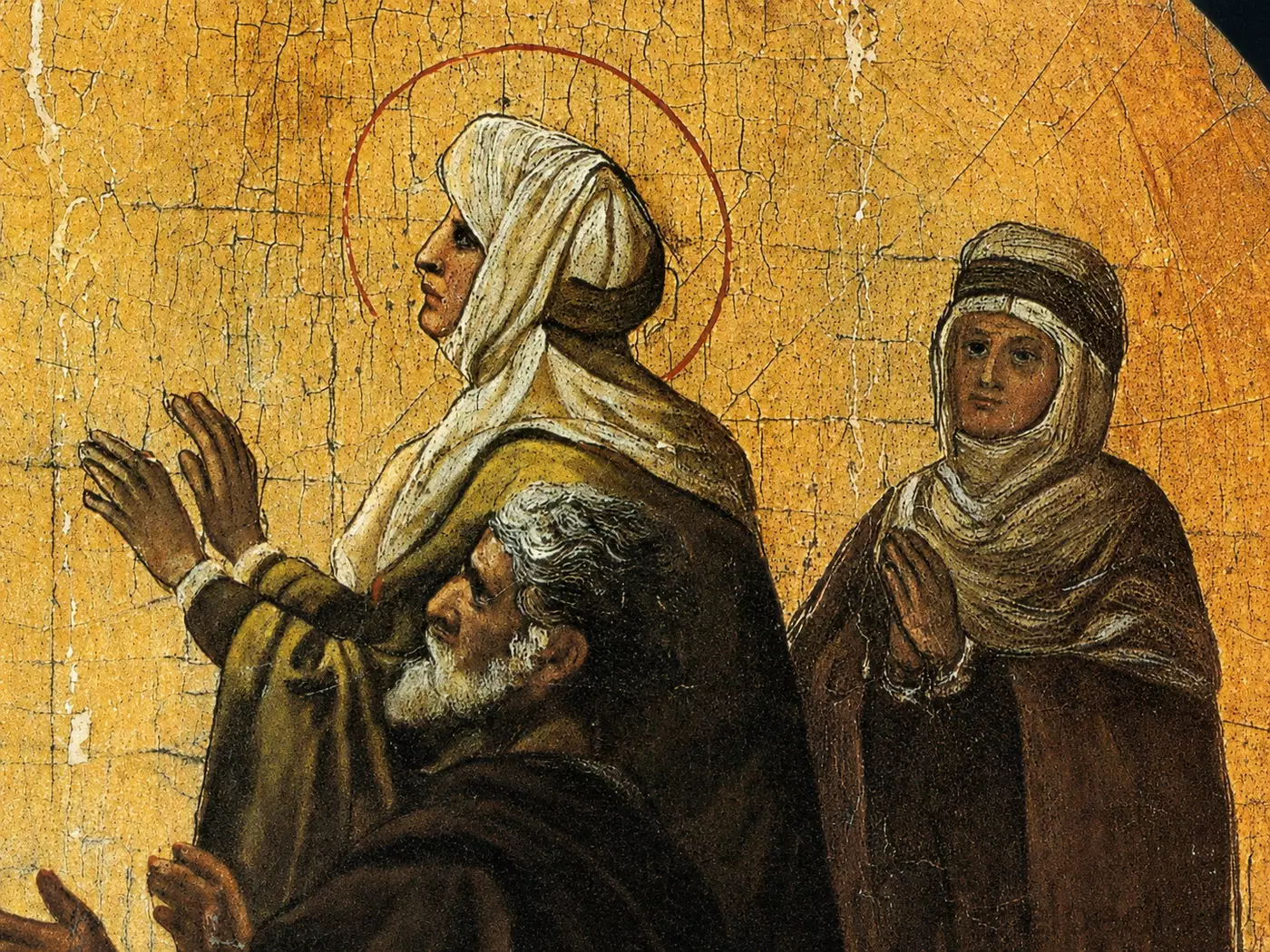
On the opposite side the rhythm changes again. A haloed woman, identifiable within the traditional narrative as Anna, raises both hands in prayer; beneath her the elderly Joachim extends his arms towards the child, his dark brown clothing absorbing much of the available light. A further female figure stands behind them with hands joined at the chest. The icon painter has given these three figures little spatial separation. Garments overlap, outlines meet, bodies are compressed against the gold, so that the group functions visually as a dark counterweight to the expansive white form of Zacharias.
Across all of this runs the cracked golden surface. The dense network of age-related craquelure is especially conspicuous around the priest’s head and throughout the open upper field, passing without distinction across background, inscription and painted forms. Along the outer edges, the wooden panel has an uneven, fragmentary silhouette. Whether this resulted from cutting, accidental loss or some later alteration cannot be determined from appearance alone. What remains is enough to alter the balance of the painting: a feast traditionally enclosed by elaborate Temple architecture survives within an object whose own damaged boundary has become unexpectedly visible.
(The translation was edited by F. Kalimeris.)