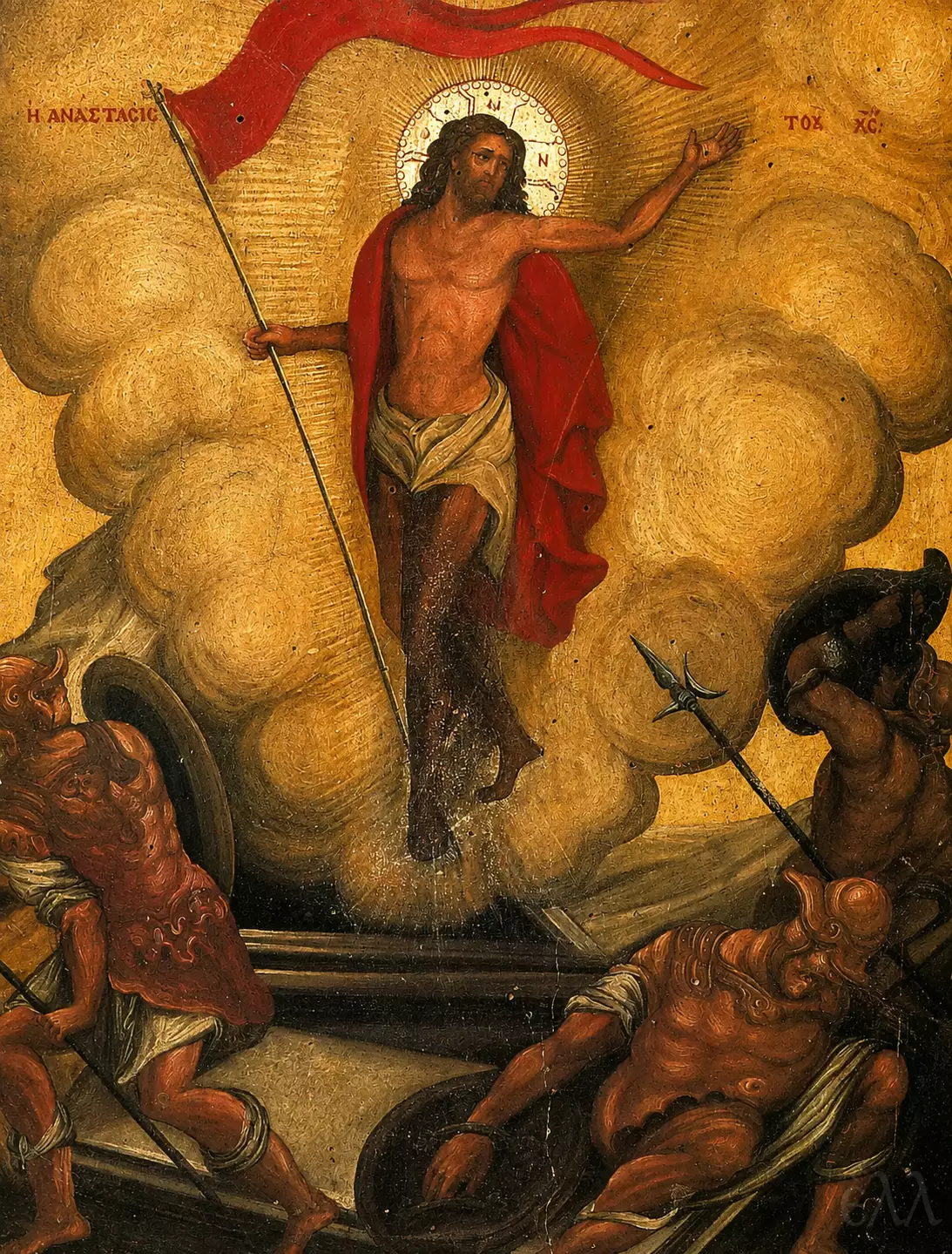
The Post-Byzantine Resurrection Icon associated with the Greek church of Santa Maria degli Angeli in Barletta belongs to an eighteenth-century artistic environment in which inherited Byzantine forms encountered the visual language of Italian painting with unusual directness. Christ dominates the composition, standing above the sepulchral zone while armed guards collapse, sleep or recoil below him. Across the gold field rises a long staff carrying a vermilion banner; around the central figure, great rounded masses of cloud open into a luminous space far removed from the severe abstraction characteristic of much Middle Byzantine painting.
Any identification of this scene as the Descent into Hades requires qualification. The theological idea of Christ’s victory over death certainly governs the image, yet the visible iconography differs markedly from the established Byzantine Anastasis. Adam and Eve are absent; Christ does not grasp Adam by the wrist, the broken gates of Hades do not form the familiar dramatic crossing beneath his feet, and the righteous of the Old Testament are nowhere assembled around him. Instead, the painter employs a Western-derived representation of the risen Christ above the tomb, accompanied by soldiers and the banner of victory. An Orthodox Post-Byzantine image, then, but one in which the Resurrection is expressed through a pictorial formula strongly affected by Italian art. Anna Kartsonis’s fundamental Anastasis study remains an important point of reference for the formation and development of the Byzantine type.
The Post-Byzantine Resurrection Icon and Its Hybrid Visual Language
At the centre, Christ establishes the vertical axis with exceptional firmness. His body is nearly frontal, although the slight turn of the head and the opposed movement of the arms prevent complete rigidity. In his right hand—the hand appearing on the viewer’s left—he holds the tall staff. His left arm extends upwards and outwards, the open hand turned towards the surrounding radiance. Bare torso, exposed legs, pale cloth at the waist, deep red mantle: large areas of colour divide and clarify the body immediately. The mantle falls heavily behind him before gathering into broad folds along his left side, while the banner above repeats its red in a much freer, almost wind-driven curve.
The cross-inscribed halo provides a second concentration of light around the head. Fine rays extend from its circumference into the surrounding gold, so that the relatively small head becomes the optical centre of a much larger radiating field. The gold ground itself, unmistakably inherited from icon painting, suppresses ordinary atmospheric distance and removes the sacred event from measurable time. Against it, however, the painter has introduced enormous clouds, modelled through ochres, browns and muted yellow highlights. They swell forward like substantial bodies. Gold denies natural depth; clouds impose a sense of volume.
Below, a different rhythm takes control: bent torsos, helmets, weapons, shields, partially visible limbs. The soldiers form a broken succession of diagonals around the dark horizontal structure of the tomb. On Christ’s left, in the lower part of the composition, one guard is pressed into the corner while a long weapon rises obliquely into the scene. To the right, another figure has fallen backwards, the body turned almost horizontally, while farther above a dark armoured guard occupies the edge of the pictorial field. The human disorder at ground level is deliberate. Above, the risen Christ remains vertical and stable; below, bodies scatter, weapons shift, gestures stop halfway through their movement.
Closely associated with Western Resurrection imagery is this contrast, especially with the type in which Christ rises triumphantly while the guards at the sepulchre are overcome by the event. The banner strengthens that association. Its sweeping curve is theatrical in comparison with the stillness of the body, and the modelling of Christ’s partly unclothed figure gives him a corporeality less characteristic of the canonical Byzantine Anastasis. Yet the painter retains an iconic centrality, a golden background, a hieratic enlargement of the sacred figure and a degree of frontal clarity. Two pictorial traditions occupy the same panel without becoming fully indistinguishable.
Such artistic intersections were hardly accidental in eighteenth-century southern Italy. Greek Orthodox communities established along the Italian and Adriatic coasts commissioned painters who worked within a cultural region shaped by Ionian, Venetian, local Italian and older Byzantine practices. Eugenia Drakopoulou’s scholarly discussion of these artistic transfers addresses Barletta specifically and associates festival and apostolic icons of the Santa Maria degli Angeli iconostasis with Dimitrios Bogdanos, a Corfiot painter and priest whose work remained connected with Byzantine models while also revealing knowledge of Italian painting. The authorship of the present panel should not be assigned to Bogdanos without precise catalogue documentation, but the artistic setting defined by that research is directly relevant.
The church itself preserves the material history of this exchange. Its monumental iconostasis, organised in several registers, served a Greek community with an established presence in Barletta. Within such an ensemble, the Resurrection panel would have been encountered in relation to other Christological scenes rather than as an isolated experiment in Italianate painting. Its forms—iconic in structure, Western in several narrative details—belong to an ecclesiastical environment in which established visual practices could absorb new pictorial habits without relinquishing their original devotional setting.
The composition makes that accommodation visible with particular clarity. Christ does not simply rise into an empty gold field. Around him clouds accumulate in great rounded volumes, beneath him the tomb establishes a horizontal barrier, across him the banner creates a long diagonal, and below him the soldiers break into discontinuous poses. Vertical ascent, horizontal tomb, diagonal staff: the principal lines meet around the central body. Their geometry is simple, the resulting visual pressure considerable.
Christ, the Banner and the Radiating Halo
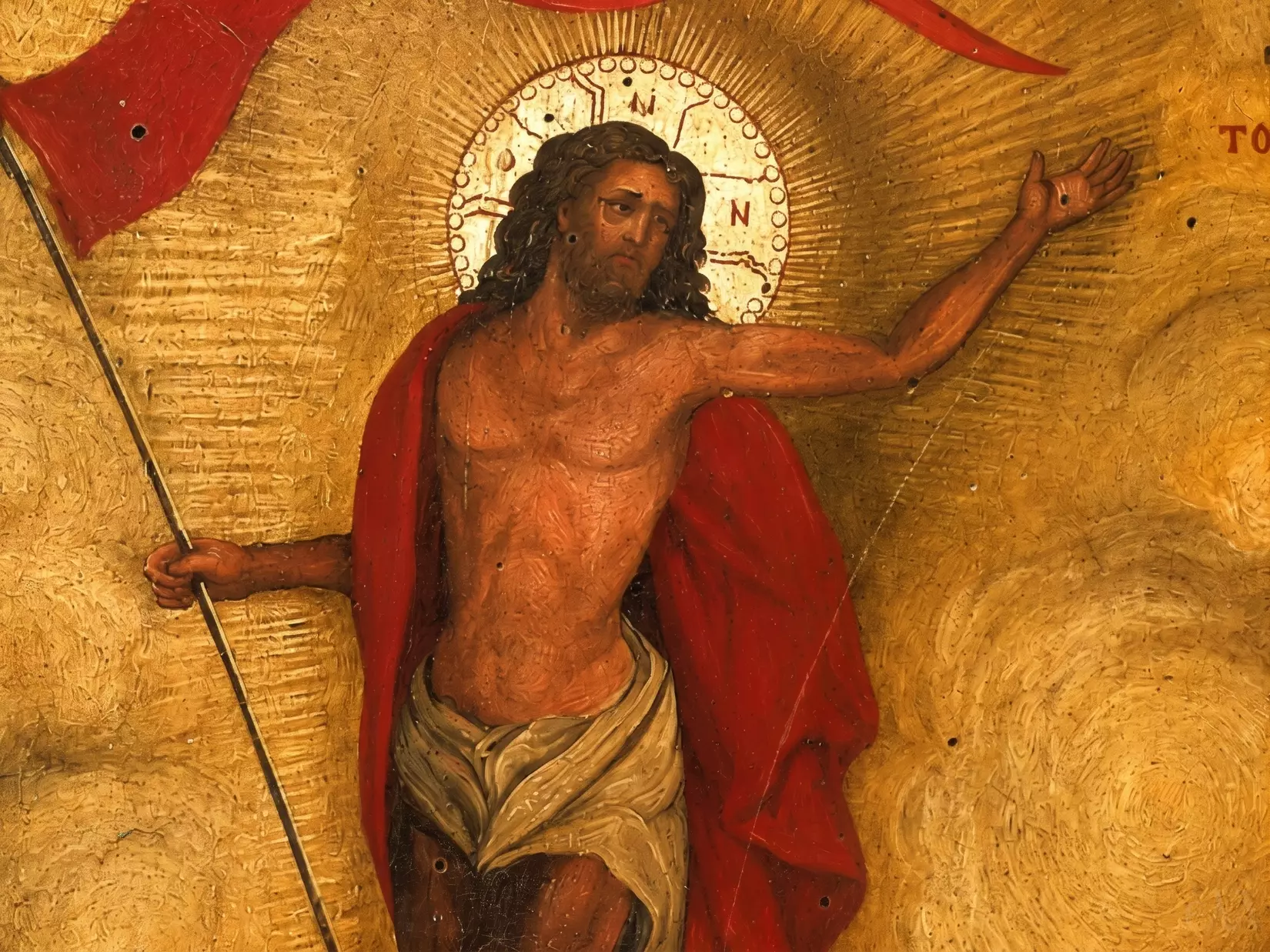
Seen more closely, Christ loses some of the monumentality produced by the complete composition and reveals the painter’s markedly linear handling. Dark contours organise the torso, shoulders and arms; within them, warmer and lighter tones establish the chest and abdomen through restrained modelling. The anatomy is simplified yet deliberately corporeal. Long dark hair descends onto the shoulders, framing a face whose expression remains grave and concentrated, detached from the agitation unfolding beneath him.
Particularly important is the raised left hand. The extended fingers continue the outward movement of the arm and lead directly into the fine radiating strokes that surround the figure. Behind the opposite shoulder, the red mantle forms a dense chromatic mass; overhead, the banner suddenly loosens into a broad undulating strip. The body still, the cloth in motion. This division between physical stability and animated drapery gives the figure much of its authority.
The cruciform halo, whose brighter interior is edged by repeated ornamental marks, remains one of the most concentrated passages of the image. From it spread thin rays that extend well beyond the head and across the golden field. Their repetition creates a visual bridge between halo and cloud, between the compact sacred sign immediately around Christ and the enlarged luminous zone surrounding his upper body. The radiance is not confined to a single circular form. It expands outward.
Surface losses, abrasions and scattered interruptions remain visible across the face, halo, background and garments. Small dark lacunae punctuate the gold and flesh tones, while other worn passages disturb the continuity of the painted surface. They do not obscure the principal structure. Indeed, in the closer view the painter’s economy becomes more apparent: dark contour, warm flesh, concentrated red, gold field, repeated radiating strokes. The modelling does not depend upon elaborate tonal gradation; it is carried instead by line, selective highlights and sharply differentiated colour zones.
In the complete panel the guards give the Resurrection its narrative disturbance, but in the detail that disturbance almost disappears. Christ, isolated against gold and cloud, approaches the visual condition of a devotional image. The staff remains in his right hand, the left arm rises, the banner sweeps overhead. What had belonged to a crowded Resurrection narrative becomes, through cropping and close viewing, a study in the central figure itself—body, halo, gesture, red mantle.
For this reason the Post-Byzantine Resurrection Icon is especially revealing as an example of artistic adaptation. The painter preserves recognisable elements of Orthodox icon painting while adopting a Resurrection formula whose soldiers, victory banner, bodily modelling and cloud-filled setting derive substantially from Western practice. The panel does not reproduce the traditional Anastasis. It visualises the risen Christ through another established Christian image, translated into the material and devotional language of a Post-Byzantine icon.
(The translation was edited by A. Williams.)