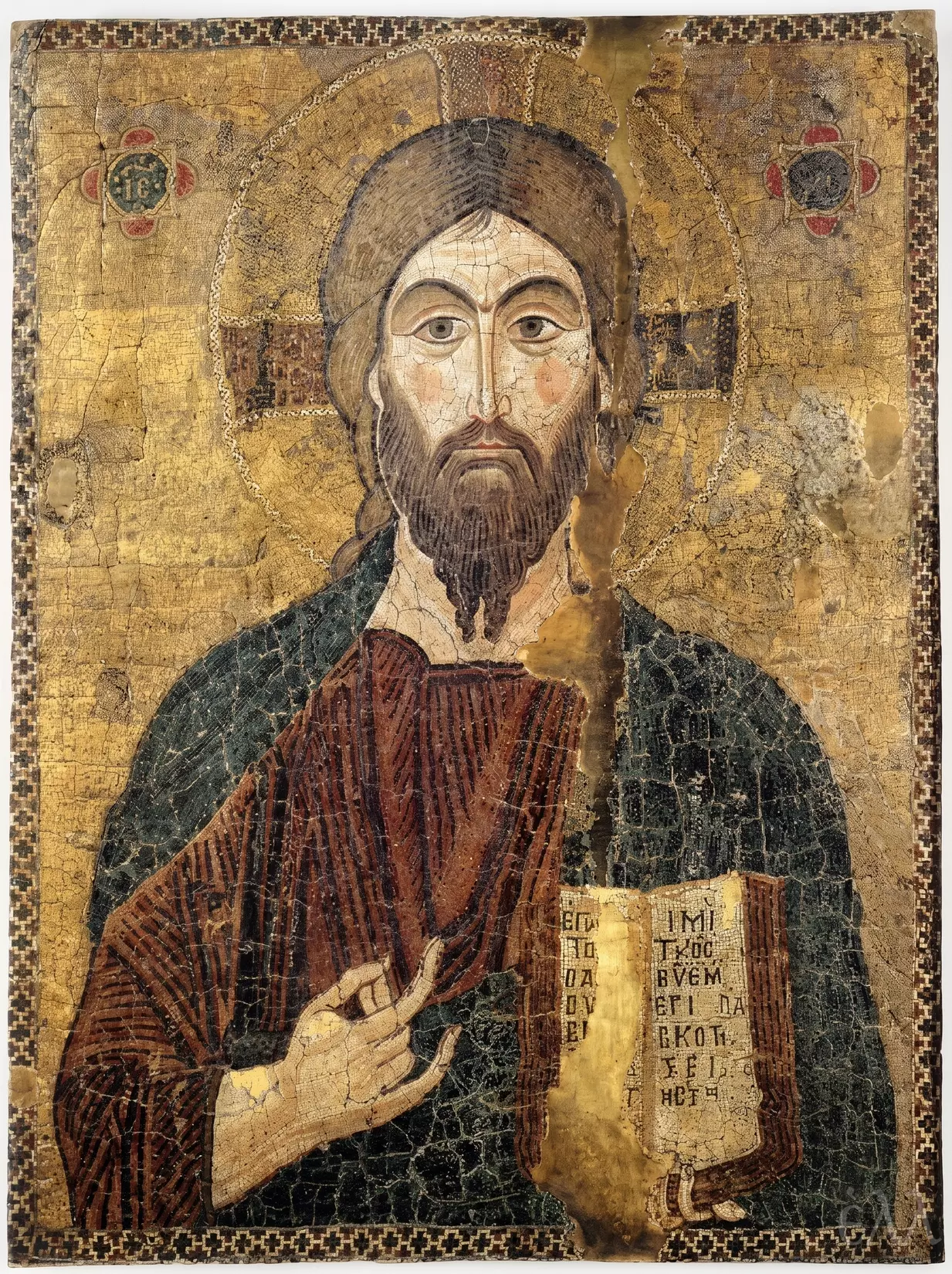
The Christ Pantokrator mosaic icon in the Museo Nazionale del Bargello in Florence, dated to the third quarter of the twelfth century, compresses into a panel measuring only 54 × 41 cm an artistic language usually associated with the vast golden surfaces of Byzantine churches. Christ appears half-length and almost wholly frontal against a gold ground, holding an open Gospel book in his left hand while raising his right in a gesture of blessing, the palm turned outward towards the viewer. The text of the Gospel begins with the declaration «Ἐγώ εἰμί τὸ φῶς τοῦ κόσμου…»—“I am the light of the world” (John 8:12). Word, gesture, gaze: the three elements govern the image.
The mosaicist is unknown. Modern scholarship dates the work to about 1150–1175 and attributes its production to Constantinople, placing it within the artistic culture of the Komnenian period. Conventionally described as a miniature mosaic, the work belongs to a rare group distinguished by the extraordinary minuteness of its tesserae and the refinement with which they reproduce effects associated with painting. Maria Harvey’s micromosaic study discusses the Bargello Pantokrator within this exceptional group of portable works and confirms both its Constantinopolitan attribution and its present Bargello location. The Metropolitan Museum likewise records the icon as a miniature mosaic of 1150–1175, attributed to Constantinople and measuring 54 × 41 cm.
Unlike a monumental apse or dome mosaic, the image brings the Pantokrator within the physical scale of an icon panel. Its concentrated frontality, gold field and carefully ordered inscriptions preserve the commanding visual structure of monumental Byzantine representations of Christ; the minute execution, by contrast, produces an unusually intimate effect. As a mosaic icon it belongs to the tradition of portable sacred images while retaining the material splendour and light-responsive character of mosaic.
The Christ Pantokrator Mosaic Icon: Surface, Gesture and Authority
Across the panel Christ occupies nearly all the pictorial field. Little space remains between his shoulders and the ornamental frame, and the great cruciform halo expands until it approaches the upper border. This compression is important. No landscape, throne, architectural setting or subsidiary narrative absorbs attention: figure, book, hand, face. The gold ground withdraws ordinary spatial coordinates and at the same time acts as a luminous field against which the darker garments acquire exceptional weight.
A narrow border surrounds the composition, formed by a continuous geometric sequence of small equal-armed crosses and rectilinear motifs in dark, reddish and pale tesserae. Against this measured perimeter, the larger circular movement of the halo becomes especially prominent. Its cross is articulated internally by richly patterned rectangular fields, while a pale beaded contour marks the circumference. The abbreviated Christogram IC XC occupies ornamental medallions in the upper corners, themselves shaped through dark centres and reddish lobes. Nothing in these marginal elements reads as isolated decoration. The repeated geometry belongs to the same ordering principle that holds the frontal figure within the frame. Their regularity stabilises a composition whose surviving surface is now visibly interrupted by extensive losses.
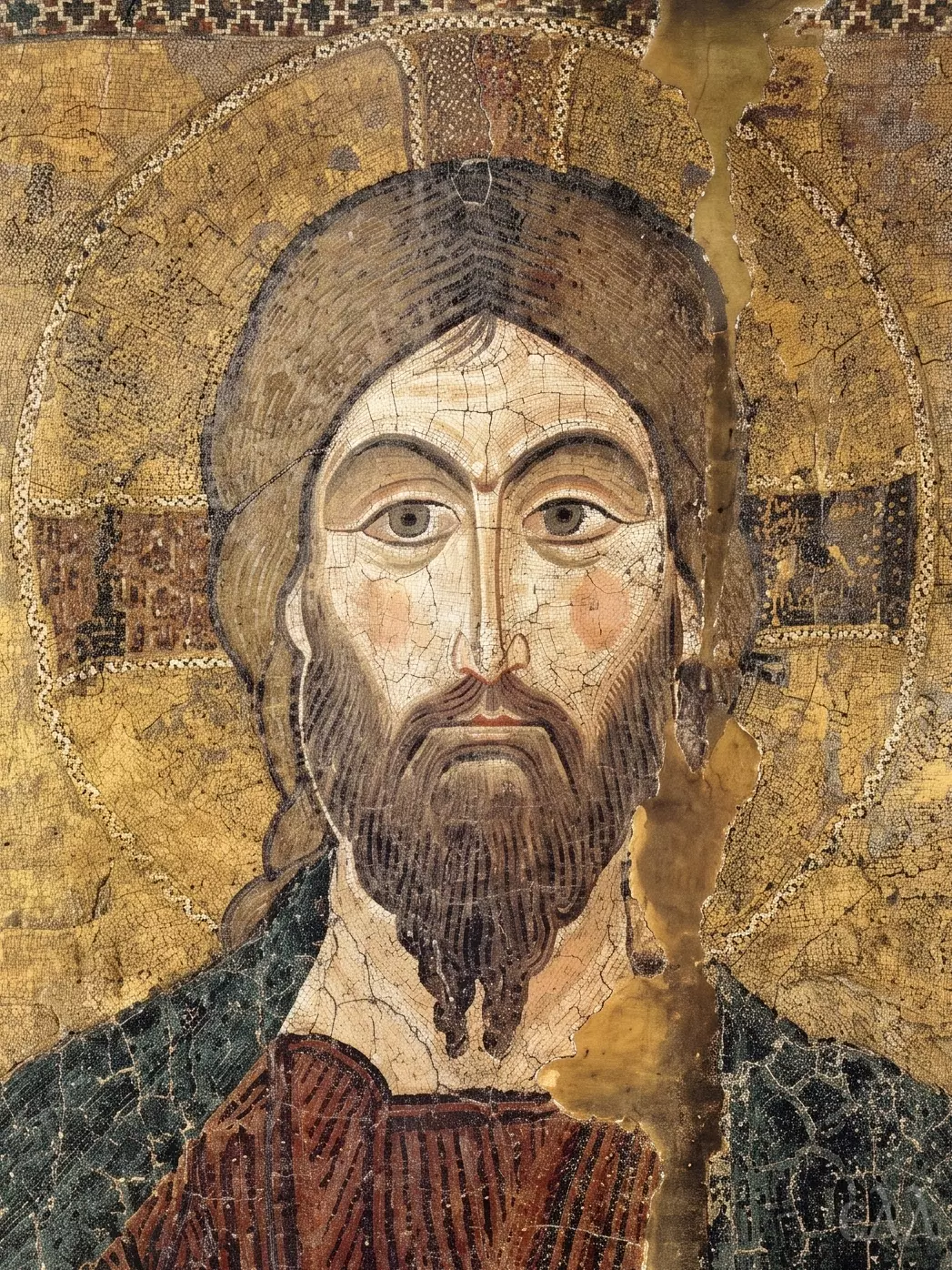
The face, elongated towards an oval, establishes the principal visual tension. Dark hair parts near the centre and falls in controlled, close-set strands; the bifurcated beard descends in narrow points beneath the chin. Long arched eyebrows nearly meet above the bridge of the nose. Beneath them, the large eyes avoid a perfectly axial stare, their gaze turning slightly aside. The shift is small, yet sufficient to introduce tension into a face otherwise constructed through severe symmetry. The mouth is narrow and firmly closed, the nose long and sharply defined: joined brows, restrained lips, oblique gaze, frontal bearing.
Corporeal volume remains deliberately compressed. Even so, the flesh is not treated as a flat monochrome area. Minute changes from pale cream to ochre, rose and brown articulate the forehead, the hollows below the eyes, the cheeks and the sides of the nose. Particularly fine tesserae are employed in these exposed areas, and their close arrangement produces the almost paradoxical impression of a painted surface. Working with individual pieces, the mosaicist suppresses, as far as the medium permits, the fragmentation normally associated with tessellation. From a short distance the face coheres; at close range, countless minute decisions become visible.
Within the refined artistic environment of twelfth-century Byzantium, this controlled modelling finds a convincing place. Komnenian art could combine linear discipline with heightened psychological concentration, sometimes moving towards pronounced emotional intensity and increasingly elaborate rhythms of contour and drapery. In the Bargello icon that tendency remains restrained. The figure does not twist, and the garments do not erupt into the agitated folds encountered in some later Komnenian monuments. Tension lies instead in the eyes, the mouth and the taut contours of the physiognomy.
The garments provide a different order of movement. A reddish-brown tunic crosses the chest in sharply organised linear folds, while a dark blue-green mantle surrounds the upper body. Rows of narrow tesserae follow and reinforce the direction of the cloth. Fold after fold is described by dark lines, some almost parallel, others bending abruptly as they converge around the raised arm and chest. Deep sculptural mass is not the result; rhythm is. The longer linear sequences do not model the drapery as deep recession; they register the cloth as a patterned field moving across the torso. The body remains present, its corporeality subjected to the pattern of the surface.
Most striking in the lower half is Christ’s right hand. Raised before the chest, it is large in proportion to the face, with long, narrow fingers arranged in a deliberate blessing gesture. The palm faces outward. Two fingers extend while the others bend into a conventional configuration, and the scale of the hand gives it unusual prominence within the composition. It almost interrupts the sweeping folds of the reddish garment. Hand and book consequently form a carefully balanced pair, the gesture on one side of the central axis and the written word on the other.
In his left hand Christ supports the open Gospel book. Its pages, framed by a dark reddish binding, carry the Greek text from the Gospel according to John: «Ἐγώ εἰμί τὸ φῶς τοῦ κόσμου…» (John 8:12). The choice is especially effective in mosaic. A declaration of light appears within an icon whose gold tesserae alter visibly as illumination moves across the surface. Yet the relationship need not be reduced to a single symbolic equation. The inscription performs an immediate iconographic function: it identifies Christ through his scriptural declaration as well as through physiognomic convention and the cruciform halo. The book bears the words; beside it, the raised hand gives visual form to authoritative address.
Time has profoundly altered the material continuity of the panel. A broad vertical lacuna descends through Christ’s left side, beginning at the upper edge, cutting into the cruciform halo and hair, continuing beside the cheek and neck, and passing downward into the garments and Gospel book. Other losses disturb the gold field, especially on the right side of the composition, while fine fissures spread through substantial areas of the surviving surface. The damage is too extensive to disappear from the experience of the work. Across an otherwise controlled geometry, these losses expose the vulnerability of an object made from extraordinarily small and painstakingly assembled units.
The interruptions make the surviving precision still more apparent. Around the damaged areas one sees the mosaicist adjusting tesseral orientation to hair, flesh, fabric, lettering, halo and background, each requiring a different visual rhythm. The gold field is comparatively expansive; the face, densely calibrated. Hair is constructed by repeated directional strands; the garments, through longer linear sequences. Another scale governs the open pages, where the Greek letters must remain readable. Small only in physical dimensions, the icon contains several distinct systems of mosaic setting within a confined surface.
Its later history introduces another dimension. Byzantine miniature mosaics were prized objects in Renaissance Italy, entering ecclesiastical treasuries and the collections of powerful patrons. Research on surviving inventories has connected the Bargello Pantokrator securely with the Medici collection; among the Byzantine micromosaics documented there, it is the surviving work that can be identified with confidence. The wider Florentine reception of Byzantine icons, including their place among Medici possessions, is examined in Rembrandt Duits’s contribution to Byzantine Art and Renaissance Europe and in scholarship on the Medici collection.
An object probably fashioned in Constantinople during the third quarter of the twelfth century therefore acquired a second historical existence in Renaissance Florence. Its damaged gold surface preserves the minute workmanship and severe visual authority of Komnenian Byzantine art together with the later collecting history that carried the icon into the Medici world and, eventually, the Museo Nazionale del Bargello.
(The translation was edited by E. Wilson.)