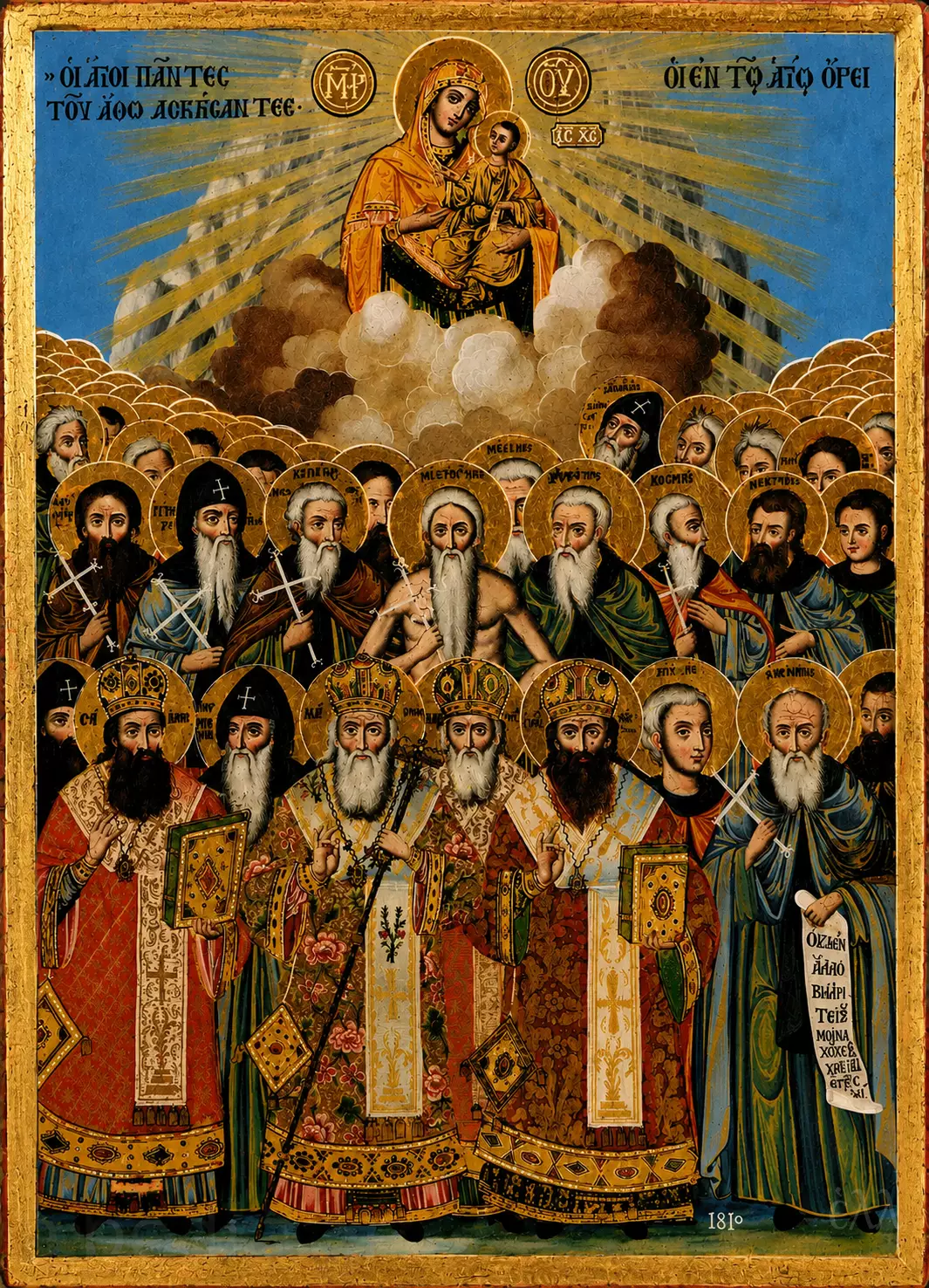
A dense field of golden haloes gives the All Saints of Mount Athos icon its immediate visual character. Painted by an anonymous artist in 1810 and preserved at the Monastery of Vatopedi on Mount Athos, the portable icon gathers into a single composition the monks, ascetics, hierarchs and other holy figures associated with the Athonite peninsula. The date, written clearly at the lower right, fixes the work within the early nineteenth century, while the subject belongs to a broader effort to give visual form to the collective memory of Athonite sanctity. The existence of a related Synaxis icon from 1796 shows that this imagery was already being formulated shortly before the Vatopedi panel.
Set against a brilliant blue field, the enthroned Theotokos appears with the Christ Child above the assembly. She wears a crown and occupies the vertical axis of the composition, surrounded by long golden rays that spread diagonally toward the sides. Clouds form a broad boundary beneath her, separating the upper apparition from the compact gathering below. The abbreviations MP ΘY and IC XC identify the Mother of God and Christ, while the large inscription across the upper field names the collective subject: the saints who practised asceticism on the Holy Mountain of Athos.
The All Saints of Mount Athos Icon and Its Hierarchical Structure
The lower two-thirds of the panel are organized through tightly packed rows. Space is compressed almost to the point of disappearance. Heads overlap, haloes touch one another, narrow passages of blue or gold remain between the figures. This density is central to the image, turning a succession of individual saints into a corporate body while still preserving distinctions through costume, age, hairstyle, inscriptions and attributes.
In the front rank stand richly vested hierarchs, many wearing mitres and carrying ornamented Gospel books. Their garments introduce the most elaborate passages of colour: deep red, pale blue, green, cream and gold, with floral and geometric patterns spread across the vestments. Square and circular episcopal ornaments hang from several figures, adding another level of surface detail. Beside them appear monks in dark habits and more simply clothed ascetics. A standing figure at the right holds an open scroll covered with writing, while several saints in the middle rows carry small crosses. Through these differences the painter constructs a visual catalogue of Athonite religious life without disturbing the unity of the assembly.
The faces are individualized within a common pictorial language. Long white beards, dark beards, youthful faces, deeply lined foreheads, varied hair types create a measured rhythm across the rows. Many saints look directly outward; others turn slightly toward neighbouring figures. The repeated circular haloes provide the strongest formal order, an almost continuous golden pattern running from one edge of the panel to the other. Names written around or above many of them further reinforce individual identity within the crowded arrangement.
Colour, Inscriptions and Athonite Memory
Blue is unusually forceful in the composition. It fills the upper background, reappears in garments and borders, and sets off the warm golds and ochres of the haloes. Against it, the orange-red mantle of the Theotokos becomes the principal chromatic accent of the upper zone. Below, the palette grows denser and more varied, matching the increasing concentration of figures. Ornamental richness, hieratic frontality, compressed pictorial space remain characteristic of an Athonite Post-Byzantine visual tradition carried into the nineteenth century.
The inscriptions, significantly, perform more than an identifying function. At the top they define the theme as a common body of Athonite saints; among the figures they restore names to individual members of that body. This combination of collective title and personal designation is particularly suited to a subject that includes both famous ascetics and figures preserved through local or monastic memory. Around the same period, Nikodemos the Hagiorite composed an encomiastic discourse for the holy fathers who had shone on Mount Athos, part of the wider formation of a shared Athonite commemoration.
Painted in 1810, the Vatopedi icon belongs to an early phase in the consolidation of this collective iconography. Its structure is direct: Theotokos and Christ above, the saints below, clouds and rays binding the two zones. Within that clear scheme lies considerable visual complexity—episcopal splendour beside monastic austerity, named figures within an almost innumerable multitude, brilliant colour pressed into a shallow, crowded pictorial field. Across the lower register, the closely spaced haloes continue almost uninterrupted to the edges of the panel.
(The translation was edited by N. Jones.)