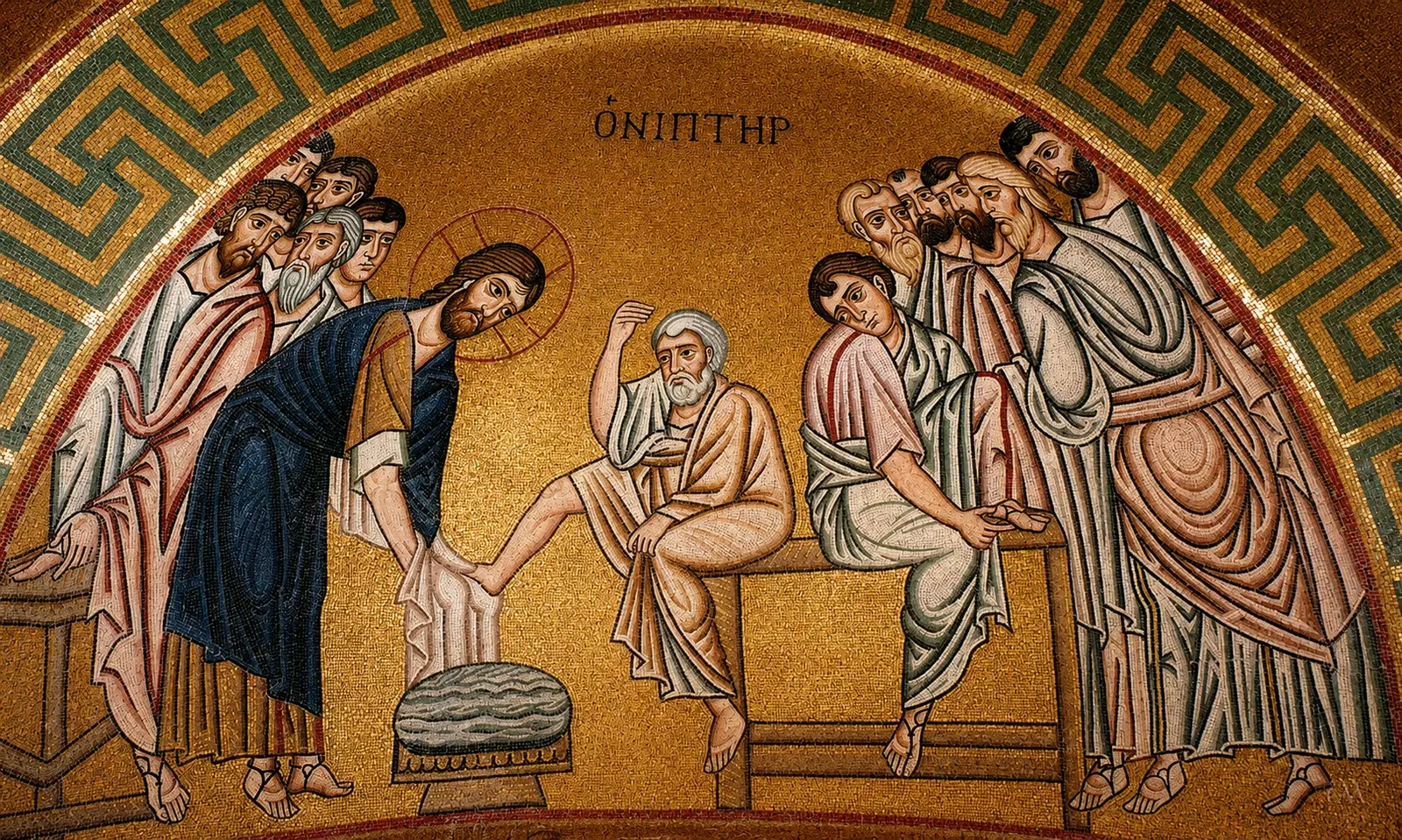
In the narthex of the katholikon at the Monastery of Hosios Loukas, the Washing of the Feet unfolds across a broad field of gold with an economy characteristic of monumental Middle Byzantine art. The mosaic, executed in the eleventh century and occupying the northern end of the narthex, represents Christ washing the feet of Peter before the Passion. Its Greek titulus, Ο ΝΙΠΤΗΡ, identifies the episode directly. The subject comes from John 13:1–17, in which Christ rises from supper, lays aside his outer garment, takes a towel and washes the disciples’ feet, establishing an image of service through an action deliberately associated with humility.
At Hosios Loukas, the narrative has been compressed into a severe, carefully measured composition. Christ bends toward Peter at the centre; the remaining apostles gather into two compact groups, observing and waiting. Few objects define the physical setting. A low basin beneath Peter’s extended foot, block-like seats and the restrained indications of an interior provide enough information for the episode to remain intelligible without competing with the figures. Above and around them, the gold ground removes ordinary atmospheric space. Its reflective tesserae belong to the larger decorative language of a katholikon whose surviving mosaics and marble revetments are among the major achievements of eleventh-century Byzantine monumental art.
The Hosios Loukas Washing of the Feet Mosaic and the Language of Humility
At the left of the composition, Christ provides its decisive movement. His body inclines strongly forward, bringing his head and shoulders down toward the seated Peter while one of the apostle’s bare feet projects across the intervening space. This lowering of the figure carries unusual visual force. The cruciform halo still identifies Christ unmistakably as the principal sacred figure, yet the posture places him below the disciple whom he serves. Within the rigid hierarchies normally governing Byzantine sacred representation, the physical descent has a deliberate theological resonance: authority is made visible through voluntary service.
The dark blue garment surrounding Christ forms the largest concentrated area of deep colour in the scene. Against the gold, pale flesh tones and generally light clothing of the apostles, its mass gives his bent figure unusual density. An ochre-toned section of clothing appears beneath it, while the pale cloth associated with the washing introduces a sharp linear accent close to Peter’s foot. The Gospel account specifically describes Christ taking a towel and tying it around himself before pouring water into a basin, details that became established elements of the iconography.
Peter, grey-haired and bearded, sits almost exactly at the compositional centre. His posture is considerably more complicated. One leg stretches towards Christ while his upper body remains upright and his raised hand approaches his head. That gesture is crucial to the episode. In John’s narrative, after initially resisting the washing, Peter asks that his hands and head also be washed; the gesture therefore converts spoken dialogue into a visible sign. Similar Byzantine representations use precisely this action to identify the exchange between Christ and the apostle.
Between them lies the basin. Low, rounded and marked by alternating grey tones, it is almost the only object whose function is purely practical. Yet its position is structurally important: beneath the extended leg, immediately between Christ and Peter, it fixes the theological narrative to an ordinary physical action involving water, touch and the human body. The eye descends from Peter’s raised hand to his face, follows the diagonal of the body toward the bare foot and arrives finally at Christ’s hands and the vessel below.
Apostles, physiognomy and compressed space
Around this central exchange, the other apostles form a dense human frame. Several gather behind Christ, while a larger group occupies the opposite side. Their overlapping heads generate depth without creating an illusionistic interior. Faces emerge one behind another; shoulders intersect; garments descend in narrow vertical and diagonal bands. Space is shallow, crowded, almost pressed against the gold ground.
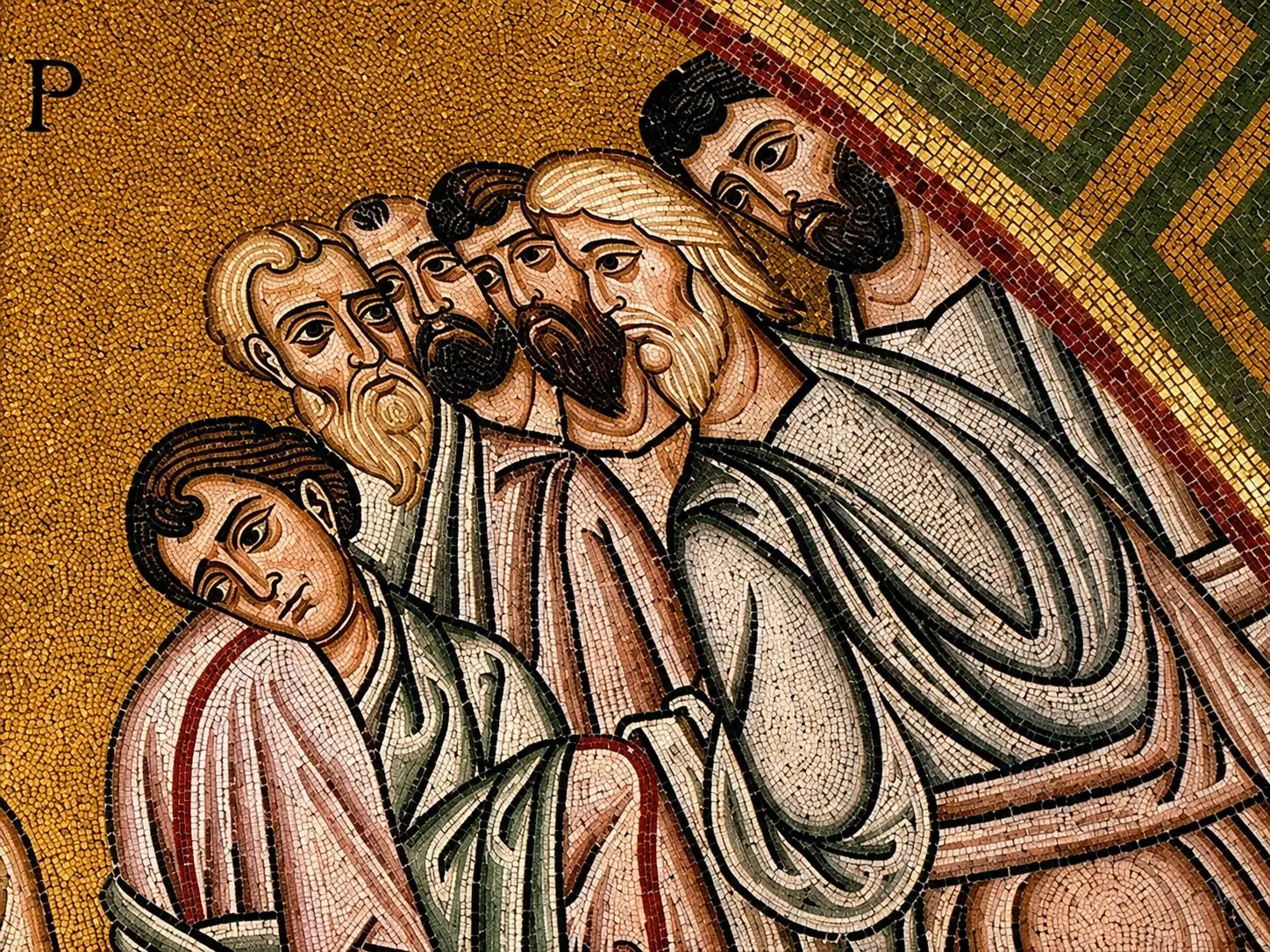
The young, beardless disciple seated close to Peter is especially prominent. His smooth dark hair, elongated face and downward inclination distinguish him from the mature apostles surrounding him. Scholarly study of the Hosios Loukas mosaics has noted that the mosaicists maintained recognizable apostolic physiognomic types across different scenes while allowing small variations in hairstyles, beards and facial structure. The youthful disciple in the Washing of the Feet, with straight hair and a central lock over the forehead, belongs to this carefully differentiated repertoire. The same research places the Washing of the Feet in the northern narthex niche, opposite the Doubting of Thomas in the south.
In the group immediately behind him, age becomes almost a compositional device. A bald forehead, white hair, dark rounded beards, a longer pale beard, black hair rising above the final figure: each head changes slightly before the next appears. The mosaicists have avoided uniformity even within severe stylistic limits. Brows curve heavily over almond-shaped eyes; noses are lengthened by dark contour lines; mouths remain small and controlled. In the enlarged faces, minute tesserae in cream, pale rose, brown, black and muted ochre build the flesh through sharply separated tonal units.
There is modelling, certainly, although line frequently carries greater expressive weight than gradual tonal transition. Dark tesserae along the nose, eyebrows, eyelids and facial contours establish physiognomy with extraordinary economy. Highlights are narrow. Hair and beards develop through rhythmic bands instead of attempting to imitate individual strands. From normal viewing distance these small discontinuities coalesce, giving faces a firmness that is partly volumetric and partly graphic.
Drapery, rhythm and the gold ground
Across the apostles’ clothing, the same principle becomes more emphatic. Pale rose, grey-white, subdued green, brown and ochre fabrics are crossed by dark bands that describe folds with almost calligraphic insistence. Some lines follow the body; others break abruptly, double back or form loops around knees and shoulders. Beneath the apparently austere surface lies considerable rhythmic complexity.
Particularly striking in the right-hand group is the movement created by repeated curved folds. One pale mantle sweeps around the shoulder and across the chest in concentric arcs, then descends towards the waist. Beside it, pink drapery is divided by long dark channels. The garments give the bodies weight while simultaneously converting them into patterned surfaces. Physical volume survives, but it is disciplined by the requirements of the wall and by the larger geometry of the composition.
Above the figures stretches the uninterrupted gold field. Gold-glass tesserae, set at minute variations of angle, respond to changing illumination instead of behaving like a uniform painted colour. The monastery’s own presentation of the katholikon stresses the capacity of these golden tesserae to gather and reflect light, visually joining the individual images across the church. UNESCO likewise identifies the gold-ground mosaics of Hosios Loukas as a defining achievement of the Middle Byzantine period.
Along the curved perimeter, the figurative scene meets a broad ornamental border of green and gold. Its repeated angular pattern imposes another rhythm, harder and more geometric than the movements below. Research on the mosaic workshop identifies this particular border around the Washing of the Feet as a distinctive interlocking geometric motif, one of several ornamental systems used by the artisans throughout the katholikon.
Monumental restraint in eleventh-century Byzantine art
The artistic language of Hosios Loukas has often been associated with the more hieratic and abstract tendencies of eleventh-century Byzantine mosaic. The figures possess corporeal presence, yet naturalistic space has been drastically reduced. Emotion appears through posture, inclination, gaze and gesture, held within a disciplined monumental structure. Research into the decoration has also shown that the vast programme was produced by a substantial workshop and that different mosaicists can be distinguished through variations in execution, even while the ensemble remains remarkably coherent.
Such restraint is especially effective in the Washing of the Feet because the subject depends upon a reversal of expected physical relationships. The teacher bends. The disciple hesitates. The others watch in silence. No elaborate architecture is required to explain the event, and almost nothing distracts from the contact between Christ and Peter.
From the elevated hand of Peter to the lowered body of Christ, from the concentrated cluster of apostles to the small basin close to the lower edge, the entire composition repeatedly redirects attention toward that contact. The gold surrounding it belongs to another order of visual experience: unmeasured, reflective, without horizon or identifiable source of light. Against it, an elementary human action—water, a bare foot, a towel, hands—acquires the monumental scale of the narthex wall.