A Byzantine Copy from Rome in the Heart of the Riviera
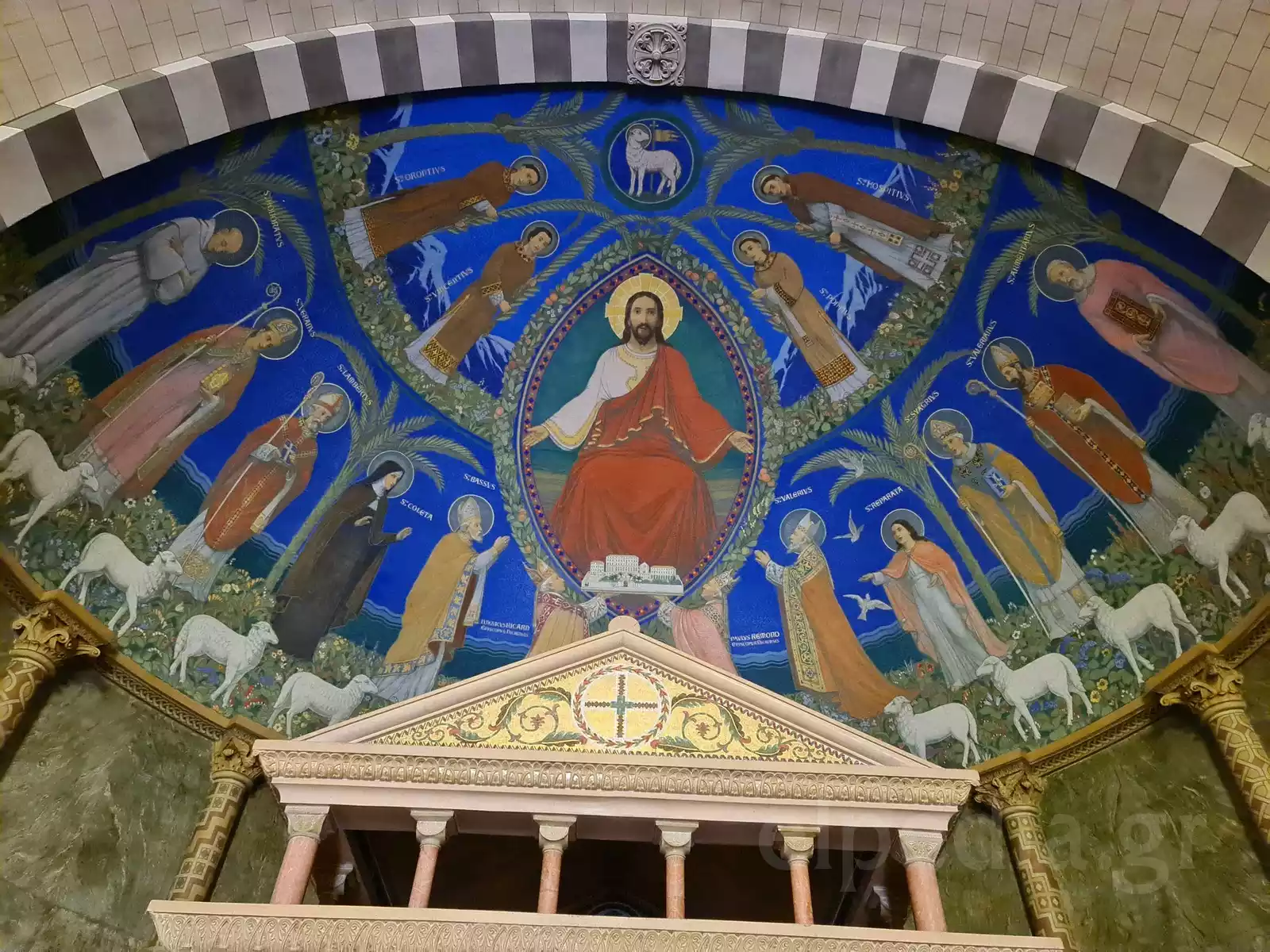
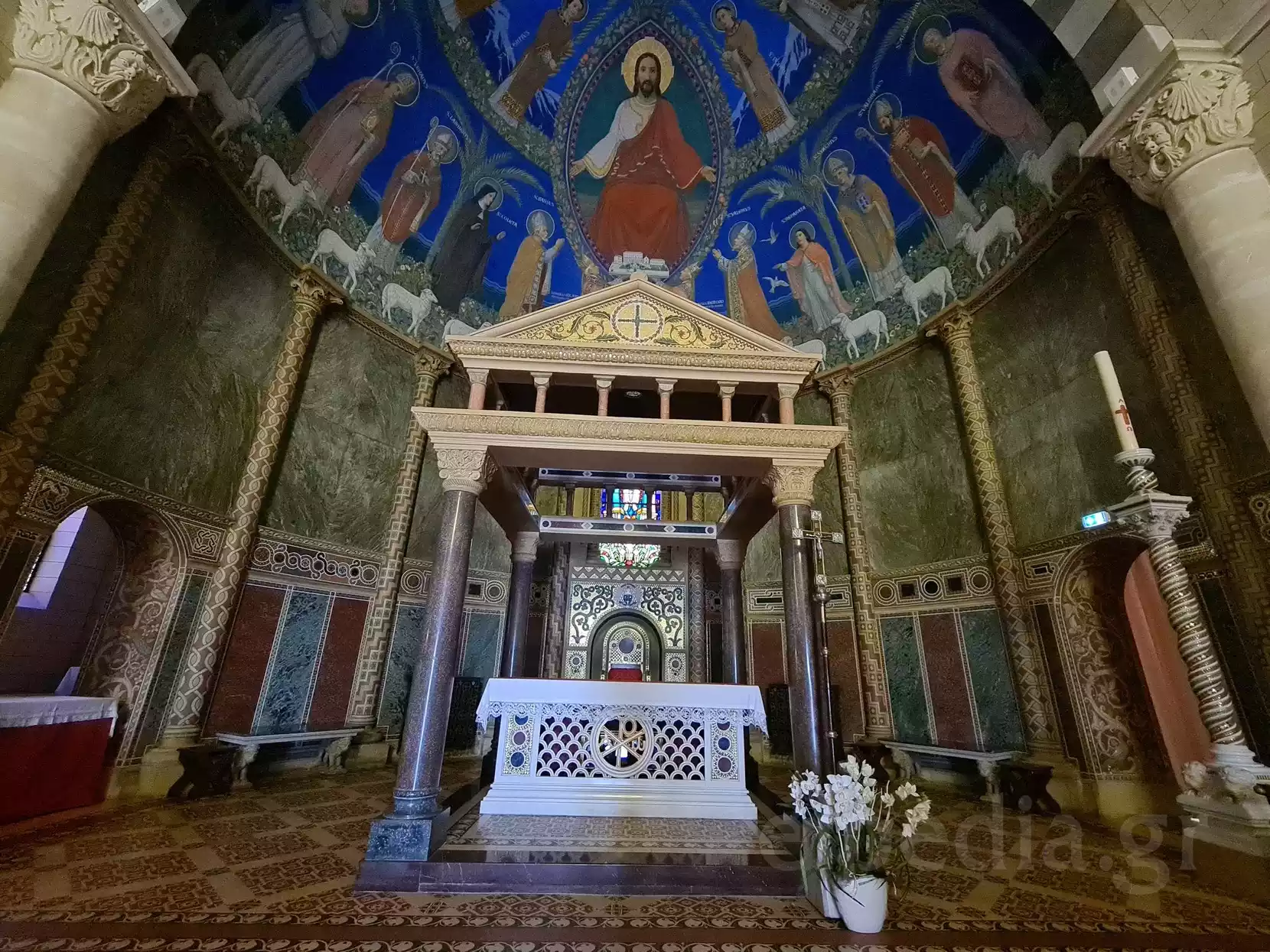
At the harbour of Nice rises a church which few visitors to the city know in depth: the Panagia of the Harbours, known to the French as Notre-Dame du Port. Built in the middle of the 19th century, with the first stone being laid in 1840, the church intended initially to cover the spiritual needs of the sailors and the dockworkers, but also of the nobles who had already begun to summer in the region. In its interior, behind a marble ciborium of neo-Byzantine style, spreads out against a deep blue background a mosaic which does not constitute an original composition, but rather a faithful, with local variations, copy of one of the most important monuments of Early Christian art. Its model is located in Rome, in the apse of the basilica of Cosmas and Damian, a work of the 6th century which determined for centuries the iconography of the enthroned Christ in the Christian West and East. In 1933 the bishop of Nice Paul Rémond inaugurated officially the by then completed church, having provided personally for its decoration, a fact which explains why his name remains engraved at the base of the composition. It is not, of course, easy for one to pronounce with absolute certainty upon the workshop which undertook the execution, yet the result stands out for its diligence and for its theological completeness. In the lines that follow are examined the central composition of the apse, as well as four individual elements of the sculptural and pictorial decoration of the church, all treated as historical evidences of an epoch which revived, with its own sensitivity, the Byzantine idiom in the West.
The Mosaic of the Apse and the Holy Sanctuary
Dominating in the centre of an oval wreath of foliage, Christ sits enthroned with a red vestment, the right hand in blessing, and around Him are arrayed, in strict frontality, the apostles and a series of saints whom the frieze identifies with Latin inscriptions. Among them stands out Saint Reparata, patroness of Nice, Saint Valerius, historical bishop of ancient Cimiez in the 5th century, and Saint Colette, from whom commenced the reformation of the order of the Clarisses. At the base of the composition, two figures offer to Christ a model of a building, a form borrowed directly from the Roman donorial iconography, where the bishop or the founder holds usually the edifice which he erected. It is evidently a matter of Paul Rémond, whose name is read clearly engraved there. Above all, in a smaller medallion, the Lamb of God closes the composition with austerity. Before the mosaic, the marble ciborium, supported upon four columns with Corinthian capitals, shelters the white Holy Altar, the facade of which is adorned with geometric, almost Cosmatesque decoration of coloured marble. The harmony between the warm blue of the background and the cold white of the marble creates a contrast which, however self-evident it may seem today, constituted in the decade of 1930 a bold aesthetic choice for a French parish church.
The Relief Column of the Months
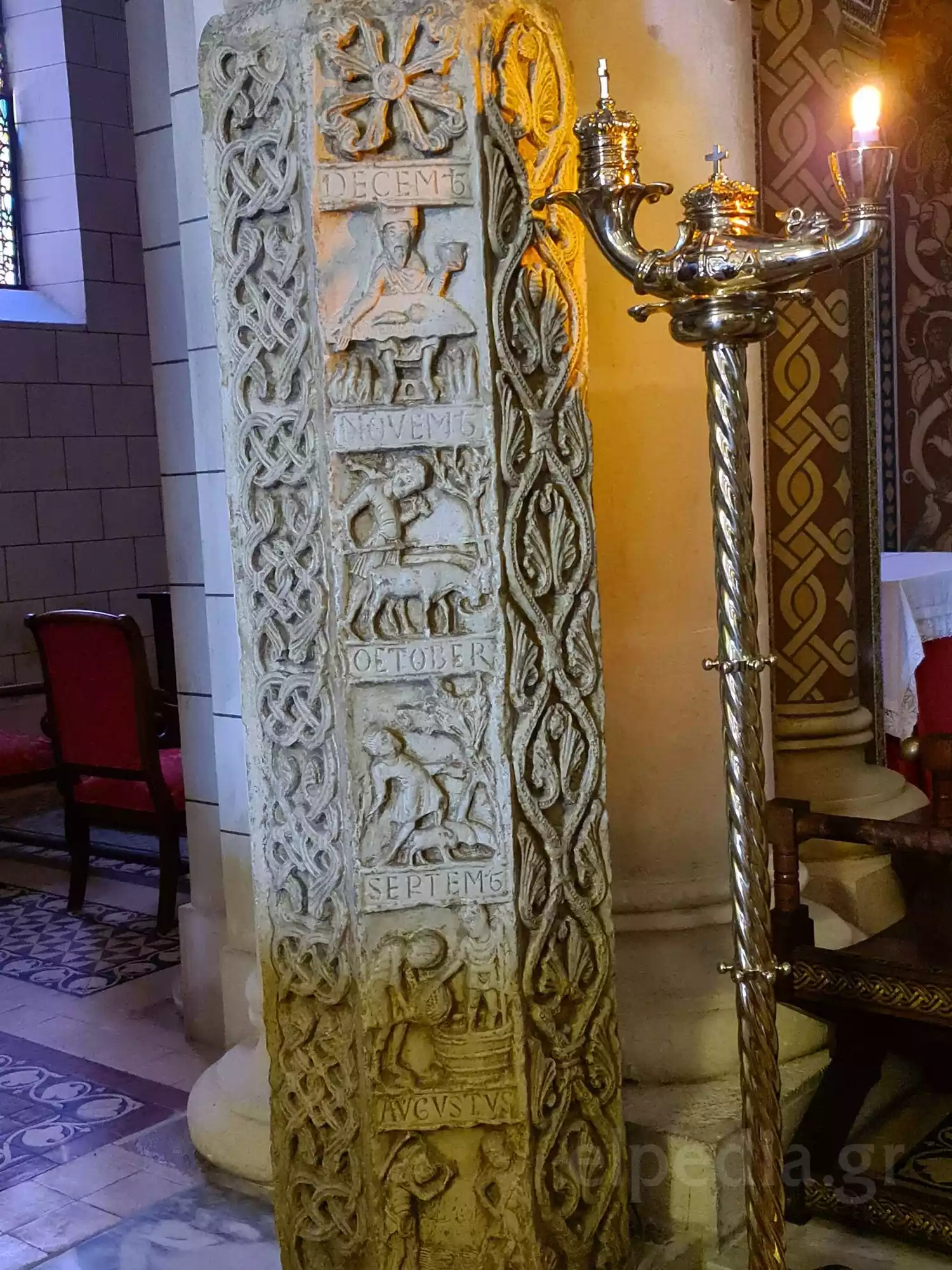
A little further on, a carved pier of limestone bears, in successive rectangular frames, the representations of the months of the year, each with its Latin name and a scene of agricultural labour: September with the vintage, October with the slaughter of the swine, November with the sowing. At the summit, an eight-petaled rosette frames the composition, whilst two vertical zones with complex interlace, recalling Celto-Lombardic tradition, demarcate the historiated frames. Such columns with the labours of the months occur frequently in Romanesque sculptures of southern Italy and of Lombardy of the 11th and 12th century, where the calendar of the earth was connected visually with the liturgical life of the church. I do not know with certainty which exact monument was the direct model here, yet perhaps this does not have as much significance, as the very choice to integrate such a theme within a church dedicated to the sea and to labour. Beside the pier, a gilded candlestick with small crowns and a cross at the summit, a work evidently much later, brings into contrast the roughness of the stone with the brilliance of the metal.
The Archangel Michael and the Array of the Apostles
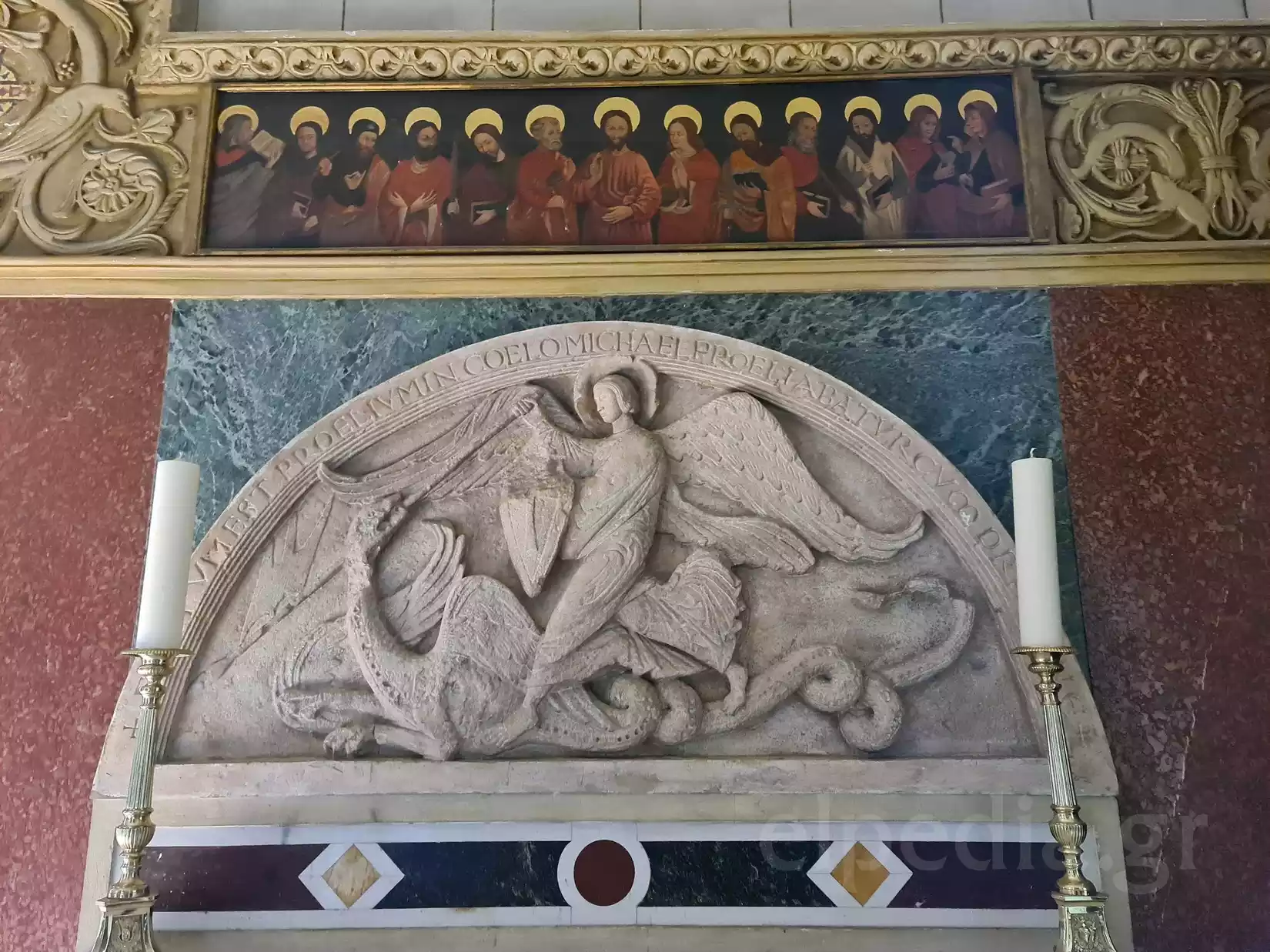
In another point of the church, a semicircular relief represents the Archangel Michael casting down the dragon, with his wings spread and the garment waving in heavy folds around the body of the beast, which twists its tail in coils. The Latin inscription which frames the arch, “factum est proelium in coelo Michael proeliabatur cum dracone” (‘there was war in heaven: Michael fought against the dragon’ (Rev. 12:7)), refers to the Revelation and to the war which occurred in heaven. Above this relief, within an oblong frame with a gold ground, twelve figures with halos stand the one beside the other, holding books or twisting their hands in gestures of speech, in a style which recalls strongly Italian painting of the Trecento, perhaps an older piece which was integrated later into the whole of the decoration. The strict, almost rhythmic repetition of the halos creates a visual score, where the gaze glides from figure to figure without stopping anywhere for long.
The Coat of Arms Above the Door
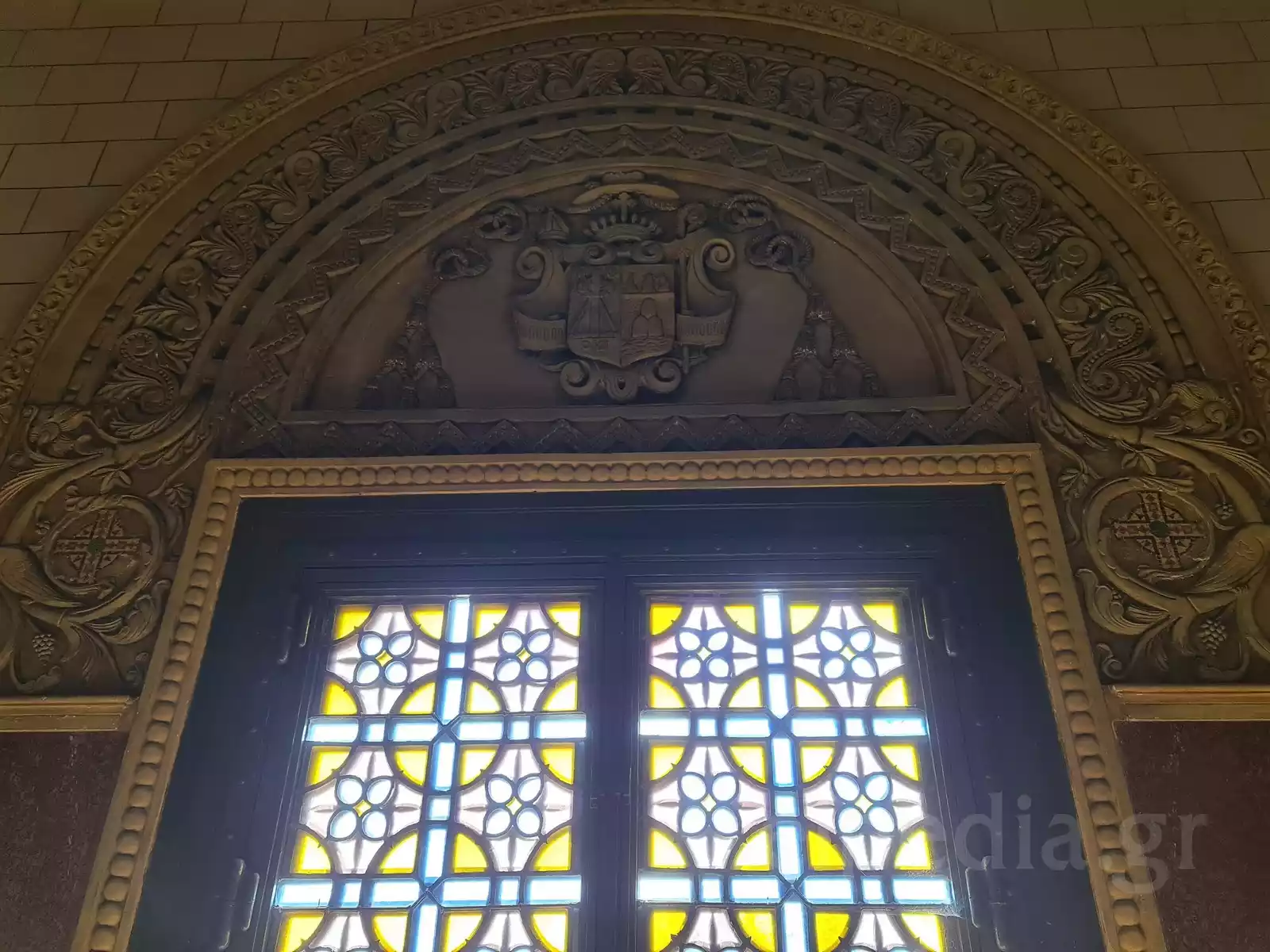
Above a double-leafed wooden door with stained glass windows in yellow, white and light blue geometric design, opens a semicircular tympanum with a relief coat of arms. A shield with what resembles a ship or towers in its interior, crowned by an episcopal mitre and cross, is framed by vegetal winding ornaments and two small isosceles crosses within circular medallions. It is a matter most probably of the coat of arms of the diocese, perhaps even personally of Rémond, without however this being able to be confirmed with absolute certainty solely from the aspect of the sculpture. The zig-zag motif which runs round about the arch, together with the acanthus leaves at the corners, belongs to a vocabulary of decoration which the neo-Byzantine and the neo-Romanesque revival of the end of the 19th century utilised widely in all of France.
The Griffins of the Frieze
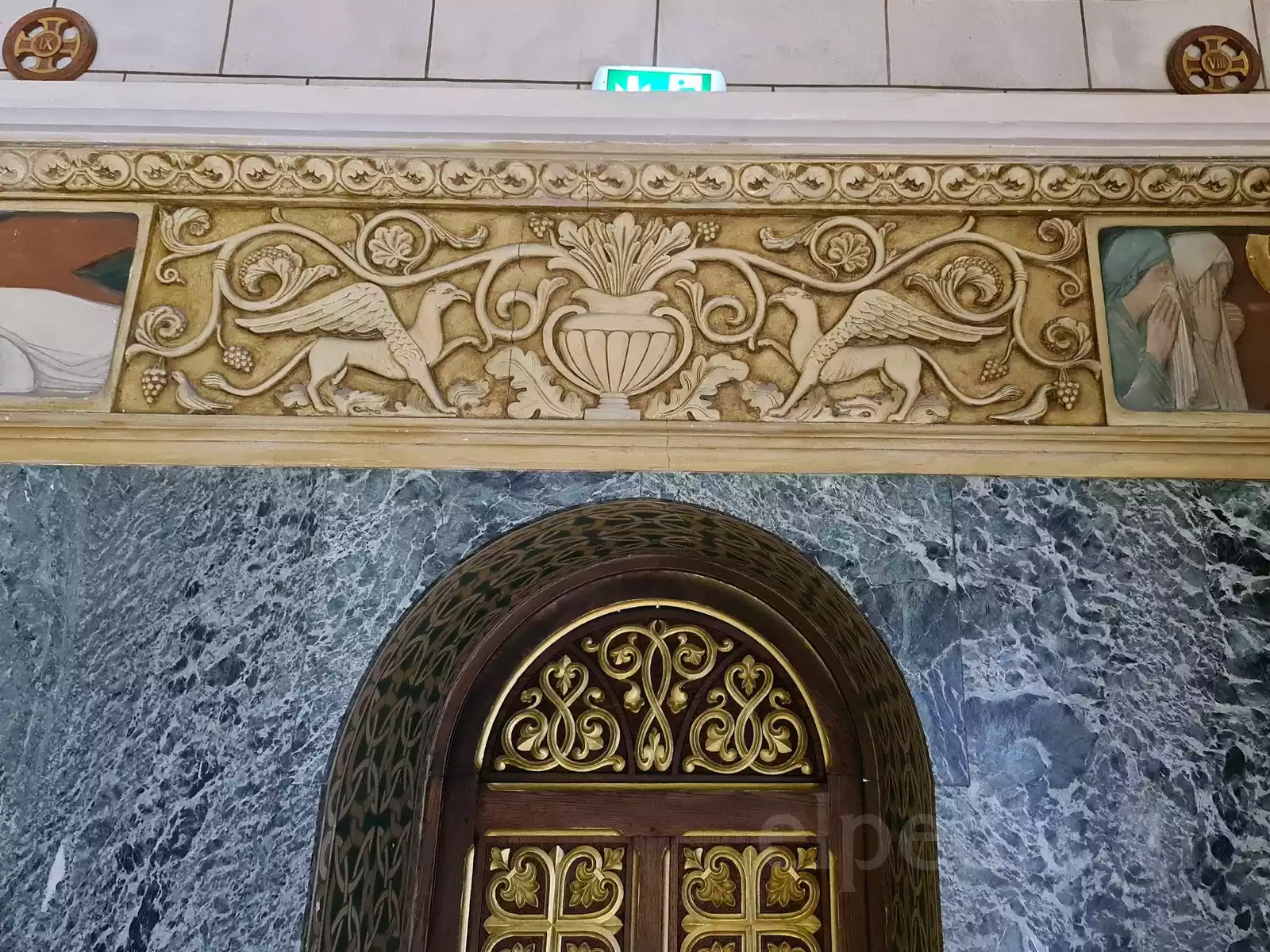
In yet another zone, two griffins, creatures with the body of a lion and the head of an eagle, face each other on either side of a central vessel from whence gush forth tendrils with grapes, acanthus leaves and small birds. This form, known already from Early Christian and Byzantine templons, symbolised usually the fount of eternal life which mythical beings guard, an idea which here is transferred almost verbatim onto French soil of the 20th century. Beneath the frieze, an arched wooden door with gilded iron decorations opens between two frescoed figures, of which are discerned only the extremities of garments and a hand in an attitude of prayer, a remnant evidently of a broader scene of Lamentation or Passion which continues beyond this point. The precision in the carving of the wings of the griffin, with every feather engraved separately, bears witness to a workshop familiar with the Romanesque sculptural tradition.
The Panagia of the Harbours gathers, in a relatively restricted space, samples from three at least different traditions: the Early Christian mosaic of Rome, the Romanesque sculpture of Italy with its columns and its mythical figures, and the neo-Byzantine revival which connected them all beneath a single roof at the beginning of the 20th century. The church does not merely copy, it composes, borrowing iconographic forms from very different epochs and adapts them to the needs of a parish which wished to honour its sailors, the saints of its local tradition and a bishop who dedicated part of his life to its completion. Perhaps for this reason, if someone enters there without knowing anything beforehand, hardly will he understand immediately how many different threads of the history of art converge around the Holy Altar.
(Translated from the Greek text by John Sakkouli.)

