Analysis of colour, technique, and iconography of a landmark work of post-Byzantine painting
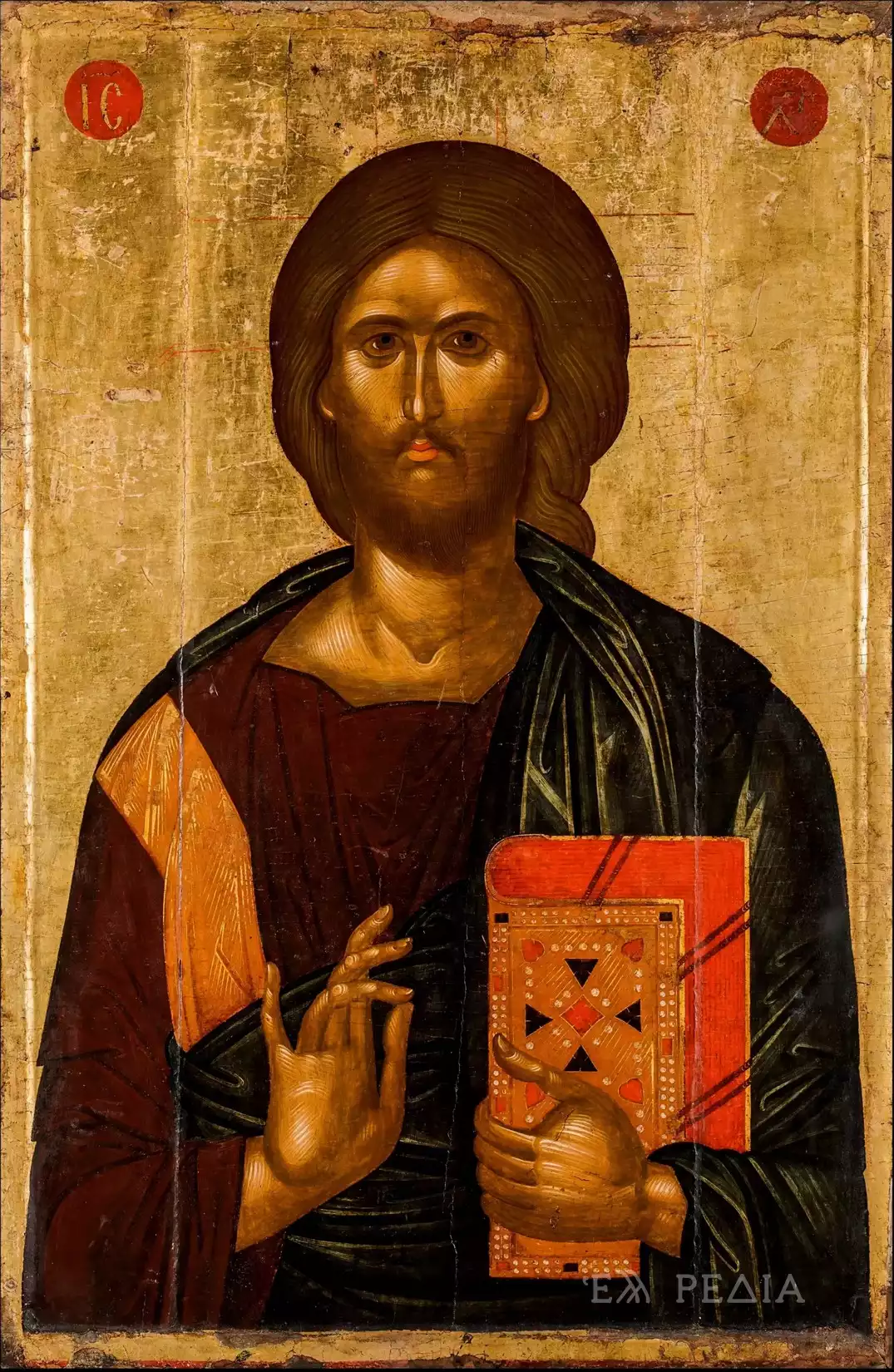
Among the surviving specimens of Cretan hagiography, few concentrate so clearly the technical maturity as the icon of the Pantocrator attributed to Angelos Akotantos, perhaps the most important painter of Venetian-ruled Handakas in the first half of the 15th century. This artist, known also by the signature “Hand of Angelos” which he placed upon his works, is considered today the first Byzantine painter who dared to emerge from the anonymity of tradition. In the icon we are examining, Christ is depicted in a frontal posture, with the right hand raised in blessing and the left holding a closed Gospel, within a composition where every detail appears weighed. Relevant to the subject, a recent analytical study examined with spectroscopic methods another work attributed to the same painter, thus illuminating facets of the technique which he appears to have followed systematically in his workshop.
The dating of the Pantocrator is placed in the years of the most mature artistic activity of Akotantos, between 1425 and 1450, when this painter had already acquired fame beyond the boundaries of Crete. Wood, gesso, gold leaf, and egg tempera compose the material substrate upon which the figure was built, while the selection of colours, deep red beside dark green, is not accidental but obeys a logic of contrast that reinforces the plasticity of the body. It is not, moreover, a mere repetition of an established iconographic type, however much the type of the Pantocrator traces back to prototypes far older than the 15th century. It is rather a personal reading, imbued with the classicising spirit which the Cretan school would develop more fully in the ensuing decades.
Style, colour, and iconography in the Pantocrator of Akotantos
The first impression one gleans before the composition is equilibrium. The golden background, worn today in several places and with traces of older incisions visible beneath the light, does not function merely as a decorative element but as a bearer of the immaterial light which Byzantine theology attributes to the divine. Upon this background, the two red metallic medallions with the monograms IC and XC are not found there accidentally, but organise the surface into three zones which the eye reads with naturalness, from top to bottom. The hair of Christ, long and undulating, is rendered with fine parallel lines that create a sense of movement without, however, disturbing the general stillness of the figure, an equilibrium that is not easily achieved.
The garment presents two principal tones, the deep crimson of the chiton and the dark green of the himation, with the folds being rendered through an alternation of illuminated and shaded surfaces. At this point it is worth pausing longer. The folds are not simple linear incisions as in older, more schematised works, but develop with progressive gradations that recall the manner in which light falls in reality upon fabric. Such a thing presupposes, beyond technical training, an observation that surpasses the boundaries of purely symbolic representation. The golden clavus that runs diagonally across the shoulder, besides, with its sharp, geometric designs, betrays a virtuosity in the use of gold-striation which few of his contemporaries possessed to the same degree.
The Gospel and the gesture of blessing
Almost at the centre of the composition, the closed Gospel which the left hand of Christ holds functions as a second pole of attraction for the gaze of the spectator. Its cover, red with golden decorative frames and a cross at the centre, faithfully imitates the luxurious bound gospels that circulated in the most important treasuries of the era, an element demonstrating how well the painter knew the models of ecclesiastical goldsmithing. To the right, the blessing hand accurately forms the fingers in the known gesture, where the thumb touches the ring finger whilst the index and middle fingers remain extended, an iconographic convention which nevertheless is rendered here with an anatomical accuracy rare for the era. It is worth noting that a similar attention to detail is located also in other portable icons attributed to the same artist, an element that reinforces the overall picture of a workshop with a stable, recognisable language.
The face of Christ in detail
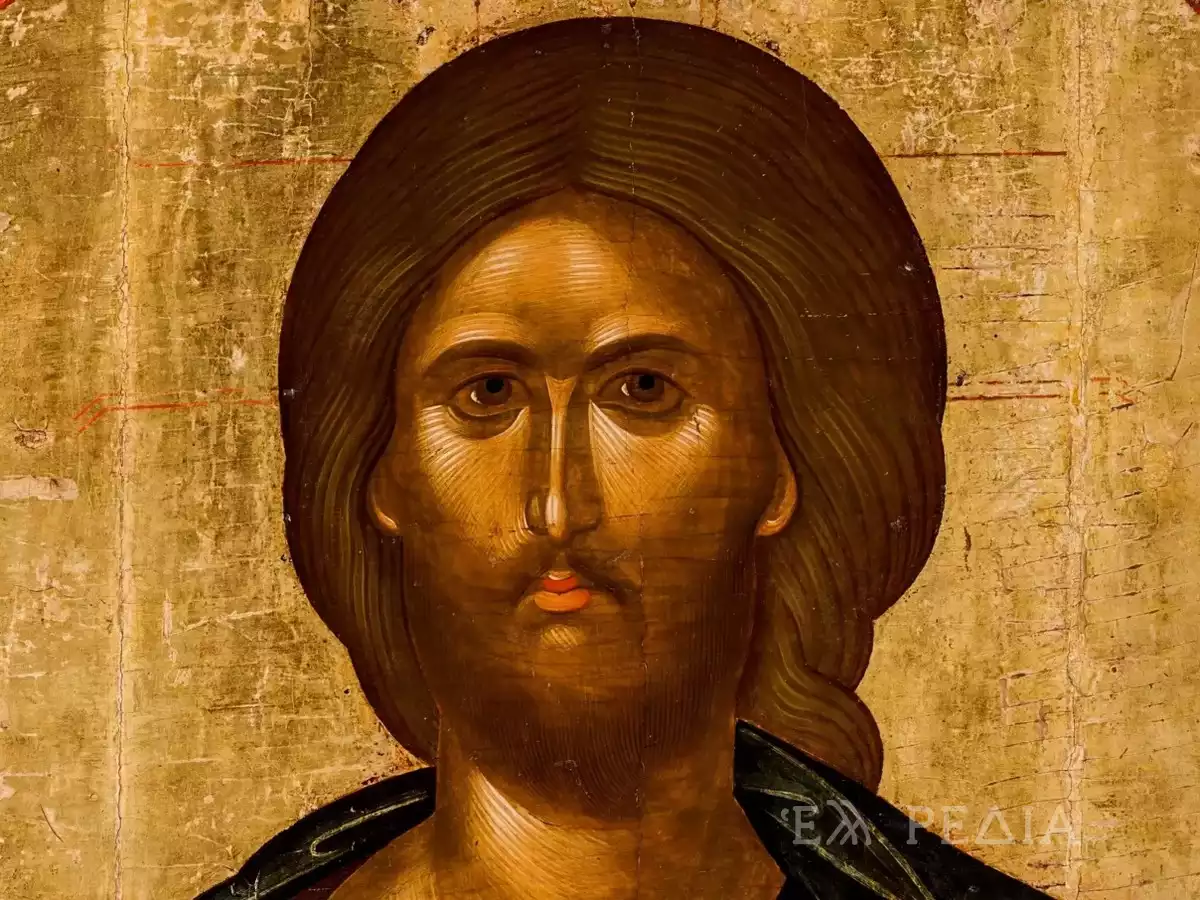
Turning attention to the face, there where the art of Akotantos reaches perhaps its culmination, one discerns a construction resting upon the finest, almost linear brushstrokes over a deeper brown underpainting. The eyes, large and almond-shaped, with a strong outline and a dark gaze, do not look somewhere in particular, but seem to embrace the space before them in its totality, creating that known sense of piercing presence which Byzantine iconography systematically pursues in the figures of the Pantocrator. The nose, long and slender, divides the face into two almost symmetrical parts, whilst the lips, painted in a vivid red that stands out from the more general brownish-yellow tone of the skin, impart a note of vitality to a figure otherwise austere. One might perhaps say that here is hidden also something more difficult to define, a tension between the austerity of the theological type and something more human that escapes, or at least so it appears the longer one looks.
The beard, short and well-groomed, is rendered in the same manner of linear texture that characterises the hair as well, creating a visual continuity between the two elements. On the forehead and the cheeks, the luminous ridges that denote the volume of the face are worked with carefully graduated tones of ochre, a technique known in Byzantine painting as proplasmos, upon which the lighter layers are gradually built. Not a few are those who consider that precisely in this manner of managing the light on the face is located the greatest affinity of Akotantos with antecedent Byzantine prototypes, without this, however, negating his personal seal.
The position of the work in the Cretan school
The Cretan school of painting, into which this work is unquestionably integrated, developed within particular historical conditions, there where the Byzantine tradition continued to live even after the fall of Constantinople, beneath the aegis of the Venetian administration of the island. Akotantos, together with a few more painters of his generation, laid the foundations upon which later artists would build, such as Andreas Ritzos, who indeed purchased anthivola (working drawings) from the workshop of Akotantos after his death. It is no exaggeration to say that this line of influence reaches, through successive generations of painters, to Domenikos Theotokopoulos himself, who referred to Akotantos with singular respect.
The fact that the painter signed his works, something unusual for the era when anonymity was considered almost a rule in religious art, reveals an artistic self-consciousness that surpassed the narrow boundaries of the artisan iconographer. Within this framework is also integrated the Pantocrator which we examine here, not as a mere functional object of an era, but as an historical document of an artistic personality who knew the value of his signature.
The study of a work like the Pantocrator of Akotantos is never fully exhausted, perhaps because every new glance reveals something which the previous one had left unnoticed. Between the theological austerity of the iconographic type and the personal virtuosity of the painter, this icon stands as a witness of an era when Cretan art was beginning to form its own, recognisable physiognomy, without renouncing its Byzantine roots. The golden background, the fine lines of the face, the careful colouristic contrast in the garment, all these compose not merely a devotional icon, but a first-rate historical document for the comprehension of post-Byzantine painting. There remains, to be sure, open the question of how many more works of the same workshop remain today unknown or erroneously attributed to other painters, a question that perhaps may never be definitively answered.
(Translated from the Greek text by John Sakkouli.)

