Iconographic and stylistic analysis of a post-Byzantine figure in the Holy Monastery of Panagia Peleketis
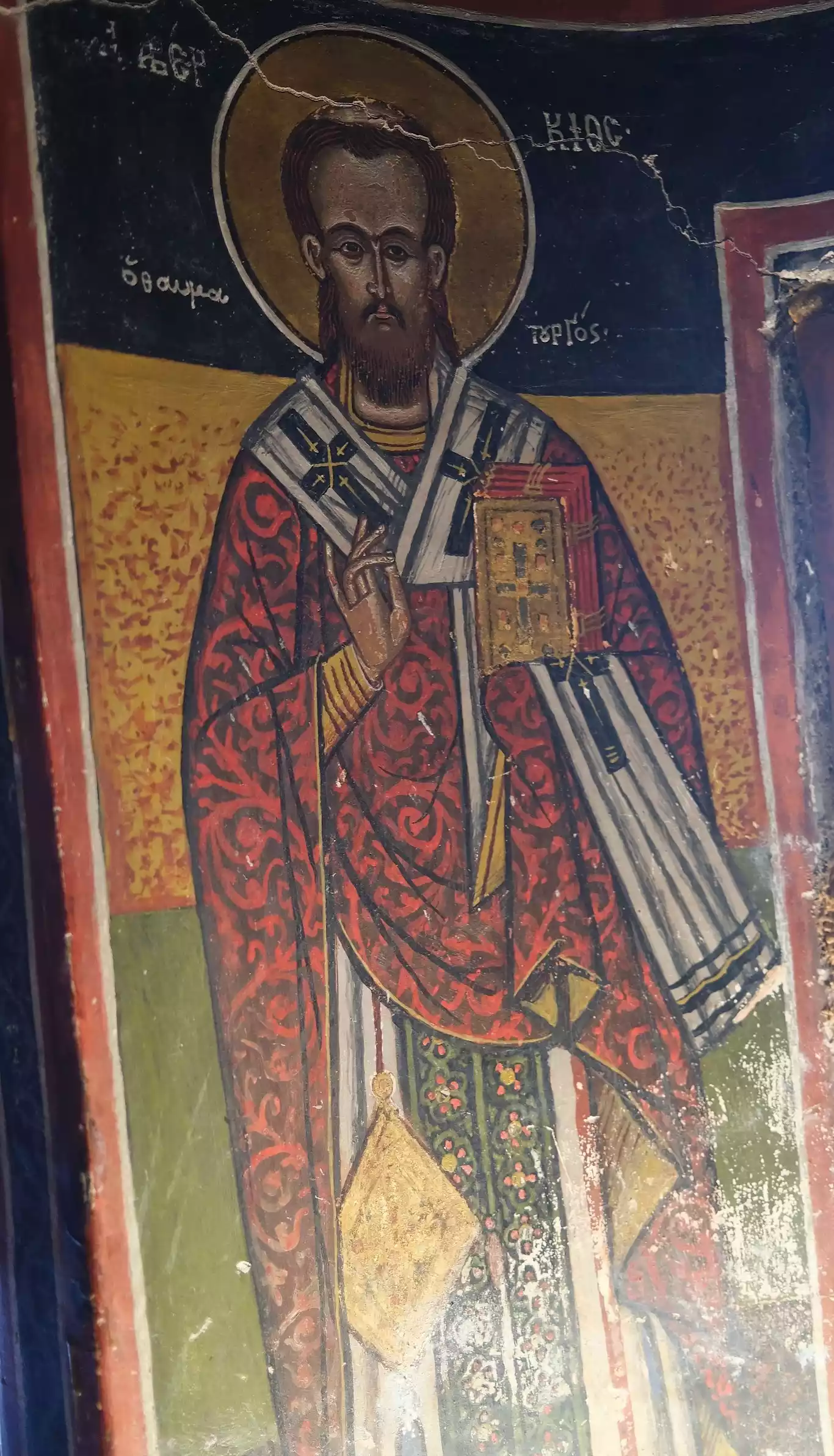
In a narrow niche of the katholikon, there where the light falls obliquely from some small opening, stands full-length a hierarch with a thick beard, the right hand raised in blessing and the Gospel held tightly in the left. Two worn but still legible inscriptions name him Saint Abercius the Wonderworker. This is a fresco that adorns the interior of the Holy Monastery of Panagia Peleketis, built in the precipitous mountain masses of the Agrafa, in an area that belongs today to the Holy Metropolis of Thessaliotis and Fanariofersala. The Monastery of Panagia Peleketis, like the majority of the monasteries of the wider region, functioned for centuries as a refuge of spiritual and artistic life in the years of Ottoman domination, when the inaccessible mountain mass protected populations, institutions, and traditions from the direct supervision of the central authority. Saint Abercius, bishop of Hierapolis of Phrygia during the 2nd century, is honoured in the Orthodox tradition as equal to the apostles, renowned for his miracles and for his missionary action in an era when Christianity was still seeking its place within the Roman empire. His image in the monastery is not a simple reproduction of an established type. It bears the traces of a local workshop, which, working far from the great urban centres, formed its own vocabulary of colour and design.
Saint Abercius and his place in the mountainous hagiographic tradition
In the katholika of the monasteries of the Agrafa, as in a multitude of provincial churches of the Orthodox East, the hierarchs usually occupy a prominent position, near the sanctuary or in the lateral niches, there where their liturgical capacity justifies proximity to the holy bema. Among them, Abercius appears less frequently than other great fathers of the Church, a fact which renders interesting the choice of the specific type here. Besides, his veneration is closely connected with the Asia Minor tradition, there where he exercised his pastoral work, and the transfer of his cult to a mountainous Helladic monastery testifies to the steady circulation of festal and iconographic models within the Orthodox world, independently of geographical distances. It is not excluded, indeed, that the dedication is connected with local tradition or with the personal piety of some donor, an element that can hardly be reconstructed now with certainty.
The face, the halo, and the gaze
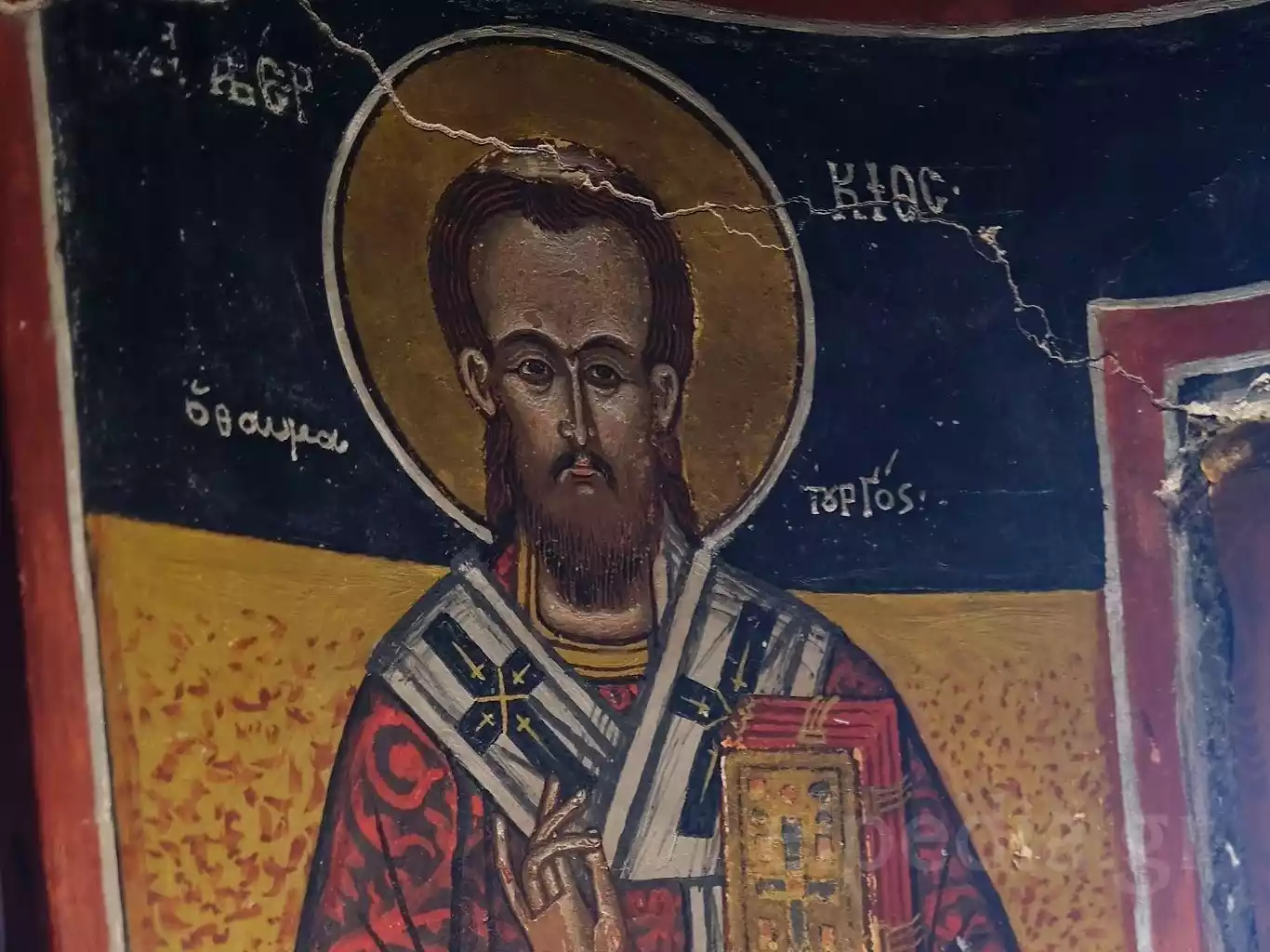
The figure of the saint is dominated by a face elongated, ascetic, with sunken eyes that look directly at the viewer, without the slightest inclination or turn. The forehead, high and partially bald, is illuminated by a series of fine lines that indicate the shading of the flesh, while the hair, auburn, falls in strict symmetry on either side of the face. The beard, long and forked at the end, completes the impression of senescent wisdom that the painter sought to render, not with naturalistic detail but with frugal, almost linear means. Behind the head spreads a halo in tones of ochre and gold, traversed diagonally by a crack that begins high up and vanishes towards the right, at the point where the inscription «ΚΙΟΣ» completes the name of the saint. This crack, not at all coincidental in the reading of the work, functions like a second, involuntary trace of writing upon the first; it records the time that has passed over the canvas of the mortar, the dampnesses of winter, perhaps even some older earthquake of the region.
The background of the composition is divided into two zones with a clear, almost geometric section: above, the deep cyan of the sky, below, an ochre speckled with reddish spots that imitate, in a popular manner, the luxury of the marble or of the gold ground of older icons. The graphic character of the inscriptions, with the letters somewhat unequal in size and their angular terminations, betrays a hand habituated more to practice than to the academic calligraphy of the City, a characteristic that is frequently encountered in works of mountainous workshops of the late post-Byzantine period.
The hierarchal vestments and the holy book
In the lower part of the composition, there where the photographic capture reveals more clearly the texture of the colour, the saint wears a white omophorion speckled with black crosses, cast over a deep red phelonion, embroidered with spiral arabesques which recall, not accidentally, the fabrics of Ottoman origin that circulated widely in the Balkans at that epoch. This borrowing, or rather assimilation, demonstrates how fluid were the boundaries between ecclesiastical tradition and domestic aesthetic daily life; the painter did not simply copy a Byzantine model type of vestments, he adapted it to the visual vocabulary of the time and of his place.
The right hand, with the fingers formed in the known gesture of blessing, appears slightly disproportionate in relation to the wrist, an imperfection that probably derives from the limited anatomical practice of the artist rather than from conscious stylised intention. In the left, wrapped in a red cloth of reverence, the Gospel is held, with its cover being rendered with alternating squares of light blue and gold, an imitation of the precious metallic bindings that adorned the sacred texts in the great monasteries. Lower down, the green of the base and the red door with the silver frame on the right of the composition demarcate an almost architectural space, where points of deterioration of the plaster are also discerned, small desquamations that allow the substratum to appear. Not few are the times that such details, although apparently unrelated to the subject, say more about the life of a monument than a founder’s inscription could say.
This work, anonymous like so many others of mountainous Greece, does not claim a position among the great ensembles of Palaiologan or Cretan painting. But it merits attention precisely because it documents, in the most direct manner, how religious art functioned in the periphery: how a local hand, with limited means and perhaps without access to great models, managed to compose a figure that remains, despite its imperfections, full of inner life. The study of such frescoes, as historical documents more than as objects of veneration, opens perhaps a path for the better understanding of how the post-Byzantine hagiographic tradition survived and mutated in the most remote corners of the Helladic space. It would not be an exaggeration to say that the crack in the halo of Saint Abercius, however much it appears an insignificant detail, condenses in its own manner the whole history of a place that remained, almost literally, off the map.
(This is a translation from the Greek text and the translation was done by John Sakkouli.)

