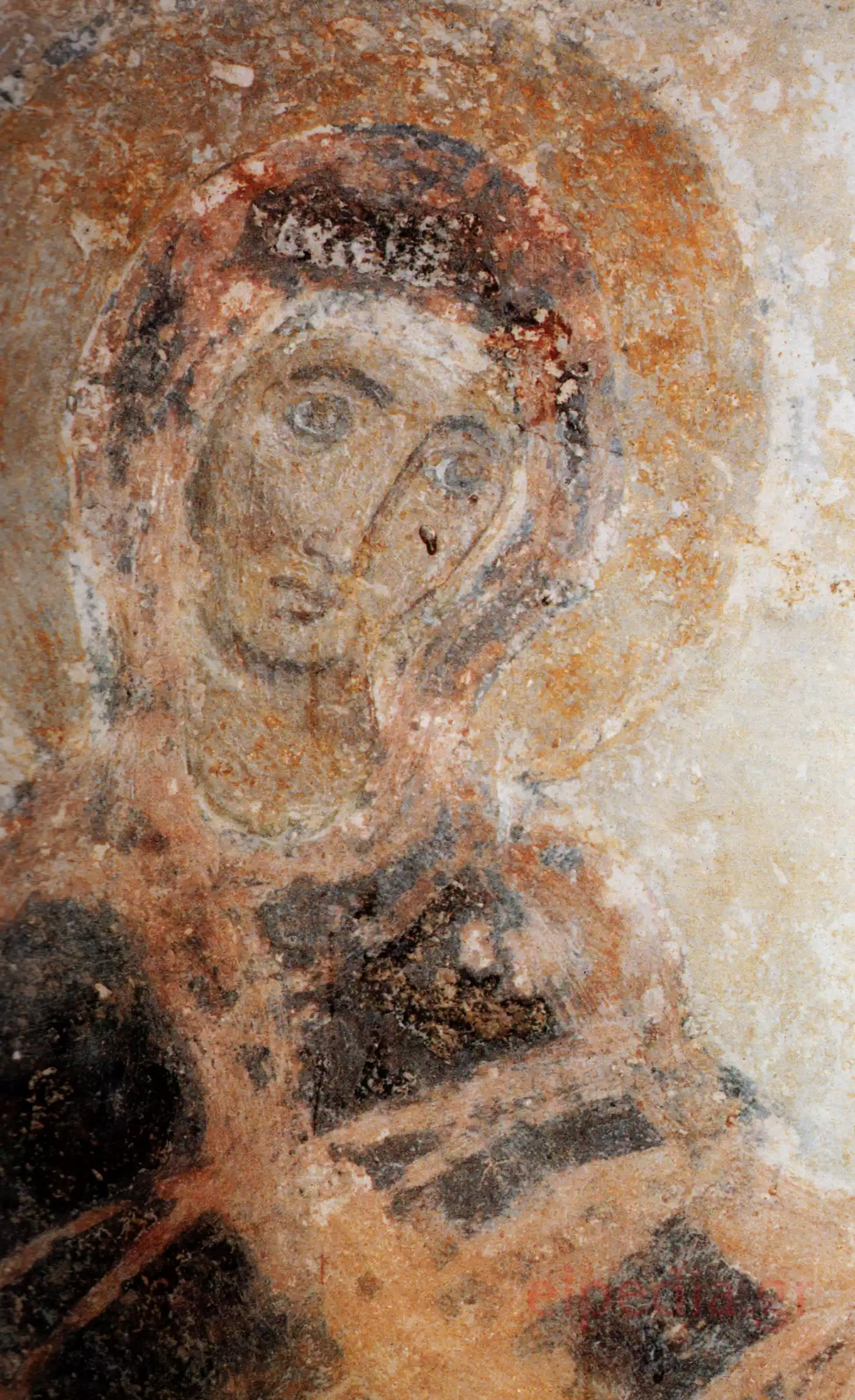
In the northern apse of a small Byzantine church on Naxos there survives, dimmed by time yet still discernible in its principal features, one of the oldest known representations of the Theotokos within a Deesis composition, dated to the seventh century AD. This church bears the name Panagia Drosiani and belongs to one of the oldest monastic complexes of the Byzantine world, with roots that scholars place between the fourth and sixth centuries.
Unknown remains, as with the greater part of early Christian painting, the name of the craftsman who held the brush.
The figure we discern, in an attitude of supplication and with delicate, almost translucent features, does not stand alone upon the wall. It belongs to a wider composition which far exceeds the established threefold form of Christ, Theotokos and the Forerunner, as this was later fixed in Byzantine art; at Drosiani the Deesis acquires five figures instead of three, two of which remain to this day open to interpretation, a question that has repeatedly occupied research concerning the earliest frescoes of the monastery and their period. Its survival is owed, in a certain ironic sense, to later layers of lime-wash and painting which covered it for centuries, thereby protecting it unintentionally from the fury of iconoclasm.
The Fresco of the Panagia Drosiani and Its Composition
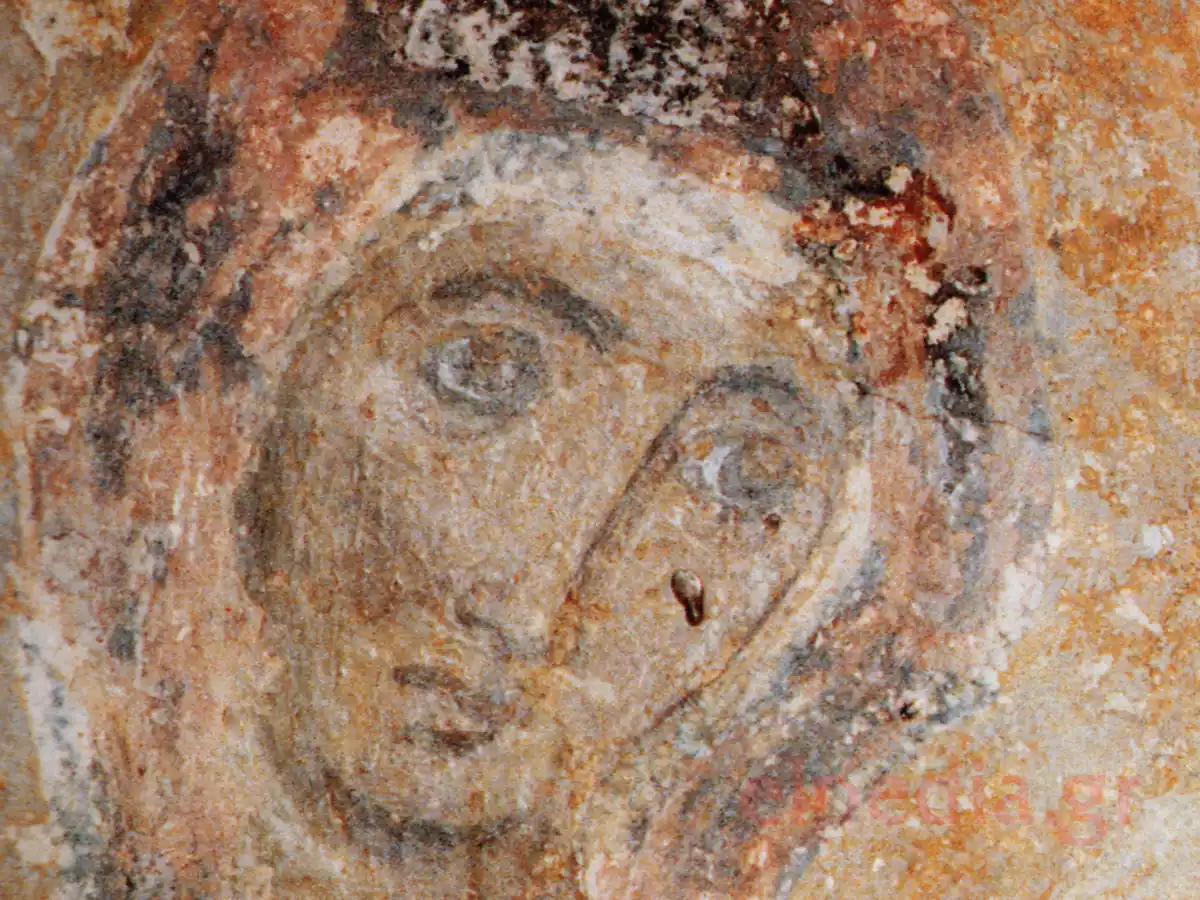
The face we see fills almost the entire surface around it, encircled by a halo drawn with a double outline, in tones of ochre passing into a deeper orange toward the edges. The head-covering, dark-toned at the crown and pale around the face, frames features which decay has left asymmetrical: one eye still retains its bold outline, the other has almost dissolved into the colour of the wall. Between them a slender nose and a small, almost pursed mouth give the face an introverted expression, far from any theatricality.
The Face of the Theotokos: Line and Decay
Below the neck, dark patches mark where the plaster has come away entirely, leaving the masonry bare. This is not, however, chance decay devoid of meaning for the present-day viewer. The contrast between the surviving portion, with its delicate lines of the face, and the lost portion of the body reveals something of the very technique of execution: the pigment was applied in thin layers upon wet plaster, a method which left vulnerable precisely those points where adhesion was weakest. Around the head, traces of red pigment can be discerned on the fabric covering the hair, a reminder of the traditional red maphorion of the Theotokos, although the main body of the garment no longer survives to a degree that permits secure conclusions as to its design.
Colour and Technique
The palette is confined to earth tones: ochre, brown, a subdued red and the dark, almost black, of the losses. There is no wealth of golden ground here, such as will dominate centuries later in the Cretan school; the surface remains austere, with the line carrying the whole weight of the expression instead of the colour.
This austerity is not a technical weakness. It echoes rather the late antique tradition of portrait painting, that which had already shaped, in the funerary portraits of the Fayum, a manner of rendering the gaze through large, expressive eyes. The fresco of the Panagia Drosiani appears to inherit precisely this gaze, transposing it into a religious context without substantially altering its language.
Its Place in the History of Byzantine Painting
Very few pre-iconoclastic frescoes have reached us, since the destructive fury of the eighth and ninth centuries obliterated the greater part of the pictorial production of the early Byzantine centuries. According to scholars, the Panagia Drosiani possesses the best-preserved fresco programme of this period, a fact which explains in part the scholarly interest that the monument has attracted. Over these original representations, later painters added new layers reaching down to the fourteenth century, covering the Deesis for hundreds of years before it was uncovered once more. In the dome of the same church, there survives a singular double depiction of Christ, first at a youthful age and then as a mature man, a feature which shows how rich and unusual was the theological programme conceived by the unknown artist or artists of Drosiani.
The visitor who stands today before this face does not merely behold a remnant. He sees the point at which the late Hellenistic sense of the human form met the need of a newly formed Christian community to give shape to intercession, to supplication, to human anguish before the divine.
The two unidentified figures which accompany the five-figure composition remain, until further notice, an open question for research, a reminder that even the most thoroughly studied monuments conceal gaps which no bibliography has yet managed to fill entirely. Decay, moreover, does not only take away; sometimes it leaves visible what a perfect surface would conceal, namely the manner in which the hand worked beneath the final surface of the colour. On Naxos, within a space that the daily haste of visitors often passes by, this face continues to look toward a direction which the composition of the Deesis itself established fourteen centuries ago, without needing any confirmation from us in order to remain what it is.
(This is a translation from the original Greek text; the translation was made by K. Pappas.)

