An analysis of the Byzantine fresco of 1295 on Mount Athos
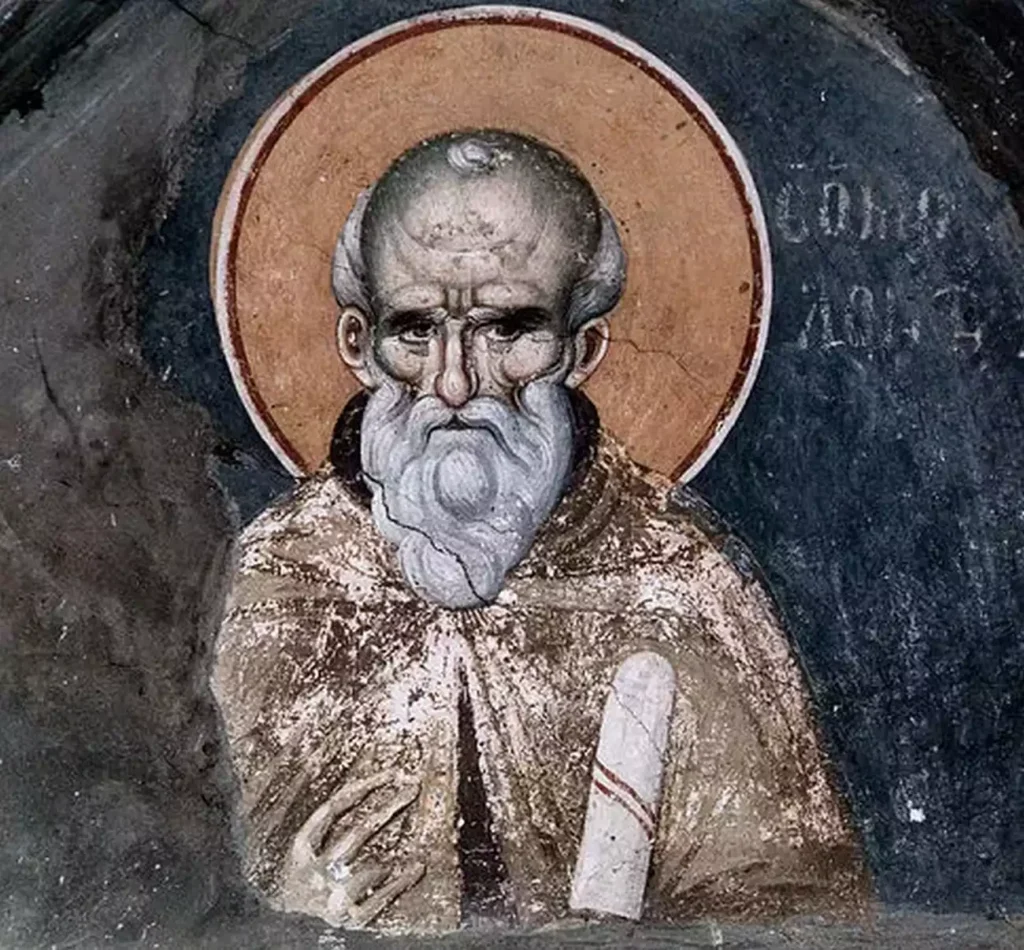
In the south aisle of the katholikon of the Protaton, at Karyes on Mount Athos, an aged figure with a white beard and a deeply furrowed face looks upon the visitor with a severity that does not easily soften. This is Saint Maximus the Confessor, the Byzantine theologian of the seventh century who paid with his own body for his resistance to Monothelitism, when his tongue and right hand were cut off before he was led to his final exile, in Lazica in the Caucasus, where he died in 662. The fresco is dated to around 1295 and is attributed, according to the tradition recorded in the eighteenth century by the Athonite Dionysius of Fourna in his Hermeneia, to Manuel Panselinos, the legendary iconographer of Thessaloniki.
The Protaton, a tenth-century church dedicated to the Dormition of the Theotokos, preserves the sole surviving examples of this painter’s art, a cycle of frescoes which the history of art regards as a milestone in the development of Palaiologan painting, with the spiritual gravity of the figures and the clarity of their modelling standing out among contemporary works. Modern scholarship has studied in detail the materials and techniques of these works by means of systematic chemical analysis, revealing how the artist combined fresco with painting on dry plaster, according to the demands of each scene. In the figure of Maximus the beard is fashioned with fine, almost linear brushstrokes upon a deep, dark background, while the halo retains the living warmth of its ochre, encircled by a dark depth that cuts it off from any particular place or time.
The figure of Saint Maximus: iconography and style
The head, bald at the forehead and covered behind with sparse grey hair, bears three deep horizontal wrinkles which cross the forehead and give at once the sense of a long, tried life. The eyes, sunk in shadowed sockets, do not seek out the viewer with sweetness; they look somewhat sideways and gravely, with the brows almost joined above the root of the nose. This sombreness is not an arbitrary choice of the painter; it reflects, rather, the iconographic tradition which required ascetic theologians to be stripped of every superficial calm, the face functioning as a record of inner struggle.
The beard, long and forked at its tip, whitens in contrast with the greyish skin and develops in wave-like, almost architectural bundles which the painter arranges with care for light and shadow. Beneath it may be discerned part of the neck and the beginning of a dark inner garment, before the gaze reaches the tunic, of a deep ochre hue with golden reflections in its folds, where the colour appears to have undergone the wear of centuries without, however, losing its plasticity. In the right hand, among the fingers which form a gesture of blessing or speech, and in the left, which holds a scroll of parchment with two red ribbons, the composition closes in an entirely balanced manner, with no detail left to chance.
To the right of the halo may be discerned traces of an inscription in capital letters, part of the identification of the saint which almost always accompanied such figures in Byzantine iconographic programmes. Wear has removed the completeness of the text, yet its trace remains, testimony to a practice which allowed the faithful to recognise at once which theologian stood before them, without confusion with other ascetic saints of the same period.
Colour, light, and the technique of Panselinos
The background behind the figure is not a neutral grey, as it appears at first glance, but a deep greyish blue which approaches black in its shadowed areas, creating a strong contrast with the bright brown of the halo. This juxtaposition of warm and cool colour constitutes a characteristic of the palette which the relevant research has connected with the use of natural earth pigments, applied both by the technique of true fresco and by lime-painting on dry surfaces, according to what each part of the composition required.
The manner in which the volumes of the face are rendered, with successive layers of shadow passing from dark brown to the light rose of the highlights, testifies to a painter who knew well the capacities of his material. There is here neither the hard linearity of earlier workshops, nor yet the excessive softness that would lead to a loss of character. Balance — this is perhaps the word that best describes the result, a balance which scholars of Byzantine art recognise as the hallmark of the artistic circle of Panselinos, in distinction to more dramatic or more schematic tendencies of the period.
Of interest, too, is the surface of the wall, where cracks and small flakings of the plaster let the passage of the centuries show through. This is not a defect that diminishes the work; on the contrary, it adds a layer of historical authenticity, as the viewer perceives that he stands before a material record of seven centuries, not before a reproduction.
Saint Maximus in the iconographic programme of the Protaton
The presence of theologians and ascetic fathers in the decoration of churches such as the Protaton did not constitute a mere choice of piety. It answered to a broader programme which required the Church to be presented through the succession of the defenders of the true faith, from the apostles down to the later confessors. Maximus, by his theological contribution to the controversy concerning the two wills of Christ, held a particular place in this succession, since his work had shaped to a great extent the subsequent Orthodox Christology.
Within the context of the Hesychasm that was flourishing on Mount Athos at the time these frescoes were being painted, the figure of a theologian who had suffered torture for his faith acquired additional weight. Nor was it by chance that among the monks and theologians of the period the thought of Maximus was undergoing a particular revival, a revival which art recorded upon the walls of churches even before it was systematically set down in written texts of the following century.
The placement of the figure in the south aisle, among other hierarchs and ascetics, follows the established practice of ranking the saints according to their office, a practice which allowed the pilgrim to read the church as an open book of theology, without need of written guidance.
The gaze of Maximus, however severe it may appear at first sight, is not devoid of humanity. Something in the shape of the lips, slightly tightened but not menacing, recalls weariness rather than wrath, the weariness of one who has been through much without bending. Panselinos, or whichever painter of his circle worked on this part of the church, seems to have known that true heroism has no need of theatricality in order to be conveyed.
Research into the whole body of the Protaton frescoes has shown that the artist, or his workshop, possessed a unified conception both of colour and of the psychological rendering of the figures, something which explains the coherence one feels in passing through the church, despite the great number of different scenes and figures that adorn it.
The figure of Maximus, finally, does not stand alone within the composition of the church. It converses silently with the neighbouring representations, part of a wider fabric which narrates the history of the Church through the persons who served her, each in his own manner of witness.
The influence of this cycle of frescoes upon later Byzantine and post-Byzantine painting was immense. Generations of iconographers, on Mount Athos and beyond it, looked toward the Protaton as a model of style, seeking that balance between the monumental and the human which the creator of the figure of Maximus had achieved with such naturalness.
Today, whoever stands before this fresco does not behold merely a religious depiction. He sees a record of pictorial thought seven centuries old, a sample of technical skill which modern scholarship continues to decode, and a man, Maximus the Confessor, whose story remains as charged today as it was when the iconographer’s brush first touched the wall at Karyes.
Translation: K. Pappas

