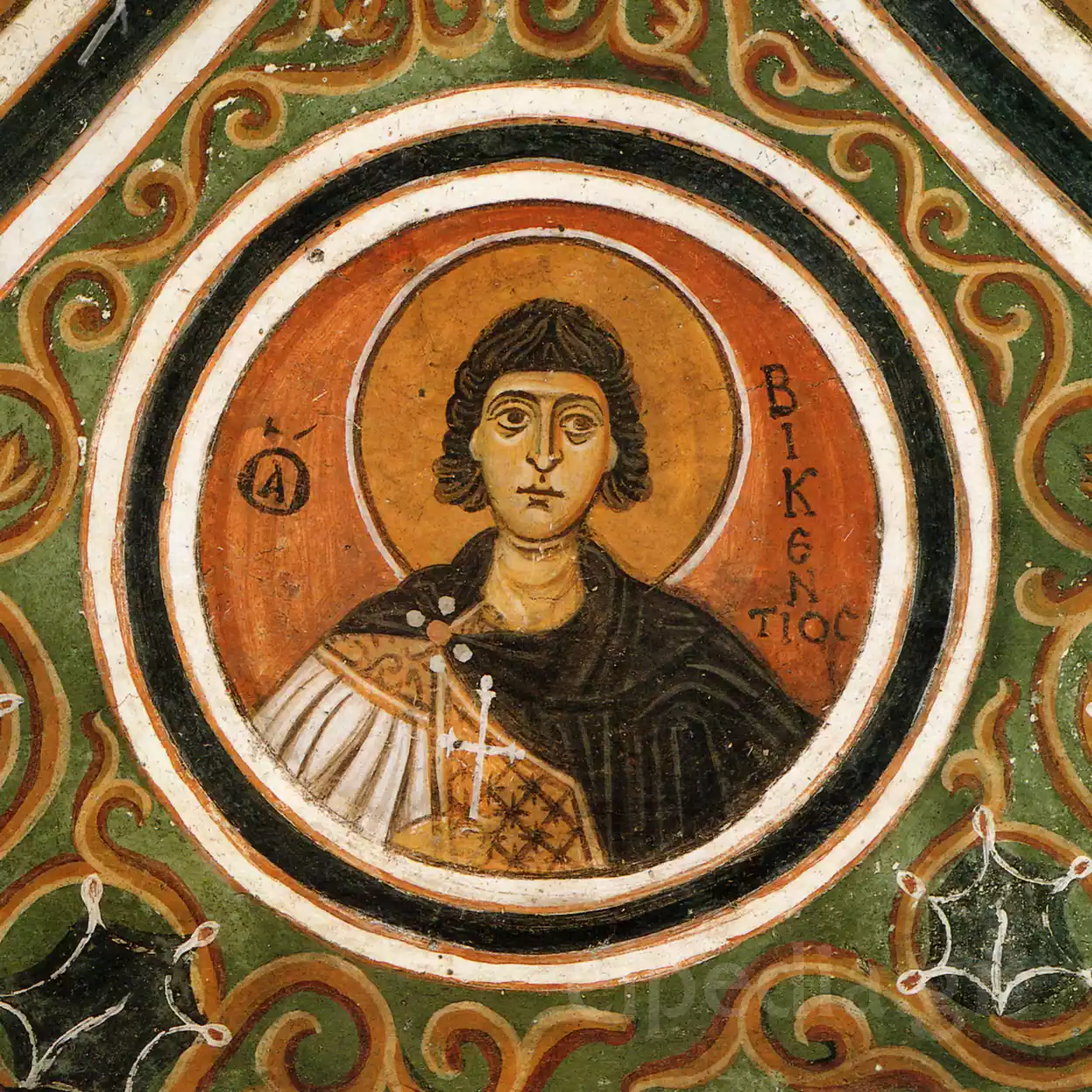
A youthful face, with dark, curling hair and a gaze all but piercing, looks out frontally from within a circular medallion, framed by an orange halo and the vertical inscription ΒΙΚΕΝΤΙΟΣ. This forms part of a wider ensemble of wall paintings adorning the southern groin vault of the crypt in the katholikon of the Monastery of Hosios Loukas, in Phocis. The painter remains unknown; the period, however, is known: the third quarter of the eleventh century, one of the most productive moments, artistically speaking, of the Middle Byzantine era. Saint Vincent appears here beside other soldier saints and martyrs, Anicetus and Arethas, within a sequence of medallions that seem to hover against a green ground interwoven with winding plant motifs.
The technique is that of fresco, natural pigments laid upon fresh plaster, a method that already carried centuries of experience behind it by the time the anonymous craftsmen of Phocis undertook the decoration of this subterranean space dedicated to Saint Barbara. The study of such ensembles, moreover, is not confined to the monastery alone; earlier archaeological surveys of the medieval monuments of Boeotia help to situate the work within a broader network of ecclesiastical painting in the region. Vincent, a deacon from Zaragoza who suffered martyrdom in the early fourth century, was honoured both in the West and in the East, a fact which explains his presence in a Byzantine church far removed from the place of origin of his cult.
The Figure of Saint Vincent in the Crypt Fresco
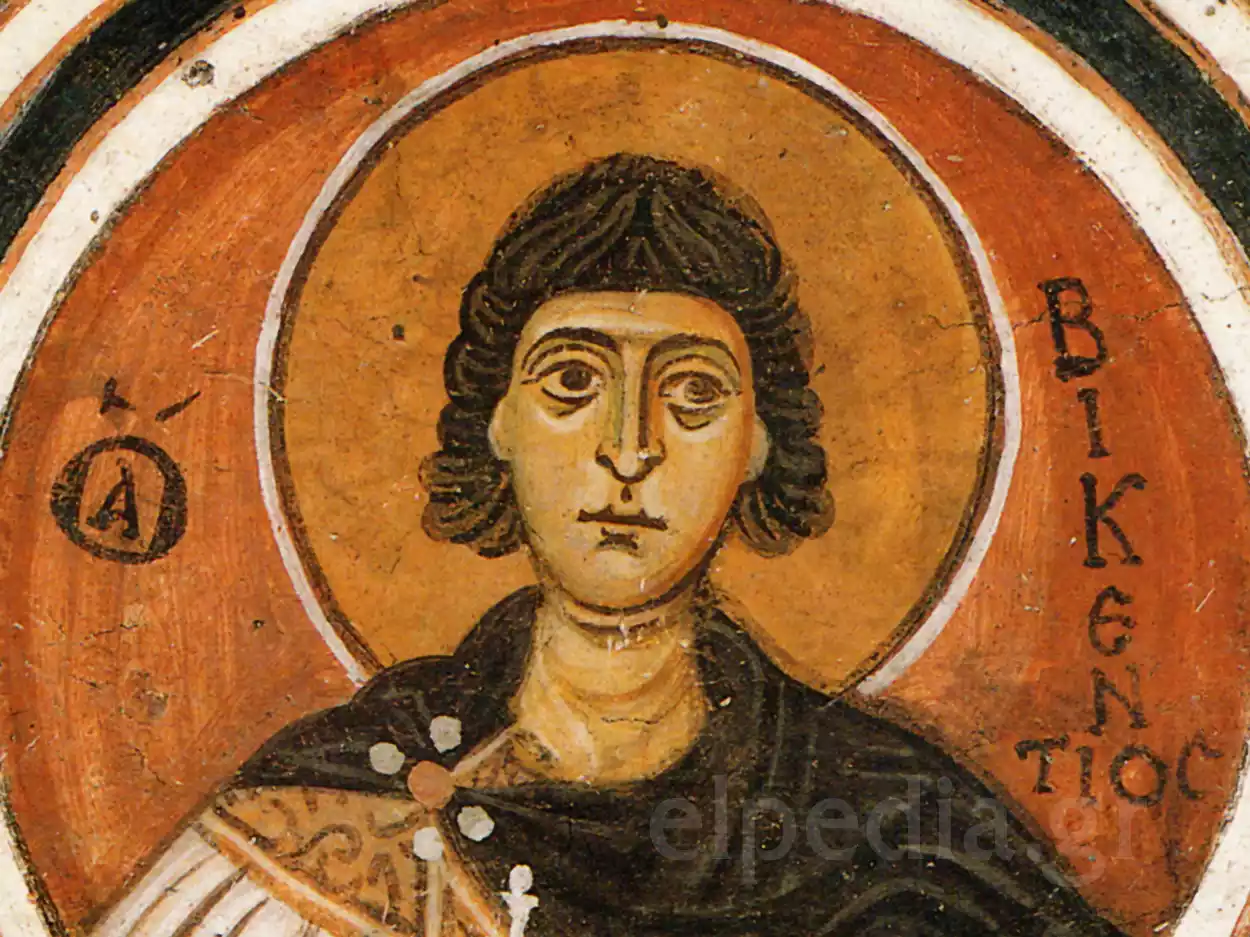
Upright, grave, without the least trace of movement upon the face, the saint regards the viewer with eyes large and slightly asymmetrical, a feature not uncommon in the painting of this period and one that lends the gaze something between severity and sorrow. The hair, dark and abundant in volume, falls in countless small curls about the forehead and ears, giving the figure a youthful, almost adolescent aspect, in contrast to the aged gravity of other saints within the same decorative scheme. The face is rendered with an underpainting in dark ochre, over which highlights in lighter tones are laid upon the cheeks, the forehead, and the nose — a technique typical of the Middle Byzantine idiom, in which light does not fall naturalistically but is organised into successive, almost linear layers.
The halo, a deep orange approaching terracotta, is delimited by a fine white line and then by a broader black band, before being absorbed into the circular frame of the medallion. Between the halo and the letter A, rendered in small cruciform script, on the left — a detail that most probably functions as an abbreviation, or as part of a wider epigraphic convention of the period — while to the right the name ΒΙΚΕΝΤΙΟΣ unfolds vertically, letter beneath letter. The garment visible in the lower part of the composition combines a dark, almost black himation, with dense folds rendered in fine, parallel lines, and a lighter inner garment adorned with gold paragaudia — bands, that is, which frequently denoted rank or particular honour within the Byzantine vocabulary of dress.
The frame surrounding the medallion is no mere decorative addendum. A double wreath in white and black encircles the medallion, while the green field beyond it fills with spiralling plant motifs in ochre, a design repeated throughout the entire decoration of the ceiling and one that unifies visually the individual figures of the saints into a single, continuous whole. Decorative frames of this kind were not designed at random; they followed, as a rule, predetermined patterns that circulated from the great artistic centres toward the provinces, adapted on each occasion to the capacities of the local workshop.
The Cross in the Hand: A Symbol of Martyrdom
Beneath the neck, where the himation is fastened with a small clasp forming three characteristic drop-shaped folds, a small cross may be discerned, held at the height of the breast. This is no incidental element of the garment’s decoration. The cross functions as the iconographic sign of recognition of the martyr par excellence — the object that distinguishes him from mere hierarchs or holy men, and that declares to the viewer at once, even without the inscription, that this is a person who underwent torture for his faith.
Its rendering is spare, almost linear, with white lines forming the vertical and horizontal bars against a dark ground. No further decoration burdens the object, no gilding, nothing to draw attention away from its plainness. It is precisely this simplicity that renders it legible even from a distance, within the half-light of the crypt, where natural light is almost entirely absent and the perception of detail rests exclusively upon the artificial source of illumination. The painter, whoever he was, evidently knew the conditions under which his work would be viewed, and adapted his technique accordingly.
Beside the cross, the texture of the dark garment acquires a particular interest of its own. The folds are not rendered with naturalistic precision but are schematised into parallel, almost abstract lines, recalling convention rather more than observation. This is a characteristic trait of many provincial workshops of the Middle Byzantine period, in which distance from the great centres of production did not necessarily signify inferior quality, but rather a different, more schematised language of expression.
The study of such a detail — a small cross in a hand not even fully visible — reveals, in the end, something broader about the manner in which Byzantine iconography operated: every object, however small it may appear, carried a specific meaning and was obliged to be recognisable, to communicate directly with whoever beheld it.
Saint Vincent: The Historical Martyr Behind the Icon
Vincent, as we know him from the sources, was a native of Zaragoza and served as deacon in the household of Bishop Valerius, when he was arrested during the persecutions of the early fourth century and put to a martyr’s death at Valencia. His renown spread quickly also to the East, where he was received into the calendar of feasts alongside other martyrs of similar standing, such as Anicetus and Arethas, who accompany him in the same groin vault. It is no surprise that the Church chose to honour together persons who lived in different ages and places; hagiographical tradition frequently organised such groupings on the basis of shared thematic criteria — such as military or diaconal office — rather than on strict chronological or geographical grounds.
The crypt of the Monastery of Hosios Loukas was not designed as a mere ancillary space. It served as a burial place for the monks of the brotherhood, a fact which explains both the thematic content of its decoration and the choice of martyr figures such as Vincent — persons, that is, whom the Church’s own tradition associated directly with the idea of sacrifice and of passage into another life. The proximity of these figures to the tombs of the monks was not, therefore, an arbitrary choice, but a deliberate theological and iconographic strategy, common to many monastic complexes of the period.
There remains, after all this, a question that no text can answer fully: who, in truth, was the man behind the brush that drew these eyes, this almost adolescent expression upon the face of a martyr? The anonymity of the Byzantine craftsmen remains, in most cases, impenetrable, and what remains is the work itself — exposed to time and to decay, yet still capable of conveying something of the intensity of an age that believed profoundly in the power of the image.
(This is a translation from the original Greek text; the translation was made by K. Pappas.)

