
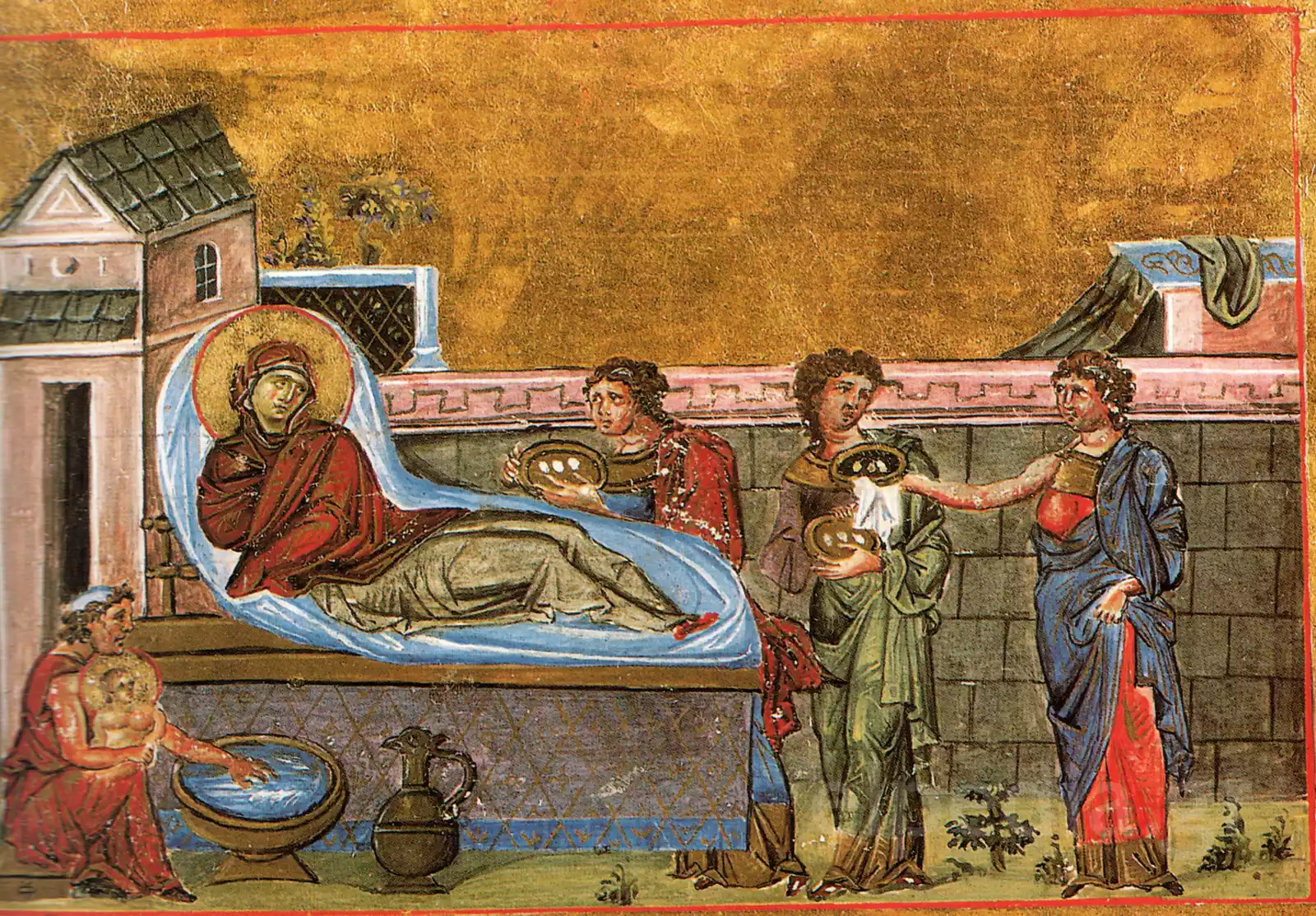
On a leaf of parchment, entirely painted with gold, around 985 AD, is depicted the moment immediately after the birth of the Mother of God. This leaf bears the shelf-mark Vat. gr. 1613, f. 22, and is preserved in the Vatican Library, having survived as part of one of the most sumptuous manuscripts ever produced by Byzantine imperial art, the Menologion of Basil II. It belongs to a set of four hundred and thirty miniatures, the work of eight painters known today only by their monograms, who divided among themselves the decoration of a book made to be read in memory of the saints, day by day, throughout the whole of the ecclesiastical year.
A book of this kind is called a Menologion, intended to accompany, at Matins, the reading of the synaxaria — that is, the brief narrative of the life of each saint, on the very day of his commemoration. The birth of the Mother of God is celebrated on the 8th of September, symbolically opening the ecclesiastical year, and the narrative followed by the iconography is drawn from the Protevangelium of James, an apocryphal text of the early Christian centuries recounting the childless old age of Anna and Joachim and the unexpected miracle of conception in their old age. The precise dating of the manuscript has occupied scholars for decades, since the pictorial style and the inscriptions argue for a period around the close of the tenth century, as documented in earlier studies on the Psalter and the Menologion made for Basil II. This age, known as the Macedonian Renaissance, favoured the flourishing of illuminated manuscripts, since imperial patronage had at its disposal abundant gold and outstanding craftsmen for works intended as much to impress as to instruct. The manuscript as a whole numbers two hundred and seventy-two leaves of parchment, a size approaching that of a small table, thirty-seven and a half by thirty-two centimetres — a scale that by itself betrays the sumptuousness of the commission.
The same apocryphal text describes Joachim withdrawing for forty days into the desert, refusing to return to his wife before receiving a sign from God, and Anna lamenting alone in the garden, until an angel announces to her that her prayer has been heard. The scene painted on folio 22 comes a little later in this narrative, when the miracle has already been accomplished and there remains its more human, everyday aspect: the bathing of a newborn.
The Composition of the Birth of the Mother of God
At the centre of the composition, reclining on a heavy wooden couch with blue sheets forming broad, undulating folds, Saint Anna still holds the bodily posture left by childbirth, half raised, her head inclined towards the infant. The painter set her within a scene full of movement, placing around her three young attendants occupied with preparing the bath. On the right, standing before a low wall of a rosy hue, two of them hold round vessels, while the third, with her hand outstretched, appears to be giving or taking something from the one beside her. At the lower left edge, a fourth woman sits bent over a round basin of pale blue water and holds in her arms the infant, already haloed, testing the temperature with her fingers before immersing her.
The composition is not organised symmetrically. The figures crowd towards the right-hand side of the folio, leaving on the left the space to breathe around the bed, a balance of weights that leads the eye from the stillness of the woman in childbed towards the movement of the attendants and back again, in a circular path that does not weary. Behind them all, two buildings with rosy walls and roofs painted a dark green rise against a background entirely of gold, without a trace of sky, without a cloud, without a horizon.
The Golden Ground and the Language of Colour
This golden ground renders no specific place. It functions rather as a declarative framework for a reality that surpasses time, a device usual in Byzantine miniature painting to signal that what we behold belongs to sacred history and not to the everyday. The band of rosy colour that runs horizontally along the upper part of the wall, adorned with a classical meander, recalls how persistently Byzantine painting retained its bonds with Greco-Roman architectural decoration, even in scenes of purely theological content. On the garment of Saint Anna deep red predominates, a colour which in Byzantine iconography is often associated with human nature and with motherhood, while the pale blue of the sheet recalls the very colours that the Mother of God herself will later wear in the mature Byzantine icons — red within, blue without — in an inversion of colours that visually binds mother to daughter from this very first moment.
The Symbolic Weight of the Bath
The bath which the attendants prepare is not mere cleanliness. In the Byzantine iconographic tradition, the same motif appears also in the scenes of the Nativity of Christ, where two midwives bathe the divine infant in an identical arrangement, kneeling around a round basin. Scholars have connected this image with older representations of the birth of Dionysus, from which Christian art appears to have borrowed the scheme, filling it with new meaning: the water as a prefiguration of baptism, the body of the infant as proof of a real, bodily birth. In the case of the infant Mary, the same water acquires a further dimension, since she herself will later be called by the hymnography the fountain of life, and thus the bath of her infancy becomes almost a foreshadowing of the title she will bear.
The Attendants with the Basins of Water
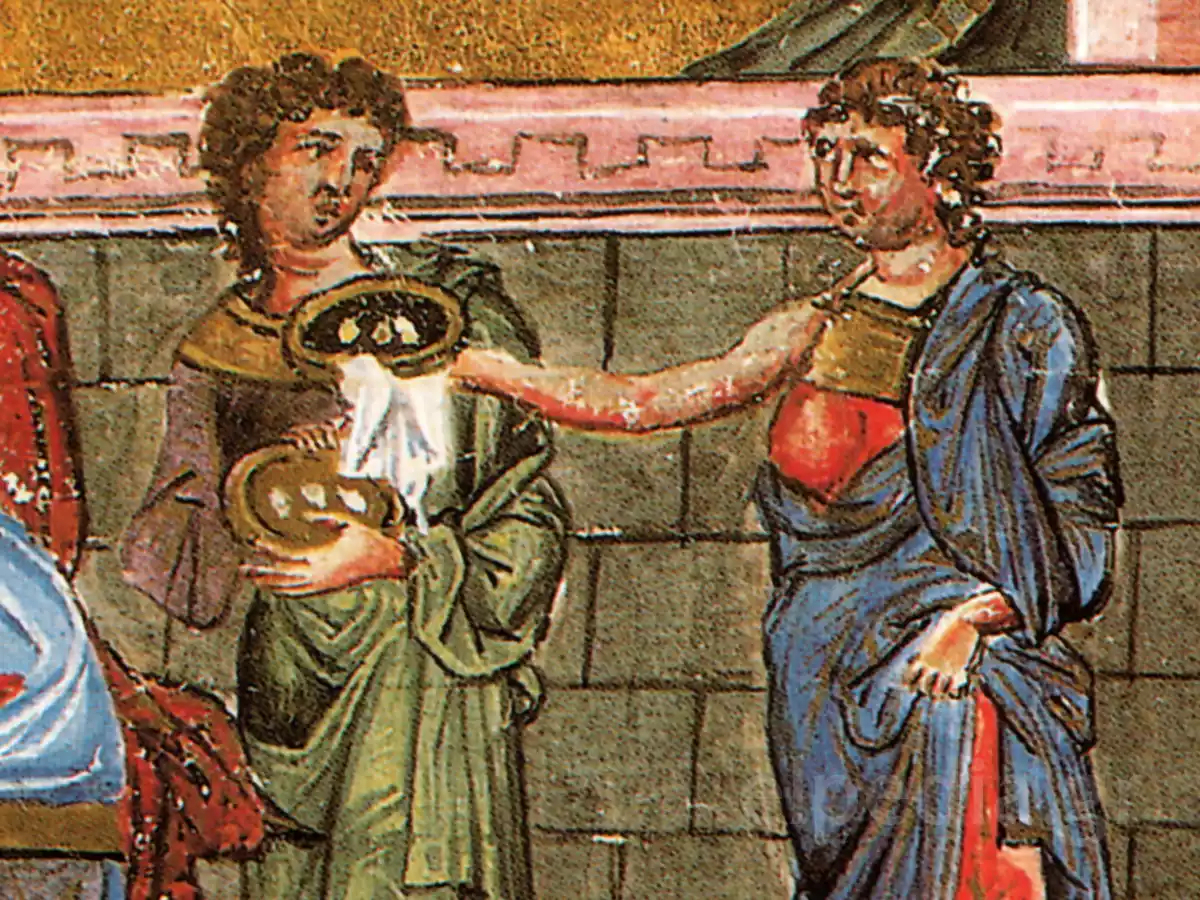
This detail brings closer the two attendants standing on the right of the composition, their faces now distinguishable, youthful, with curly brown hair, uncovered. The first, dressed in a tunic of olive hues with golden decorative bands upon the shoulders, holds in one hand a round basin in which small, round objects of a light colour may be discerned, perhaps loaves or materials intended for the bath, while in the other hand he holds a folded white cloth, a towel ready for the drying of the infant. Beside him, a second, in a blue mantle over a red tunic, extends his hand towards the first. Something passes between them. What it is, is not entirely clear.
This exchange of objects between secondary figures, repeated almost identically in dozens of birth scenes throughout Byzantine art, shows how steadily iconographic models circulated among workshops and generations of painters, a matter that has been studied extensively in relation to the visual knowledge transmitted through Byzantine manuscripts. The same composition, with attendants holding basins and cloths around the woman in childbed, one encounters again centuries later in wall-paintings such as those of Studenica in Serbia, a fact which shows how resistant to time this iconographic scheme proved. Behind them, the same rosy wall with its meander continues, and above the roof a corner of deep green foliage may be discerned, perhaps a garden, perhaps merely a convention of landscape.
Saint Anna upon the Couch
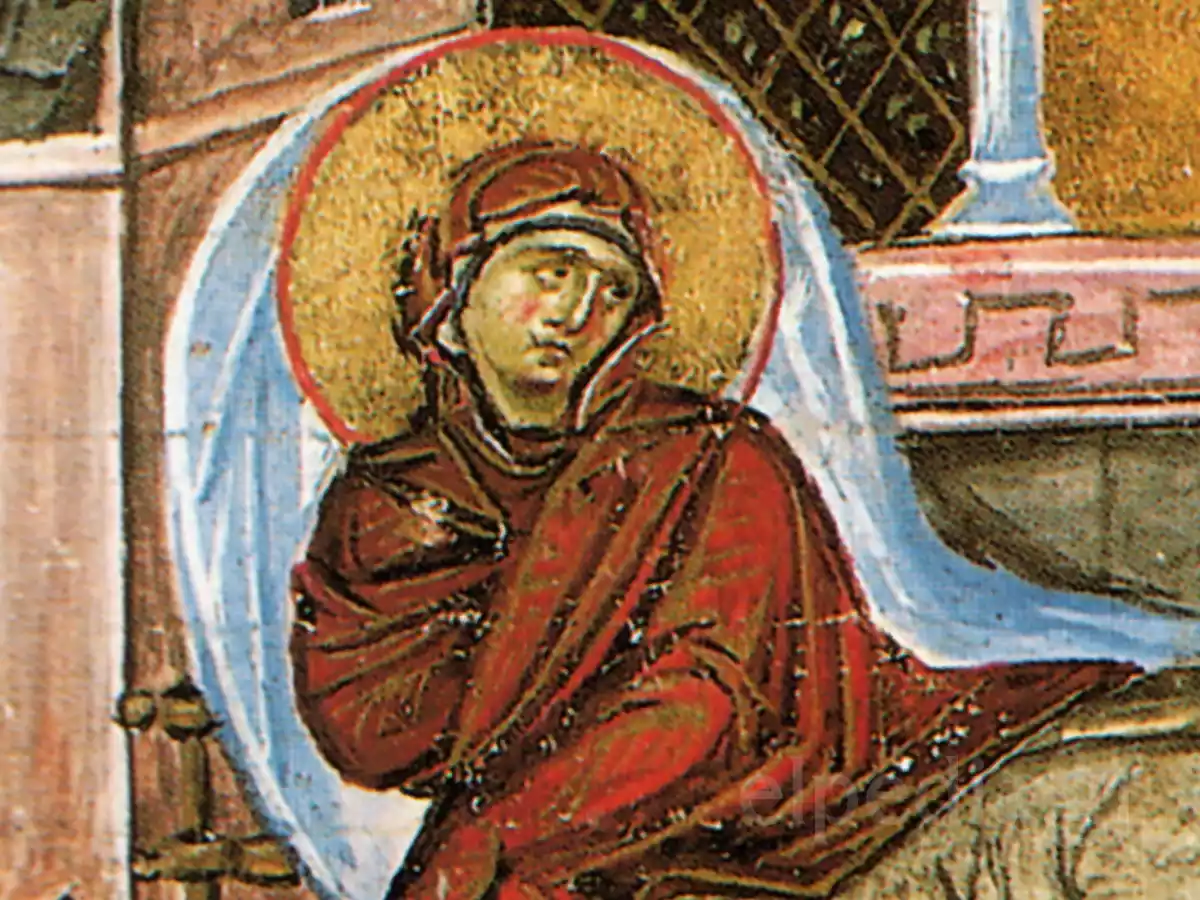
The face of Saint Anna, as it is rendered in this detail, does not look upon the infant. Her gaze turns outward, with an expression that balances between exhaustion and something harder to name, perhaps wonder, perhaps bewilderment before the very event that has just been accomplished within her body.
In the depictions of subsequent centuries this posture will become fixed as a type, with Anna almost always turning her head outward and not towards the infant, a detail perhaps explained by art’s desire to show human weariness beside the miracle, without the one overshadowing the other.
The halo about her head is formed by a circle of deep red outline around a golden field, a technique usual in the manuscripts of the Macedonian Renaissance, where the gold leaf is not spread uniformly but organised into zones that emphasise the hierarchy of the persons. On her garment, the folds are rendered with fine lines of gold, the so-called chrysography, a technique borrowed from the decoration of icons and applied here in the miniature with a care that even a goldsmith might envy. Behind her shoulder a part of a latticed window may be discerned, an element that appears often in the dwellings painted by the Menologion, a borrowing rather from the actual urban architecture of tenth-century Constantinople than an invention of the painter. It is difficult to say with certainty whether the artist knew at first hand the bodily exhaustion of a woman after childbirth, or whether he merely copied faithfully a model older than himself. The Byzantine painterly tradition does not often allow traces of this kind of personal observation to show through.
The miniature of the Birth of the Mother of God on folio 22 of Vat. gr. 1613 does not stand alone in the history of Byzantine art. It belongs to a long chain of depictions of the same subject, from the mosaics of the middle Byzantine period to the wall-paintings of the Palaiologan age, where the same basic arrangement — the couch, the attendants, the basin of the bath — is repeated with small variations for centuries.
The fact that eight different painters worked upon the same manuscript, dividing among themselves the four hundred and thirty scenes, shows how organised, by then, the production of luxury books had become at the court of Constantinople around the year 1000 AD. It was not a matter of isolated artists working alone in their workshop, but of teams trained to follow common models, capable nonetheless of preserving, within this shared vocabulary, some personal touch in the face of a woman or in the movement of a hand.
The study of such miniatures offers today something more than aesthetic delight. It allows one to follow how visual models were carried between Constantinople, the monasteries of the Holy Mountain, and provincial workshops, in a chain of copying and adaptation that remained unbroken for centuries. Today’s reading of the scene, one might say, does not differ essentially from that which a Byzantine viewer would have made a thousand years earlier, so far as its basic elements are concerned — the couch, the attendants, the bath. What changes, perhaps, is the eye that reads it, more familiar today with questions of dating, workshops, and artistic identity than with its functional use at Matins on a particular day in September.
Basil II did not live long enough, if we are to trust the estimates of the manuscript’s time of production, to see it completed. The book passed later into the hands of the Vatican Library, where it has remained for centuries, far now from the Constantinople that gave it birth, far too from the churches where once, perhaps, the memory of Saint Anna was read aloud every 8th of September.
(Translated from the original Greek text by K. Pappas.)

