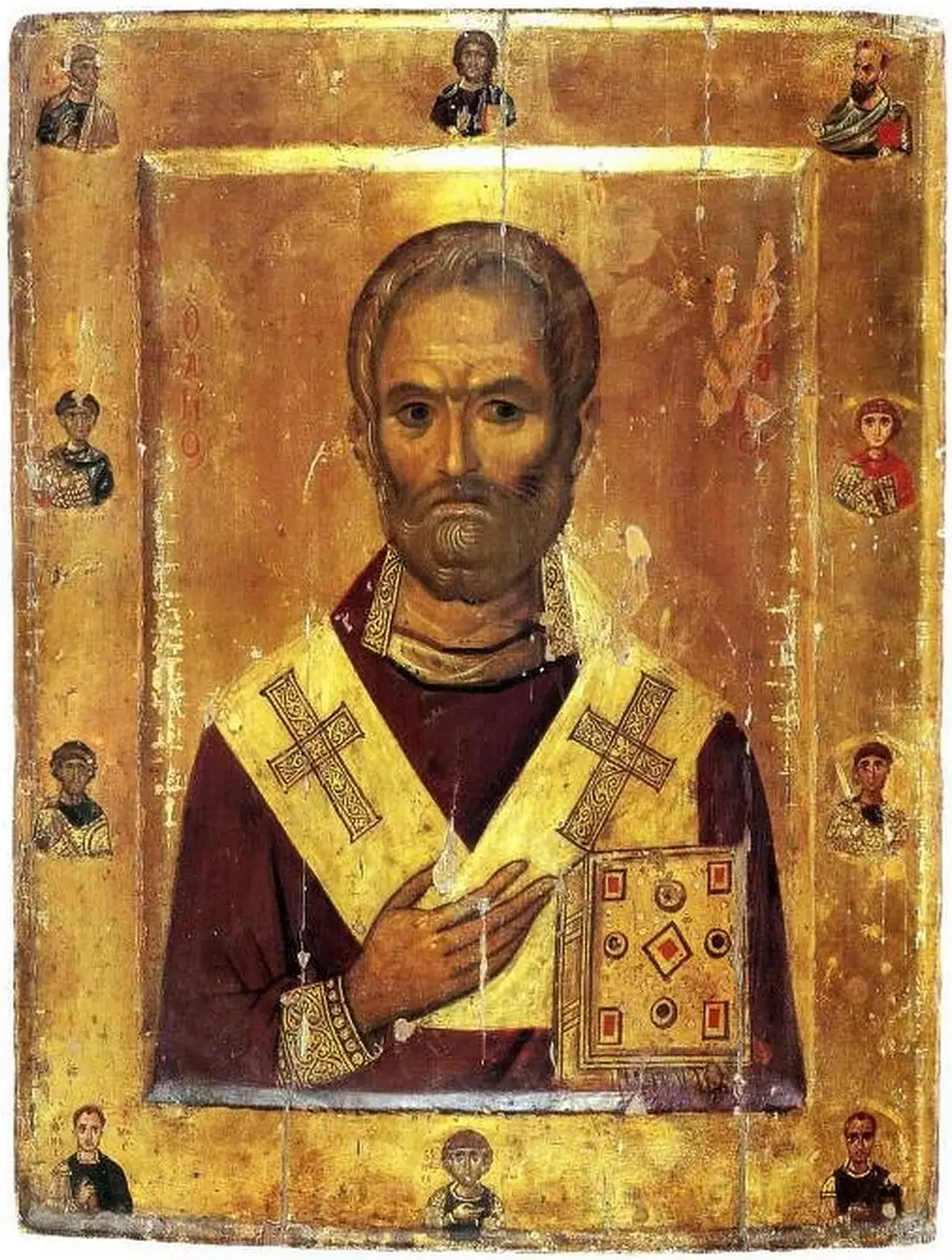
On a small, time-worn wooden surface of forty-three by thirty-three centimetres there has been preserved, since the eleventh century, the icon of Saint Nicholas, one of the most precious treasures of the Monastery of Saint Catherine in Sinai. Unknown remains the name of the painter who wrought it; known, however, and well documented is the tradition of the workshop that was active in the monastery during the Middle Byzantine period, producing works of high quality for the monks and the pilgrims who arrived from every corner of the empire. The saint is depicted in bust, frontal, with his gaze fixed directly upon the viewer, wearing his episcopal vestments and holding a closed gospel book. This composition, known in Byzantine iconography as the frontal bust, does not constitute a mere artistic choice but a theological message, since it conveys to the pilgrim the sense of the immediate episcopal presence and the didactic authority that the saint embodies as shepherd of the Church. The study of such works, as has been demonstrated too in earlier issues of the Deltion of Christian Archaeology, reveals facets of the artistic production of Sinai that remain, to a certain degree, underestimated in modern research. This is painting intended not only for liturgical use, but constituting also a historical document of an artistic tradition that continued, through revisions and adaptations, down to our own days.
The Iconographic Composition of the Icon of Saint Nicholas
The face of the saint dominates the composition, filling almost the entire pictorial field with an immediacy that leaves no room for narrative detachment. His hair, greyish and thinning at the forehead, reveals a middle-aged man, not yet the elder with the snow-white hair and the deeply furrowed cheeks who would become established as the model in later depictions of him. His gaze, dark and intense beneath thick eyebrows, focuses directly upon the viewer, without the slightest turning aside. At the height of the chest, the right hand is raised in a gesture of blessing, a spare movement that condenses the entire didactic function of the hierarch. The left holds a closed gospel book with an exceptionally elaborate cover, studded with red and dark-coloured stones arranged in strict geometric sequence, rhombi and circles alternating with almost mathematical precision. The vestments are composed of the deep-red tunic and the omophorion, white with black crosses embroidered at regular intervals, falling in diagonal arrangement from the shoulders to the knees. The folds in the fabric are spare, almost linear; their ends form at times a characteristic hooked termination, a stylistic feature that points directly to workshops of eleventh-century Constantinople.
Around the central image, ten small medallions are arranged upon the gold background, each housing the bust of a saint on a scale far smaller than that of Nicholas, at times youthful and luminous in countenance, at times aged and sombre. At the summit, Christ is flanked by the two foremost apostles, Peter and Paul, a triad that signifies the unbroken chain of apostolic succession. In the two vertical columns, left and right, four military saints, Demetrius, George, Theodore and Procopius, guard the composition, recalling the martyric dimension of the faith. At the bottom, three further figures: Cosmas, Panteleimon and Damian, the healing saints whom tradition has ever associated with the healing of the body. This selection composes a fully integrated theological programme, in which authority, witness and healing coexist around the figure of the hierarch.
The gold background, uniform and immaterial, deprives the image of any sense of space, placing the saint in a dimension that transcends place. Traces of a faint, almost effaced figure can be discerned in the upper right portion of the background, probably a remnant of an earlier repair that time did not leave untouched. The dating of the work rests chiefly on comparison with later icons of the same saint, in which his figure becomes gradually more ascetic, with hair entirely white and cheeks deeply hollowed, features that are here entirely absent. The style as a whole, spiritual, slow in rhythm, with a balanced arrangement of the figures, belongs to what scholarship has termed the monumental hieratic style, an artistic language that predominated throughout the empire until the rise of the Komnenian dynasty. The haloes, with their coarse, relief surface, constitute a technical feature encountered almost exclusively in works of the monastery, an element that reinforces the attribution of the work to a local workshop of Sinai.
The icon of Saint Nicholas does not stand alone within the history of Byzantine painting. It belongs to a wider family of works which the Monastery of Saint Catherine, founded in the sixth century on the initiative of the Emperor Justinian at the foot of the mountain where tradition places the theophany to Moses, preserved thanks to its isolation and to its uninterrupted liturgical life. Destructions that elsewhere effaced almost every trace of early iconography never reached here. Icons of the sixth, the seventh, even the eighth century survived in Sinai, offering to research a rare archive of the development of an art that elsewhere we know only in fragments.
The modern viewer, when he stands before such a work, is called to see it with two gazes at once. The one recognises in it a liturgical object, a bearer of a spirituality that remains alive in Orthodox worship to this day. The other, equally legitimate, examines it as a historical document, the product of a particular workshop, a particular era, of artistic conventions that changed and became once more the model for succeeding generations of painters.
And both gazes, in the end, see the same face, a middle-aged man, with a stern forehead and a gaze that does not turn away, holding closed a book with a rich, inlaid cover that no visitor will ever see opened.
(This is a translation from the Greek text; the translation was made by K. Pappas.)

