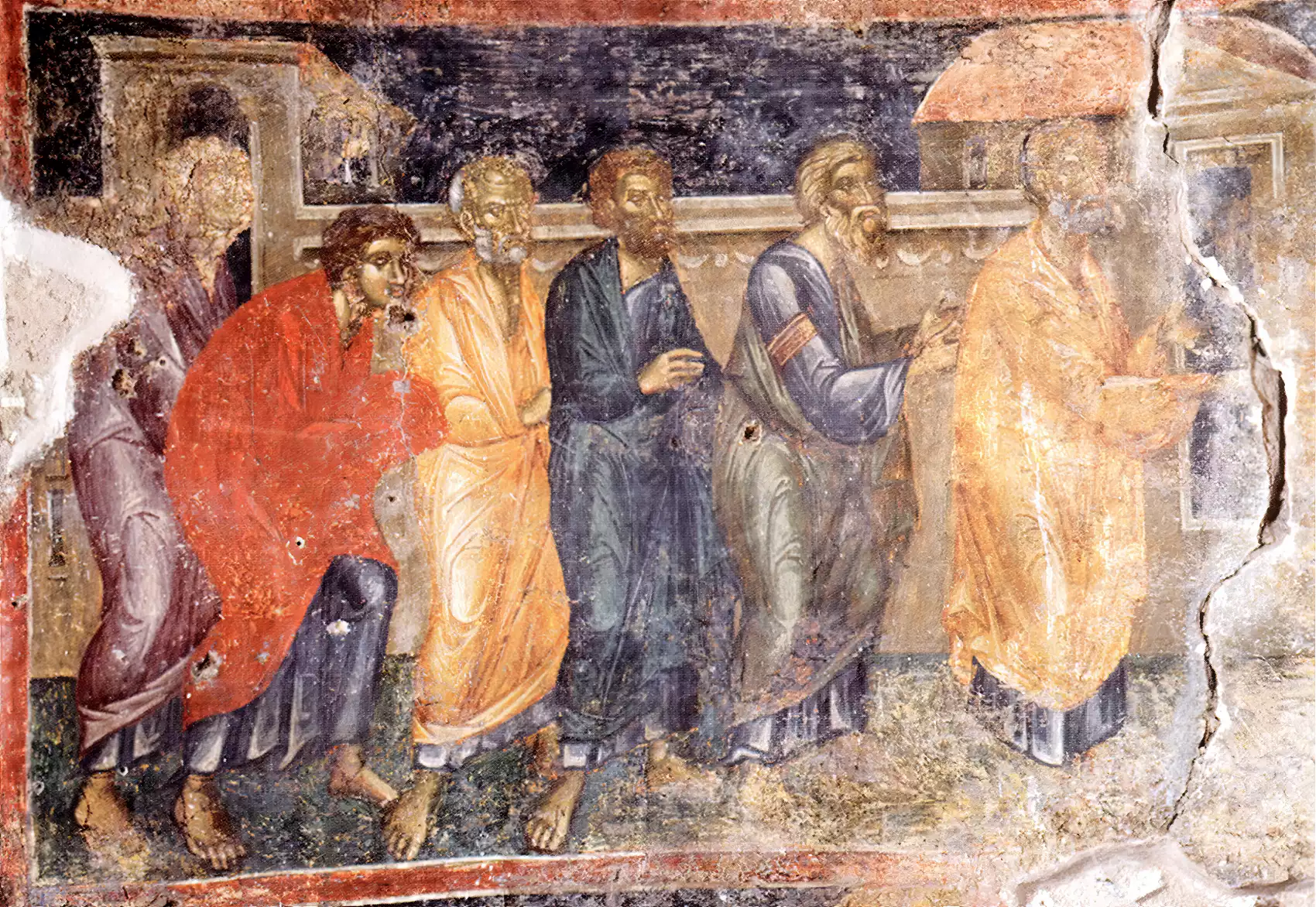
In the catholicon of the monastery of Valsamonero, on the southern foothills of Psiloritis, there is preserved from the fourteenth century a mural depicting the Communion of the Apostles, the episode in which Christ imparts to his disciples the bread and the wine of the Holy Eucharist. The painter remains unknown, a thing common to the greater part of Cretan monumental painting of that period, yet his hand betrays a familiarity with the models of Palaiologan Constantinople. The composition belongs to an iconographic type known as the Metadosis, or Communion, of the Apostles, a liturgical theme that was accustomed to adorn the conch of the sanctuary Bema in Byzantine churches, referring directly to the Divine Liturgy celebrated beneath it. At Valsamonero its presence belongs to the broader current of late Byzantine painting, that which carries the monumental language of the capital to the fringes of the empire and adapts it to local workshops. The apostles are depicted in procession, clothed in tunics and mantles of deep red, ochre and dark blue, advancing toward the point where once stood, at the centre of the composition, the figure of Christ as priest and victim at once. It is one of the rarest surviving examples of this theme in the Greek lands of that period, a fact which lends the mural a weight beyond its purely aesthetic value.
The Composition of the Communion of the Apostles at Valsamonero
The mural extends across one of the zones of the sanctuary Bema, at precisely the point where Byzantine art had for centuries established the placing of this theme, so that the image converses directly with the liturgy being celebrated. It survives today in fragments, with damage to the plaster and losses of colour which do not, however, hinder the reading of the composition as a whole. The painter organised the figures in a single row, upon a narrow strip of ground, against a deep blue background recalling a night sky, a technique common in Byzantine painting for rendering the transcendent character of the space. Above the heads of the apostles there extends a horizontal beam with pronounced relief ornament, while at the two edges of the composition architectural elements are traced, small arches and tiled roofs, which frame the scene as though it were a loggia.
The Procession of the Apostles in the Composition
In the broader composition six to seven figures may be discerned advancing one behind the other towards the right, their feet bare upon ground rendered with spare, light-coloured brushstrokes. The first of the group, clothed in a mantle of deep orange, stretches his hands forward, palms open and slightly curved, a gesture which in Byzantine iconography always signifies the receiving of the bread from the hand of Christ the celebrant. Behind him follows a figure with a bluish mantle, upon whose sleeve a red band may be discerned, an element which could refer either to a liturgical vestment or simply to a decorative detail of the garment.
The chromatic axis of the composition rests upon three principal tones, red, golden-yellow and deep blue, which alternate among the figures in such a way that the eye is led rhythmically from one edge of the scene to the other. Nor are the intermediate tones absent, the greyish hue of the mantles in the background, a whitish shade upon the sandals of certain figures.
The architecture framing the apostles aspires to no realism. It functions symbolically, alluding to the space in which the scene unfolds, probably a hall or a portico, without, however, binding the viewer to any specific topography. The arches at the corners, with their tiled roofs, echo models of fourteenth-century Constantinopolitan painting, where buildings serve as a scenic device for separating episodes rather than as a faithful record of actual structures. The gesture of receiving, repeated with slight variations in each apostle, is no mere narrative detail. It belongs to a visual code which Byzantine theology had elaborated over centuries, rendering in the body of each disciple the moment of personal, individual participation in the common mystery.
The Figures in Motion: Expression and Gaze
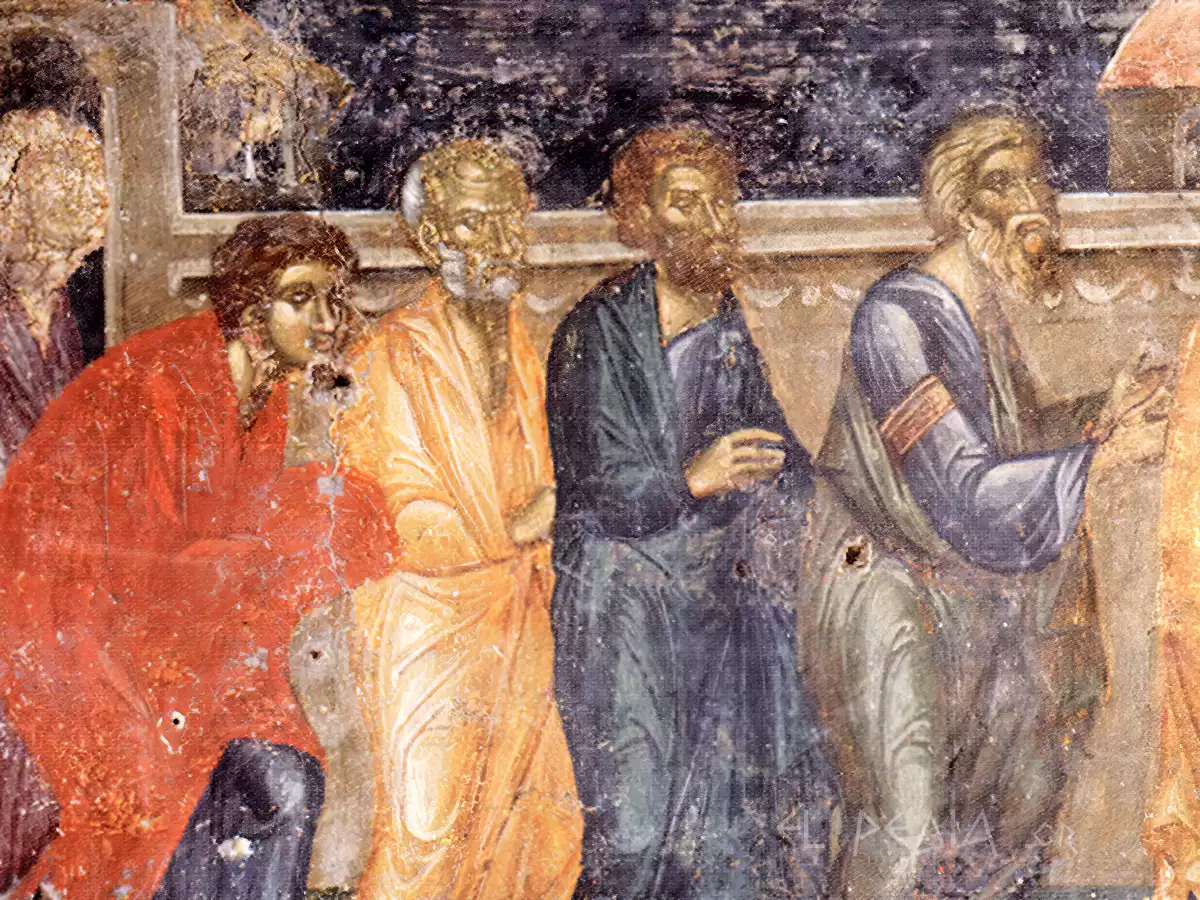
The detail excerpted from the centre of the composition reveals four figures, each of which holds a distinct bodily stance and facial expression, an element which departs from the customary conception of a single, faceless procession. The first, clothed in a mantle of deep red falling in rich folds about his shoulders, leans his body forward and brings his hand near his chin, a gesture of reflection which Byzantine painting usually reserved for figures at a moment of inward doubt or attentiveness. Beside him, an elder with a bald forehead and a white beard, clothed in a golden-yellow mantle, holds his hands crossed before his body, a posture of restraint corresponding to the iconographic tradition of the elder apostles.
The third figure of the group, with hair and beard of a reddish-brown tone, wears a dark blue mantle and turns his gaze to the right, toward the direction of the procession, with an expression restrained, almost uneasy. The last in the row, with a bluish-grey mantle and the already-mentioned red band upon his sleeve, extends his hand forward in a gesture that seems to herald the receiving of the gift. The physiognomies are rendered with delicate gradations of light and shadow upon the ochre of the skin, without the harshness of linear schematisation which characterised earlier currents, an indication of a painter familiar with the achievements of Palaiologan plasticity. Small details, such as the holes and the damage in the plaster which interrupt the garments at certain points, remind the viewer that what stands before him is no copy but the very surface fashioned seven centuries ago.
Cretan monumental painting of the fourteenth century, as attested by Valsamonero, precedes by more than a century the flowering of the great workshops of portable icons which would later make the island famous, with painters such as Andreas Ritzos continuing, on a different scale and in a different technique, the same conjunction of Constantinopolitan tradition with local sensibility. Surviving inscriptions in the same monastery date the oldest aisle of the catholicon, dedicated to the Panagia, to 1332, a fact which places the mural of the Communion of the Apostles in the first generation of an iconographic programme that would be completed gradually by the middle of the fifteenth century. Scholars who have studied the entirety of the monastery’s murals identify in them origins chiefly Constantinopolitan, a fact which brings out the importance of Valsamonero for understanding the artistic developments in Crete prior to the full development of the Venetian-ruled iconographic tradition.
The rarity of the theme in the Greek lands of that period lends the mural a documentary value, beyond its artistic quality. Few examples have survived in such a state as to allow the present-day researcher to trace the manner in which a Cretan workshop absorbed the models of the capital, without losing its own voice. The ravages of time, the holes in the plaster, the points where the colour has come away entirely, do not annul this testimony. They render it, if anything, more tangible.
We do not know the name of the painter who held the brush before this wall. We know, however, that his hand belonged to a generation of artists who learned to render the human body with a new freedom, while preserving intact the sanctity of the theme they had undertaken to paint.
(This is a translation of the Greek text; the translation was done by K. Pappas.)

