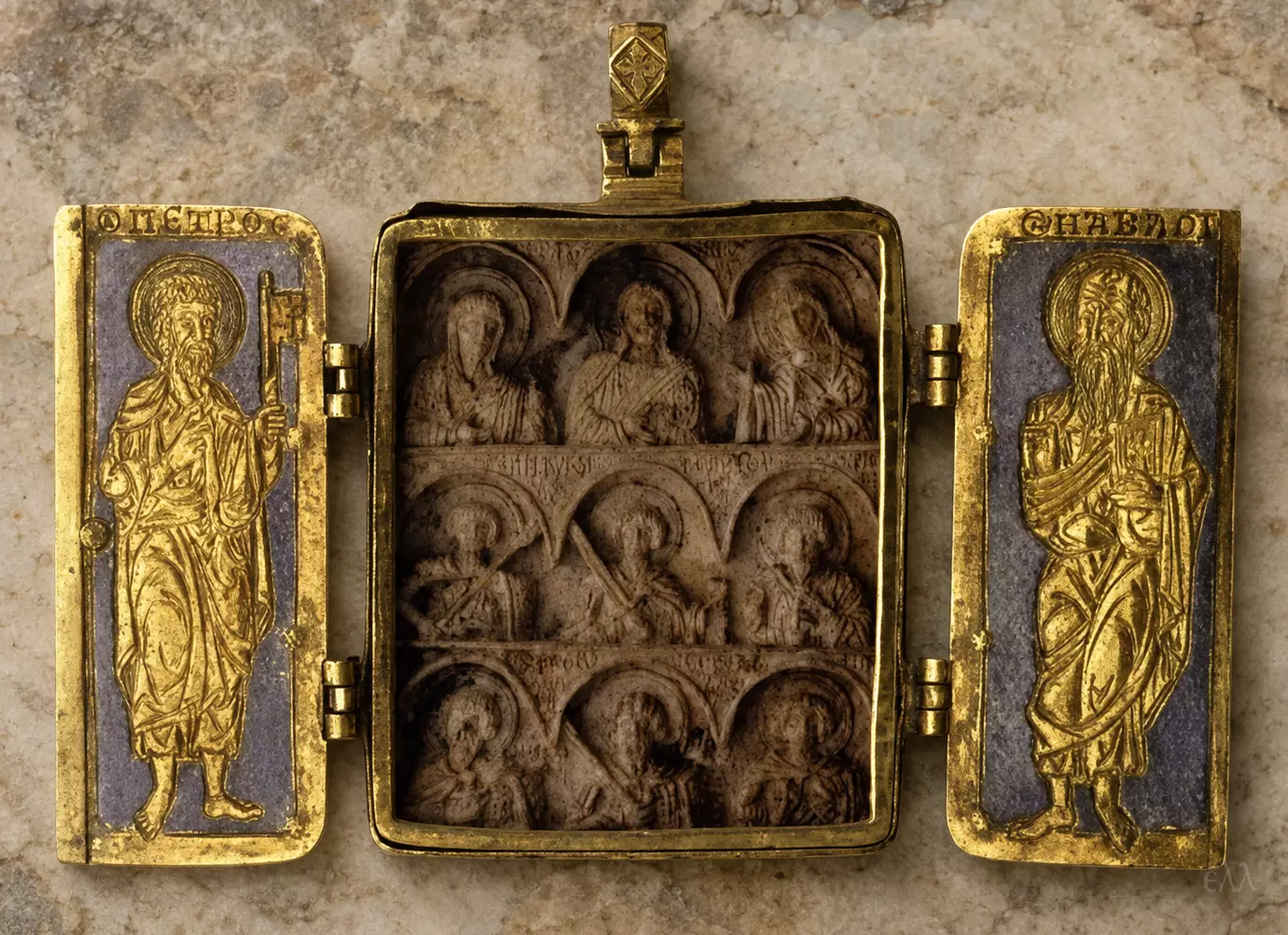
The Vatopedi Great Deesis triptych is a small Byzantine enkolpion of the thirteenth century, preserved in the Holy and Great Monastery of Vatopedi on Mount Athos. Its central element is carved in steatite, while the hinged wings are made of silver gilt with enamel decoration. The object measures approximately 5.5 × 10 × 1.2 cm when open. Its compact scale and coordinated materials place it among the refined works of Byzantine miniature art. The central stone plaque was originally a double-sided icon; later in the thirteenth century it was transformed into a triptych through the addition of a gilt frame and two metal wings.
Opened, the enkolpion presents a marked alternation between carved stone and luminous metal. The steatite panel is divided into three horizontal registers, each containing three bust-length figures beneath shallow arches. At the top sits Christ Pantokrator, flanked by the Theotokos and Saint John the Baptist in supplication, forming the core of the Deesis. Beneath them appear military saints and martyrs. The two wings carry the full-length Apostles Peter and Paul, their gilded figures set against enamelled fields. Hierarchy is expressed through position, material, repetition and scale.
The Deesis belongs to the most enduring intercessory configurations of Byzantine art. Christ occupies the principal position while the Theotokos and John the Baptist turn toward him as intercessors. In the Vatopedi triptych the theme is extended vertically, so that the principal triad presides over additional ranks of saints. The middle and lower registers contain military saints and martyrs, identified in surviving inscriptions. Among those named are Saint Demetrios and Saint George; other identifications include Saint Akakios, the two Saints Theodore, and probably Saint Loupos. Lance, sword, shield and martyr’s cross differentiate figures that otherwise share a disciplined frontal presentation.
The arches compress the individual busts into a tightly ordered grid. Each saint occupies a distinct compartment, yet the repeated curvature of the arcades draws the nine personages into a single visual system. Little space is available for narrative. Gesture, attribute, inscription and facial type carry the burden of identification. Christ establishes the principal axis, with the adjacent figures inclining toward him, while the lower saints face outward with greater frontality. At this scale the composition depends on broad silhouettes, concise modelling, incised contours and compact folds.
On the reverse of the steatite icon, another group is arranged in three tiers. The surviving documentation identifies Saint Onouphrios with the Holy Unmercenaries Cosmas and Damian, together with hierarchs whose inscriptions are partly lost. The double-sided structure also reveals how the object was meant to function physically: it could be handled, turned, opened and closed, exposing different combinations of sacred figures.
Steatite, Gilded Silver and Enamel
Steatite was well suited to miniature relief carving. Its softness allowed small facial features, drapery lines, halos, arches and inscriptions to be cut with precision. In the Vatopedi plaque the carving remains shallow and controlled. The forms emerge only slightly from the surface; recessed areas around the heads and within the arches provide enough depth to clarify the arrangement without disrupting the flatness of the stone panel. Steatite became an important material for small Byzantine relief icons and other portable sacred images.
Against the muted tone of the steatite, the side wings introduce a second visual register. Their gilded surfaces catch light more sharply, while the enamelled ground creates a cooler field behind the Apostles. Peter and Paul appear monumental despite the dimensions of the piece, their elongated bodies and linear drapery filling the narrow leaves. Their presence extends the iconographic programme beyond the core Deesis and gives the opened triptych a balanced three-part structure.
The wings were added after the central icon had been made. The monastery dates this transformation toward the end of the thirteenth century. When closed, the outer faces meet to form a foliated Resurrection cross in low relief. A possible Dalmatian origin has been proposed for the metalwork, reflecting the flourishing goldsmith tradition of the region and its Byzantine connections, though this attribution remains tentative.
A Portable Byzantine Enkolpion
Enkolpia occupied a distinctive place within Byzantine visual culture because their scale encouraged close handling. Small sacred images could be suspended from the body, while triptychs incorporated hinged leaves that opened and closed around the central representation. The format added a simple sequence of protected exterior, moving wings and revealed image. In a work measuring only a few centimetres, the mechanism creates an architectural impression, almost a tiny sanctuary articulated by panels.
The Vatopedi example is unusually dense. Stone carving, metalwork and enamel coexist within one object; full-length apostles flank a chief field of busts; inscriptions accompany saints whose identities are otherwise condensed into a small number of attributes. The Great Deesis carries the hierarchical rhythm familiar from larger Byzantine ensembles, reduced here to the scale of the hand. Repeated arches resemble a miniature arcade, giving each saint a defined place while preserving the strict order of the whole.
Stylistically, the work belongs broadly to the thirteenth century, although its iconography retains affinities with earlier Middle Byzantine models. In the carved plaque the relief is compressed, the drapery strongly linear and the facial features reduced to decisive cuts. The later metal wings introduce a more brilliant surface without disturbing the austere organization of the carved stone. Comparative study has placed the piece either within the thirteenth century or around its transition into the earliest years of the fourteenth.
Preserved today at the Holy and Great Monastery of Vatopedi on Mount Athos, the triptych records at least two stages in its material history: the creation of the double-sided steatite icon and its subsequent transformation into the hinged object now known as the Triptych with the Great Deesis.