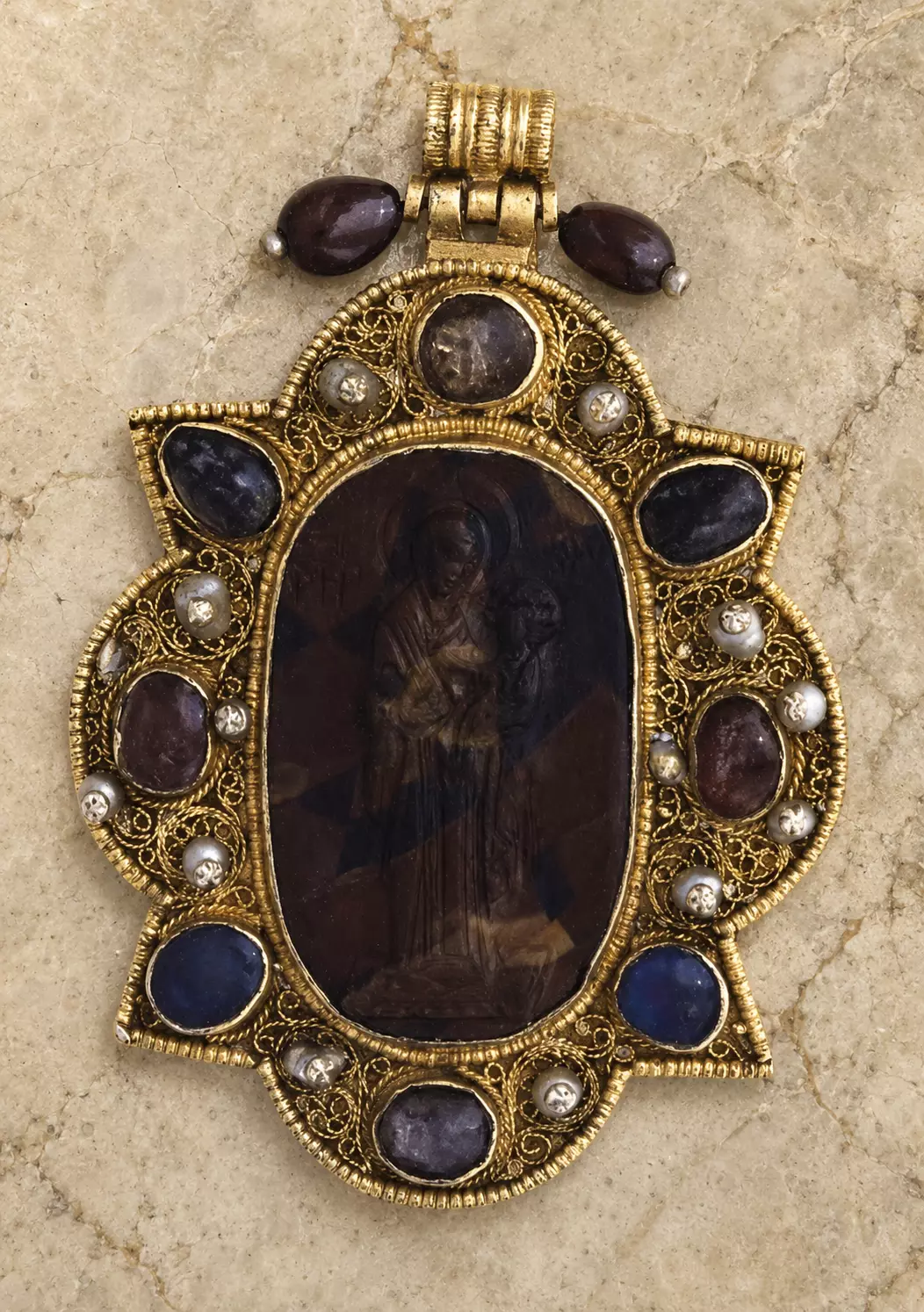
Among the precious ecclesiastical objects preserved at the Holy and Great Monastery of Vatopedi on Mount Athos is an elliptical enkolpion combining a twelfth-century hematite cameo with a considerably later metalwork setting. The object depicts Christ and the Theotokos Hodegetria and is framed in gilt silver filigree enriched with gemstones, pearls and surviving traces of enamel. Its setting is dated to the late fifteenth or early sixteenth century, several centuries after the carving of the cameo itself.
The dark hematite gives the central sacred image an unusually subdued presence. Within the oval field, the Theotokos appears standing with the Christ Child, the figures emerging through variations in the carved surface and the natural depth of the stone. The Hodegetria belongs to one of the most enduring Marian iconographic types of Byzantine art, presenting the Virgin with Christ and directing attention towards him. On such a small scale, the compact arrangement acquires the concentrated character appropriate to an object worn close to the body.
The Hodegetria Hematite Enkolpion and Its Later Setting
Around the cameo, the later mount changes the visual register completely. Fine gilt-silver filigree forms curling patterns between stones of blue, violet, reddish brown and pale translucent tones. Small pearls, distributed among the larger gemstones, introduce points of light across the surface. The outer contour expands into rounded and angular projections, creating a richly articulated silhouette around the comparatively restrained oval cameo. Above, the suspension fitting is accompanied by two dark drop-shaped stones, emphasizing the object’s original function as a pendant. Enkolpia were small sacred objects intended to be suspended, commonly by a movable ring or related attachment.
Of particular interest is the considerable chronological distance between image and setting. A twelfth-century Byzantine cameo was retained and incorporated into metalwork made around three centuries later. The later craftsman treated the older carving as the visual and material centre of the composition: ornament accumulates around it—filigree, pearls, gemstones, traces of enamel—while the hematite field remains comparatively uninterrupted. Two distinct phases of workmanship survive, as a result, within the single object.
This layered history is plainly visible in the contrast of surfaces. Dense, luminous ornament surrounds the deep brown-green stone; minute coils of wire meet smooth cabochon-like gems, irregular pearls, narrow beaded borders. At the centre, quieter and darker, remains the earlier sacred image. The documented Vatopedi collection includes numerous enkolpia in different materials and forms, and through its union of Middle Byzantine gem carving and a sumptuous late medieval setting, this example occupies a distinctive place among them.