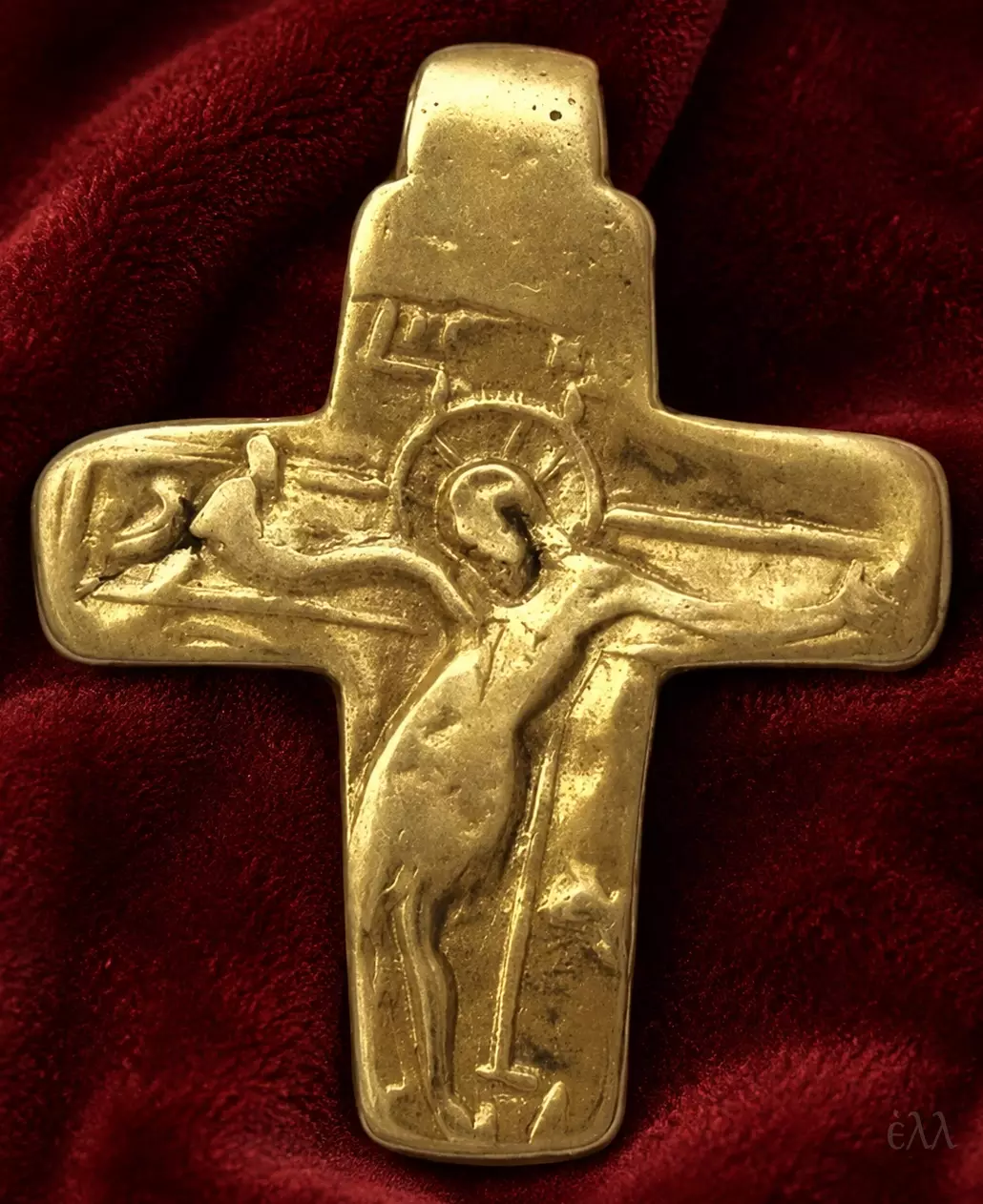
Preserved at the Holy Monastery of Vatopedi on Mount Athos, this Byzantine Crucifixion enkolpion cross is dated to the 13th–14th century and is made of black steatite and gold. Published descriptions of the object confirm this combination of subject, materials, chronology, and repository. Small in scale and intended for suspension, the piece concentrates the Crucifixion into a remarkably compact image, with Christ occupying almost the entire pictorial field.
Byzantine Crucifixion Enkolpion Cross: Form and Image
Across the short transverse arms stretches the body of Christ, strongly establishing the horizontal axis against the longer vertical stem. His torso is slender and elongated; the head inclines toward his right shoulder and is framed by a clearly defined nimbus. Below, the legs descend in a narrow, almost continuous movement toward the lower terminal. The relief is shallow and economical. Facial features, anatomy, folds and contours are indicated with restrained modelling, giving the figure a direct graphic presence despite the worn surface.
Particularly prominent is the broad suspension element above the cross. Enkolpia formed a wider Byzantine category of crosses, medallions and miniature sacred objects designed to be worn around the neck, bringing religious imagery into unusually close physical proximity to the wearer. Terms such as enkolpion, pectoral cross, steatite and relief belong to the established art-historical vocabulary used for objects of this kind.
Surface wear has softened several areas, while small irregularities and losses remain visible around the lateral branches. Yet the principal forms persist forceful: outstretched arms, inclined head, slim torso, the emphatic vertical descent of the body. In so confined a space, the craftsman depended upon contour and proportion to sustain the image, and it is this dependence that gives the small composition its compressed, close-range intensity.