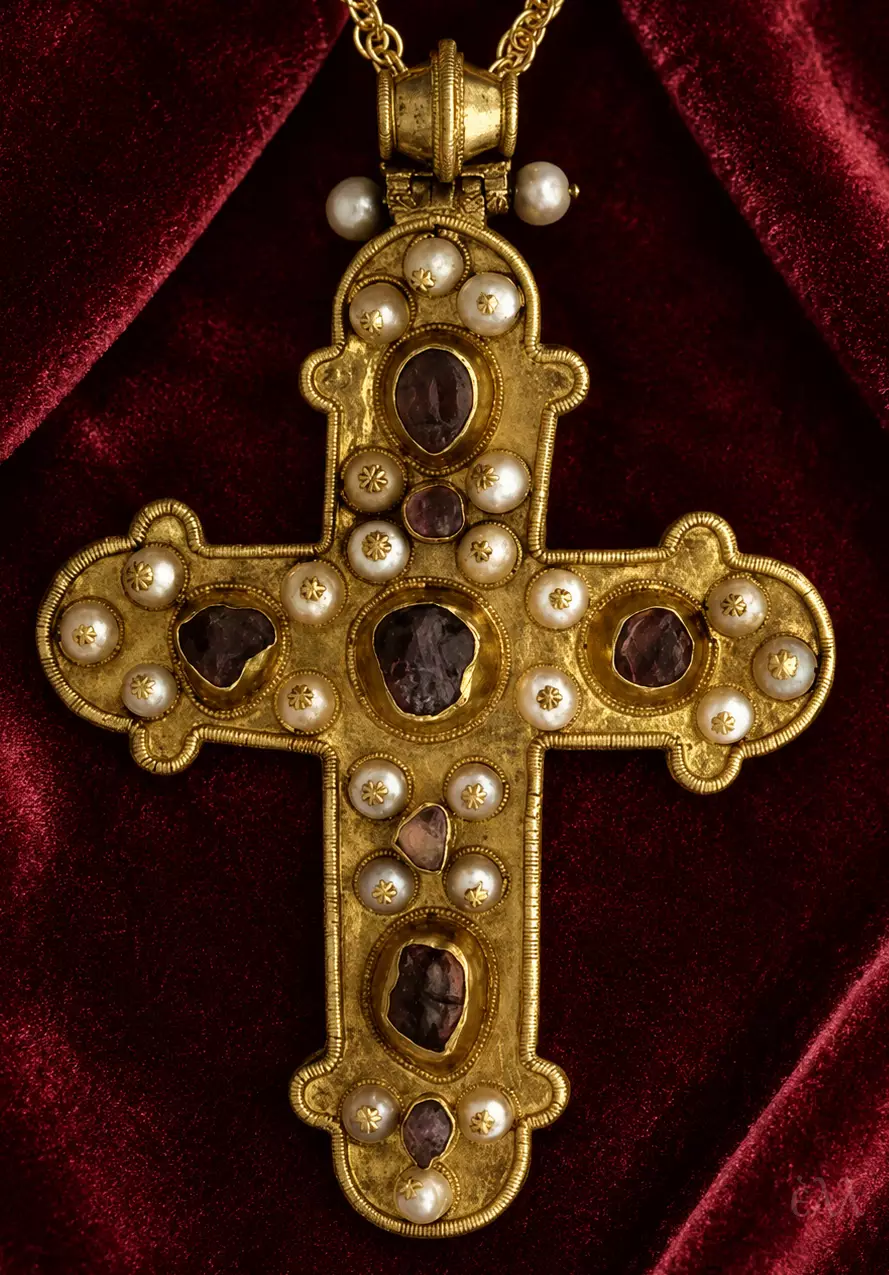
Dating from the 13th century, this Byzantine reliquary cross is preserved in the treasury of the Holy and Great Monastery of Vatopedi on Mount Athos. Fashioned from silver gilt and enriched with precious stones and pearls, the object belongs to the refined tradition of Byzantine metalwork in which sacred function, costly materials, and carefully ordered ornament were brought together on a remarkably small scale. The designation reliquary identifies its purpose as a container associated with sacred relics, while its cross-shaped form gives the object an immediately recognizable Christian configuration.
Its appearance is dominated by the warm surface of the gilded metal. Against this field, pearls of different sizes are distributed across the shaft and arms, interspersed with darker stones set into individual mounts. Several larger gems establish points of emphasis along the vertical axis: one occupies the crossing, others appear above and below it, creating a measured succession from the suspension fitting at the top to the rounded lower terminal. Across the transverse arms, additional stones extend this ornamental rhythm horizontally.
Byzantine Reliquary Cross and its Precious Decoration
At the ends of the arms, the metalwork expands into rounded, lobed forms. Their contours soften the strict geometry of the cross and provide broader surfaces for the arrangement of pearls and stones. Fine borders articulate the outline, while small projections and ornamental transitions enliven the silhouette. The suspension element above suggests that the piece was conceived to be hung or otherwise displayed in a manner appropriate to its size and function.
Pearls play an especially prominent visual role. Their pale, softly reflective surfaces punctuate the gold-toned ground and surround the darker gemstones with a contrasting luminosity. The stones themselves vary visibly in colour and shape, some irregular rather than perfectly geometric, giving the decoration a dense, accumulated character. Gold, gemstones, pearls, repeated settings: the surface is structured through material contrast rather than figural imagery.
Vatopedi preserves an important group of sacred luxury objects and reliquaries, including examples in the form of crosses and cross-reliquaries executed in precious metals and stones. Within that wider material culture, this 13th-century work demonstrates the close relationship between relic preservation and the sophisticated craftsmanship of ecclesiastical metalwork of the period. Its material richness remains concentrated within the disciplined outline of the cross, down to the final cluster of pearls and stone at the lower terminal.