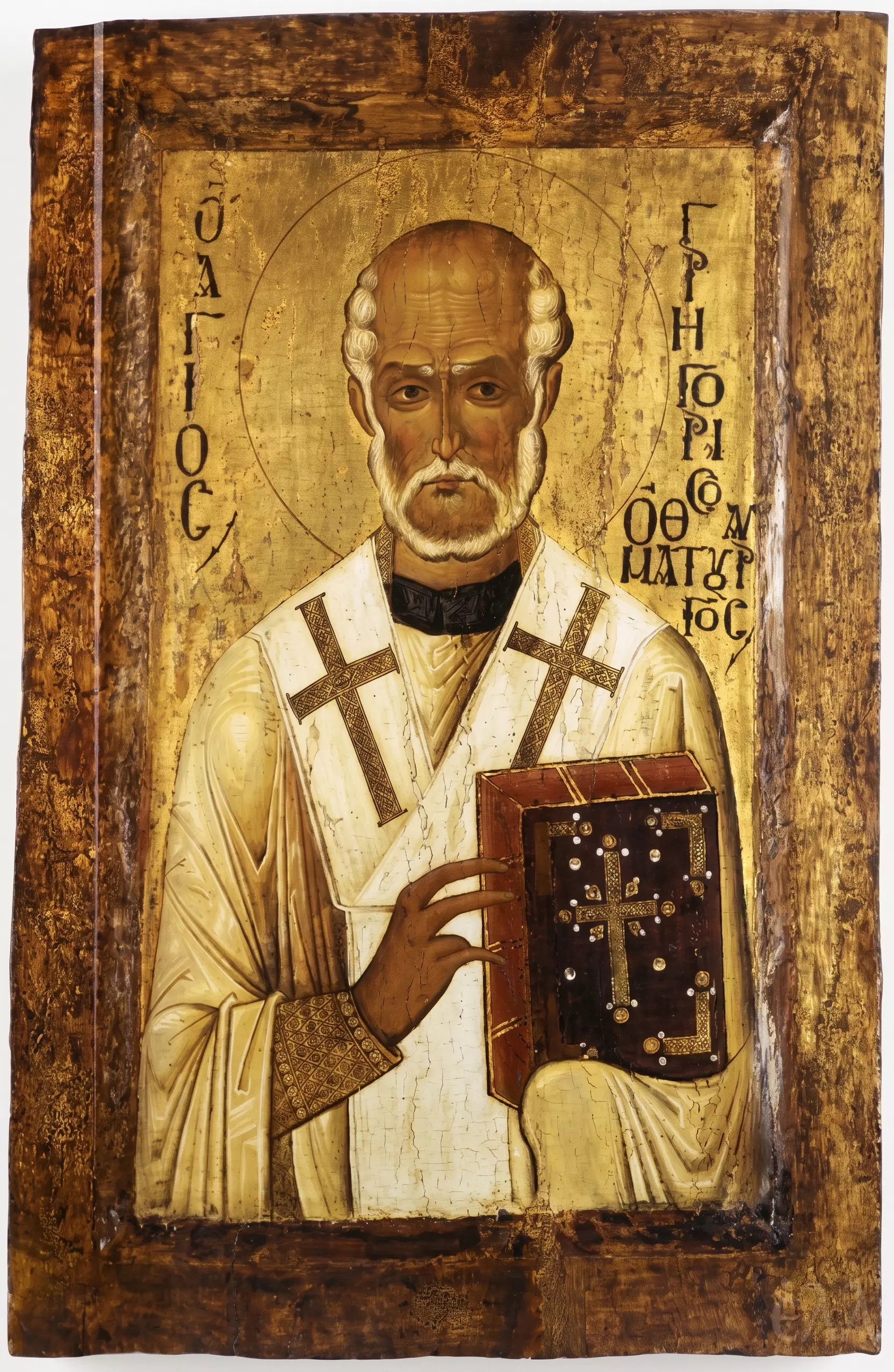
The Saint Gregory the Wonderworker icon, a Middle Byzantine panel measuring 81 × 53 cm and preserved in the State Hermitage Museum in Saint Petersburg, presents the third-century bishop of Neocaesarea as a frontal, half-length hierarch against a gold ground. Severe in its economy, the composition gives almost the entire pictorial field to a single figure; the broad shoulders, pale episcopal vestments, Gospel book and large circular halo establish a structure whose stillness is deliberate, almost architectural. Nothing distracts from the face. The work belongs unmistakably to the tradition of the Byzantine panel icon and, more specifically, to the representation of the bishop saint carrying the Gospel book as an attribute of teaching and ecclesiastical authority.
Its chronology deserves qualification. Older literature places the icon in the third quarter of the twelfth century, while the State Hermitage currently catalogues it in the first half of the twelfth century, describing it as probably the work of a master of the Constantinopolitan school and recording walnut wood, levkas and mixed technique among its material data. The museum inventory number is I-4. Such disagreement within the century does not diminish the importance of the panel; it does, however, caution against attaching every stylistic feature too rigidly to a narrow chronological phase. The Hermitage Museum catalogue provides the current museum dating and object data.
The saint’s presence depends on restraint. He does not turn, incline or engage in narrative action. His left forearm supports the closed Gospel book, while his right hand crosses the body and rests lightly against its edge. Small in scale, the gesture binds the hierarch to the book without disturbing the frontal equilibrium. His identity is reinforced by the Greek identifying inscription distributed across the gold field, its elongated letterforms becoming part of the ornamental surface.
Saint Gregory the Wonderworker Icon and the Grammar of Komnenian Sanctity
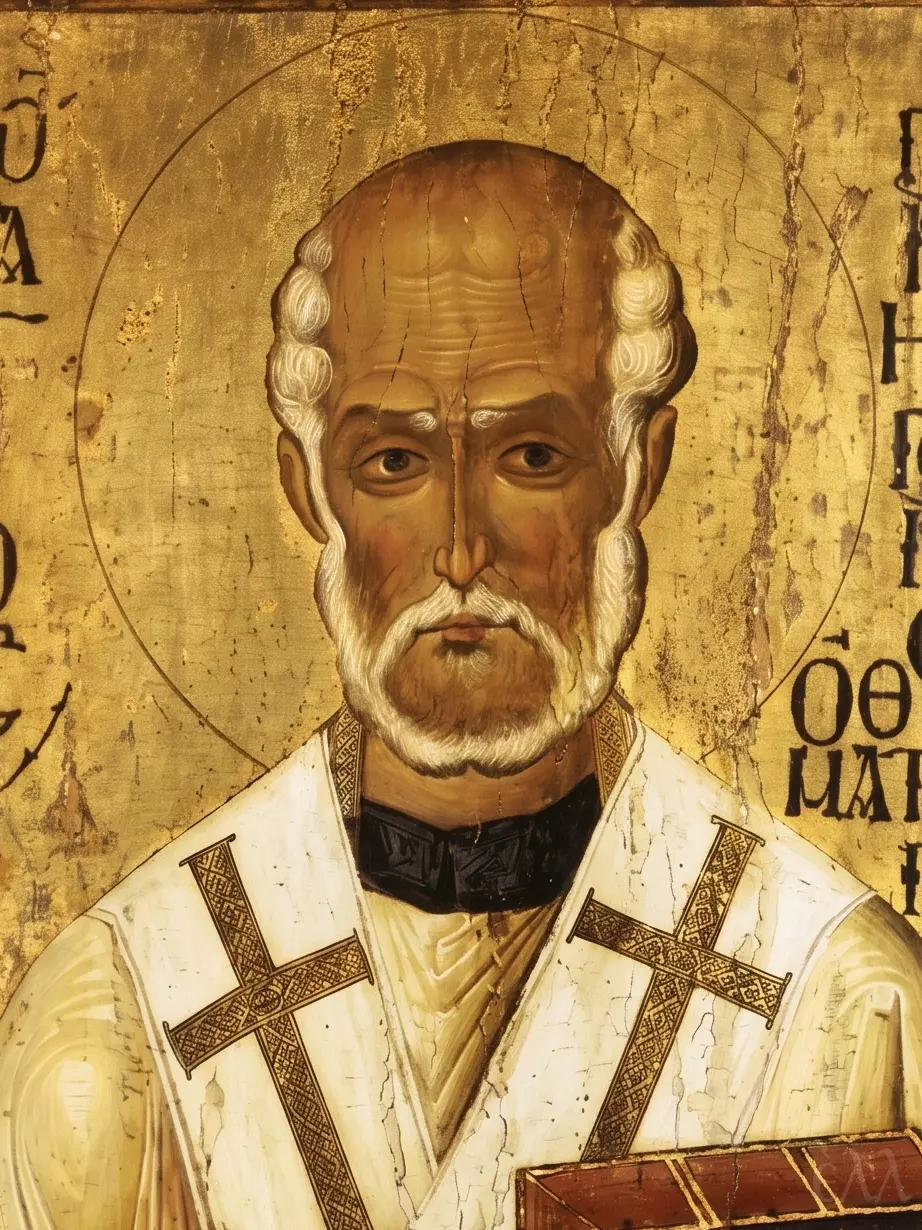
The face governs the entire image. Gregory is represented according to an established physiognomic type: advanced in age, largely bald, with short curling grey hair at the temples, a compact beard, a high forehead and eyebrows that meet or nearly meet. Yet the painter has avoided turning these characteristics into a mechanical catalogue of old age. Across the broad forehead run several parallel horizontal wrinkles, fine but emphatic, intersected by the stronger vertical movement above the bridge of the nose. Around the eyes, narrower shadows gather beneath the lids. The result is a physiognomy contemplative and highly controlled, with an impression of thought produced through line rather than dramatic expression.
Especially striking is the concentration of the eyes. Their dark pupils, enclosed within broad almond-shaped forms, meet the spectator without obvious animation. Direct though the gaze is, its emotional register remains difficult to localise. It does not describe a momentary psychological state. This ambiguity was productive within Byzantine sacred portraiture, where individualising elements could coexist with the removal of the holy figure from ordinary temporal experience. The face seems alert, grave, inwardly occupied; the small mouth, almost compressed beneath the white moustache, strengthens that reserve.
The modelling remains relatively tight. Warm ochre and brown flesh tones form the base of the face, while restricted highlights articulate the forehead, nose, cheekbones, temples and areas beneath the eyes. Shadow exists, but it is not permitted to create a deeply recessed or dramatically three-dimensional head. Line repeatedly regains control. The white hair is especially revealing: individual locks are indicated through curling, rhythmic strokes whose ornamental precision gives them physical presence while keeping them subordinate to the larger facial design. In the beard, white and grey passages follow the curve of the jaw, then close around a darker central area beneath the lower lip. Face, hair, wrinkles, eyebrows—each operates separately for a moment, then returns to the severe unity of the head.
Such coexistence of corporeal observation and stylised order belongs comfortably within the broad artistic problems of the Komnenian period. Twelfth-century Byzantine art could sustain an inherited classical awareness of bodily structure while increasingly exploiting linear rhythm, emotional concentration and highly articulate drapery. These tendencies were not mutually exclusive. Across Byzantine visual culture, classical and more abstract modes could be negotiated within the same image without either being wholly abandoned.
Against the warm complexion, the saint’s episcopal vestments open the lower half of the icon into broad regions of pale colour. Their white and cream tones are unusually luminous beside the gold ground and the dark collar encircling the neck. Large crosses lie across the omophorion. Close examination shows dense internal ornament formed by finely worked patterns and small scrolling elements, so that each cross operates simultaneously as episcopal insignia and decorative structure. The repetition is measured: one cross descends across the saint’s right side, another occupies the opposite half of the garment, the two stabilising the figure around the central axis of the head.
The underlying robe is handled differently. Its pale folds descend in narrow, sharply defined passages, particularly along the arms, while the cuff of the saint’s right sleeve carries a close geometric pattern. The drapery has little of the softness expected from cloth observed naturalistically. Fold follows fold with a certain formal rigidity. Yet it would be misleading to regard this schematisation simply as an inability to describe volume. Enough tonal change remains to keep the arms and torso legible beneath the vestments, while unnecessary spatial complexity is withheld. The figure is bodily present, its volume disciplined by surface.
That discipline becomes still clearer in the Gospel book. Large, rectangular and held upright beside the torso, it introduces the strongest compact mass within the lower composition. Reddish-brown edges surround a dark cover ornamented by a cross, pearl-like studs and small circular settings. Sumptuous without becoming ostentatious, the book answers the verticality of the figure through its hard geometry and gives the hands a precise destination. A bishop saint with an open scroll might have generated textual movement across the panel; the closed codex instead creates concentration, enclosure, authority.
Gregory himself belonged to the third century and served as bishop of Neocaesarea in Pontus. Later Christian tradition remembered him under the epithet Thaumaturgus, the Wonderworker, and his reputation ensured his inclusion among the recognised hierarchs of Eastern Christian art. His appearance in monumental programmes was considerably more common than his survival on independent panels of this type, making the Hermitage icon particularly valuable for the study of episcopal imagery. The painting narrates no episodes from his life. Biography is compressed into physiognomy, vestment, inscription, book.
This compression differentiates the panel from the narrative or vita icon, a form increasingly significant in discussions of saint imagery during and after the Komnenian period. Scholarship on the vita icon demonstrates how Byzantine painters could construct sanctity through sequences of episodes surrounding a central holy figure; Gregory’s image takes a different visual route. His identity requires no surrounding narrative cycle. The entire field is given to presence.
The gold ground contributes decisively to that effect, although its present surface also records the material history of the object. Numerous cracks cross the panel, with particularly conspicuous vertical fissures in the upper and right portions of the field. Abrasion, losses and irregular darker patches interrupt the surviving luminosity. The broad wooden frame is itself heavily worn, retaining brown, dark and golden areas rather than a uniform surface. These changes belong to the condition and age of the object and should not be treated as deliberate aesthetic effects. They nevertheless alter the way the icon is now encountered, the remarkably controlled face surviving within a surface marked by fracture.
Around the head, a simple circular halo establishes another quiet geometry. The inscription, by contrast, presses close to the halo and shoulders, its tall Greek letters descending vertically through the gold. On one side appears the designation of the saint; on the other, his name and epithet. Compared with the frontal body, the lettering is unusually animated, introducing a thin current of irregular movement into an otherwise tightly balanced composition.
Perhaps the most distinctive quality of the Saint Gregory the Wonderworker icon lies in this unequal distribution of visual energy. The vestments are pale and broadly organised; the Gospel book, dense and compact; the inscription, restless; the face, intensely worked. Even within the face there is hierarchy. Forehead and eyes receive repeated linear attention, cheeks comparatively little, beard another kind of patterned articulation. The painter does not treat every passage with the same degree of finish or descriptive pressure. Despite the frontal design, such variation keeps the panel from becoming mechanically symmetrical.
What remains is an image of episcopal authority formed through an extraordinary economy of means: a bald head furrowed by repeated lines, dark eyes, a white beard, two patterned crosses, a closed book. Action is minimal, visual pressure considerable. The anonymous painter turns physical age into graphic structure and liturgical dress into ordered fields of light, while the gold background suspends the saint outside any earthly setting. Gregory is recognisable as an individual holy hierarch, yet the image also belongs to a broader Byzantine conception of sanctity in which likeness, office and sacred presence could be concentrated within a single frontal figure. Its austerity operates as visual concentration, achieved through the controlled relation of physiognomy, episcopal insignia and sacred presence.
(The translation was edited by K. Brown.)